
A toll crossing can tell the Reserve Bank of India that traffic is moving. It cannot tell the bank what was in the truck or how much value a factory created. That is why faster data can sharpen an economic estimate without replacing the official number.
What the RBI watches before the official figures arrive
In a November 23 speech, RBI Deputy Governor Poonam Gupta said the central bank uses FASTag records to track freight and mobility, satellite and radar images to assess weather risks and agricultural output, and ship movements for an early view of seaborne imports. These signals sit alongside official statistics, surveys and other inputs. Gupta said the RBI checks the signals against official data because they can be noisy or cover only part of the economy.
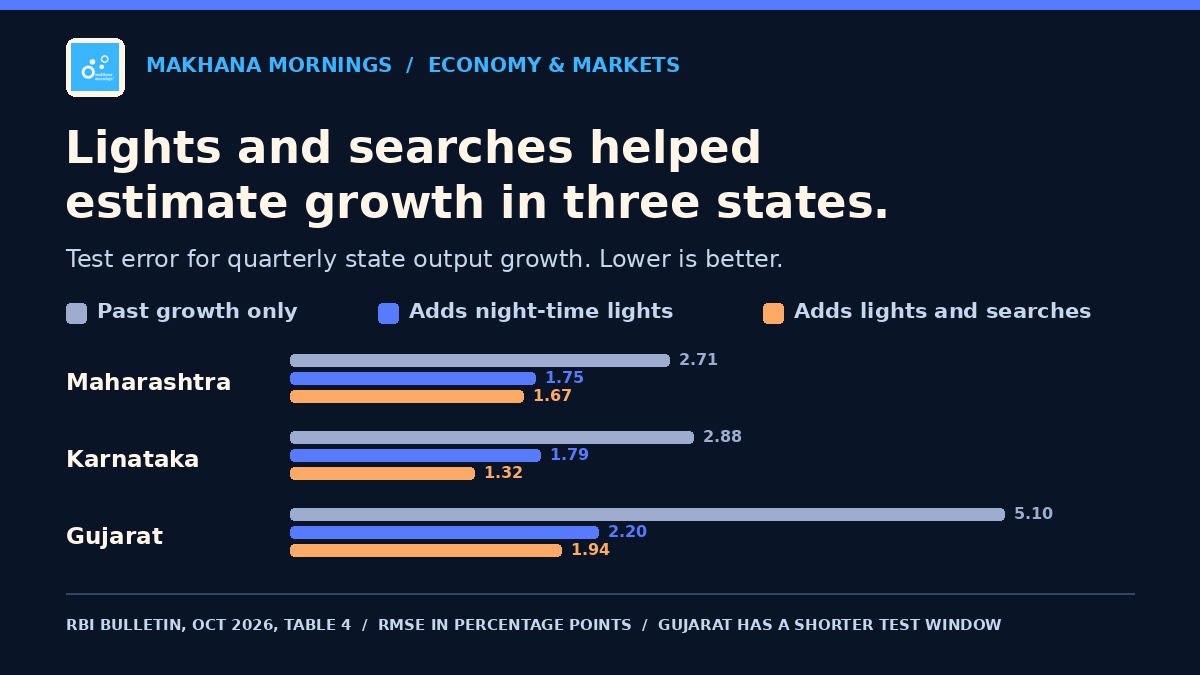
An experiment found smaller errors in three states
An October RBI Bulletin study tested whether adding night-time satellite lights and Google Trends could improve estimates of quarterly growth in gross state value added, a measure of economic output. Against a model based on past growth alone, the combined model reduced its error measure by about 38% in Maharashtra, 54% in Karnataka and 62% in Gujarat. The comparison used root mean squared error, which gives more weight to large misses.
These were retrospective tests in three industrial states, with a shorter data window for Gujarat. They did not show that Gujarat grew 62% faster, or that the model would deliver the same gains in other states. The study tested lights and search patterns, not FASTag itself.
The Crunch: Faster signals are useful when they help you ask a better question before the official figure arrives. Use them to check whether traffic, spending and output point in the same direction, not to treat any one of them as the answer.



Leave your thoughts