
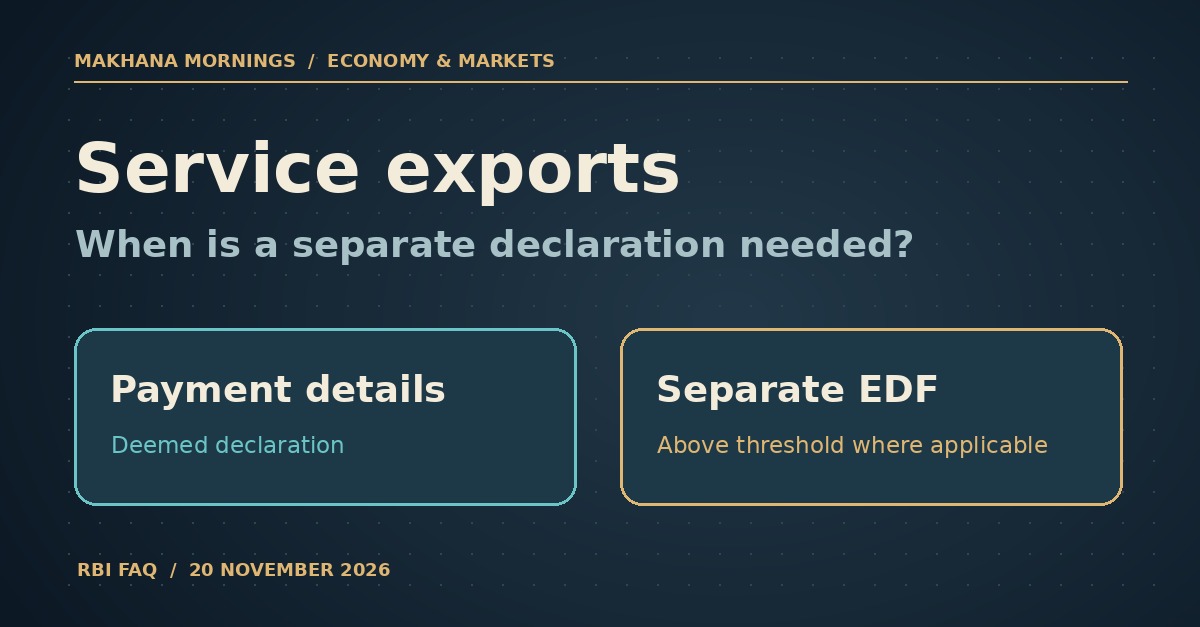
The Reserve Bank of India’s 20 November 2026 FAQ clarifies when an Indian service exporter needs to file a separate Export Declaration Form, or EDF. The rules apply to transactions undertaken from 1 October. The FAQ explains the rules already in effect; it does not introduce a new threshold.
The distinction is who exports and how much each payment is worth
For resident individuals who export services, the declaration is treated as submitted when they give their authorised dealer the payment details it needs to credit the remittance. The FAQ does not apply a ₹10 lakh ceiling to this route for resident individuals.
For service exporters other than resident individuals, the same approach applies if each inward remittance is ₹10 lakh or less, or the equivalent in foreign currency. Above that amount, a separate EDF is required. The threshold applies to the individual payment received, not the total across a customer relationship.
Simpler filing does not remove bank checks
The authorised dealer still collects the information it needs to verify the transaction and reports the remittance in the applicable monitoring system. The RBI also says the old SOFTEX form was discontinued from 1 October. Software exporters use the EDF where the new rules require one.
Transactions begun before 1 October remain under the earlier framework, according to the FAQ. That makes the start of the transaction distinct from the date on which its payment arrives.

Leave your thoughts