
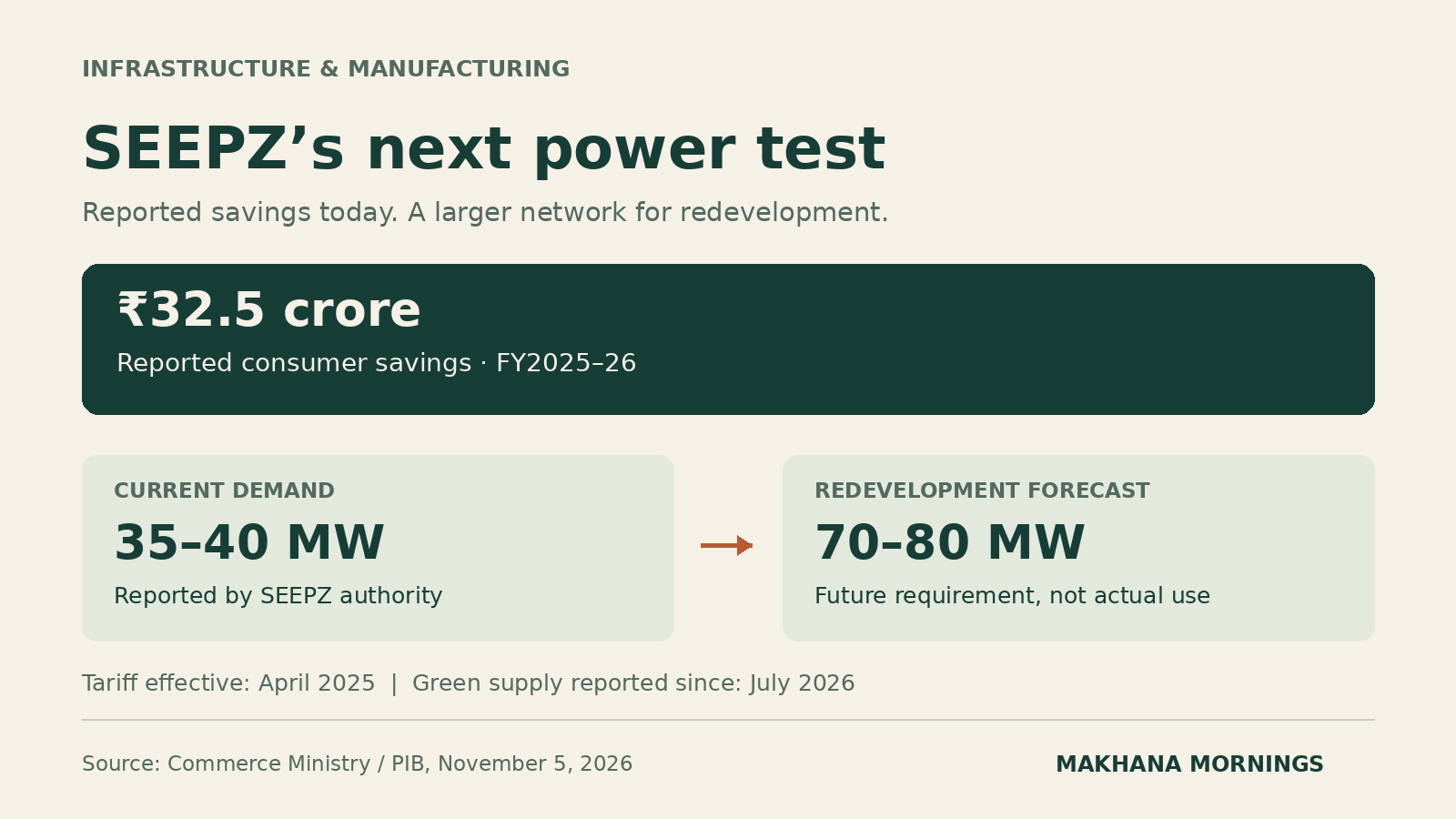
Mumbai’s SEEPZ export zone has reported ₹32.5 crore in electricity-cost savings for consumers in FY2025–26. Its next task is to keep power dependable as redevelopment raises demand: the authority expects a requirement of 70–80 MW, against about 35–40 MW today.
The figures come from a Commerce Ministry update published on November 5. For the jewellery, electronics and IT businesses in the zone, the useful question is how lower operating costs can be sustained as more production space comes into use.
The Breakdown
The update covers 495 electricity consumers, including 243 units and other utilities. It compares a ₹5.60-per-unit rate inside SEEPZ with ₹8.65 outside, and projects annual savings of ₹54 crore by FY2029–30 at current consumption levels.
Those headline rates should not be read as an all-in bill for every business. The published AEML SEEPZ tariff schedule separates energy, wheeling and fixed or demand charges across consumer categories. It also provides for time-of-day adjustments and says duties, taxes and power-purchase adjustments sit above the base tariff. A unit assessing its savings needs its own connection category and consumption profile.
An existing tariff, followed by greener supply
The tariff schedule took effect on April 1, 2025, under MERC’s March 28, 2025 order. November’s announcement is therefore an update on an existing arrangement, rather than a new tariff taking effect this week.
The ministry separately says 100% green electricity supply began in July 2026. That date falls after FY2025–26, so it should not be used to explain the preceding financial year’s savings.
This distinction matters for exporters tracking both costs and environmental performance. A tariff tells a business what it pays under a charging structure. A green-supply claim concerns the electricity procured for it. The two can strengthen an industrial location’s appeal, but each needs its own evidence and reporting period.
Redevelopment brings a larger power requirement
The authority reports 48 substations, 53 MVA of aggregate capacity and about 30 km of underground cabling. Additional substations are being developed; battery storage remains planned. The 70–80 MW requirement is a redevelopment forecast, not present consumption.
SEEPZ’s building programme provides context for that forecast. NEST–02 was inaugurated in December 2025, when the government also reviewed wider infrastructure improvements. More usable floor space makes power planning part of the redevelopment itself: incoming units need connections and a network sized for their operations, not just completed buildings.
The ₹54 crore savings projection holds consumption constant. It is therefore a different scenario from the higher-demand redevelopment plan. Combining the two into a single forecast of future savings would require assumptions about the timing of occupancy, electricity use and applicable tariffs that the update does not provide.
The Crunch
SEEPZ’s reported savings offer a useful measure of operating-cost relief. The next measure is delivery: when additional substations and storage enter service, how much load the redeveloped zone actually adds, and what consumers pay as it grows. Those milestones will show whether the power network keeps pace with the new factory and services space.


Leave your thoughts