
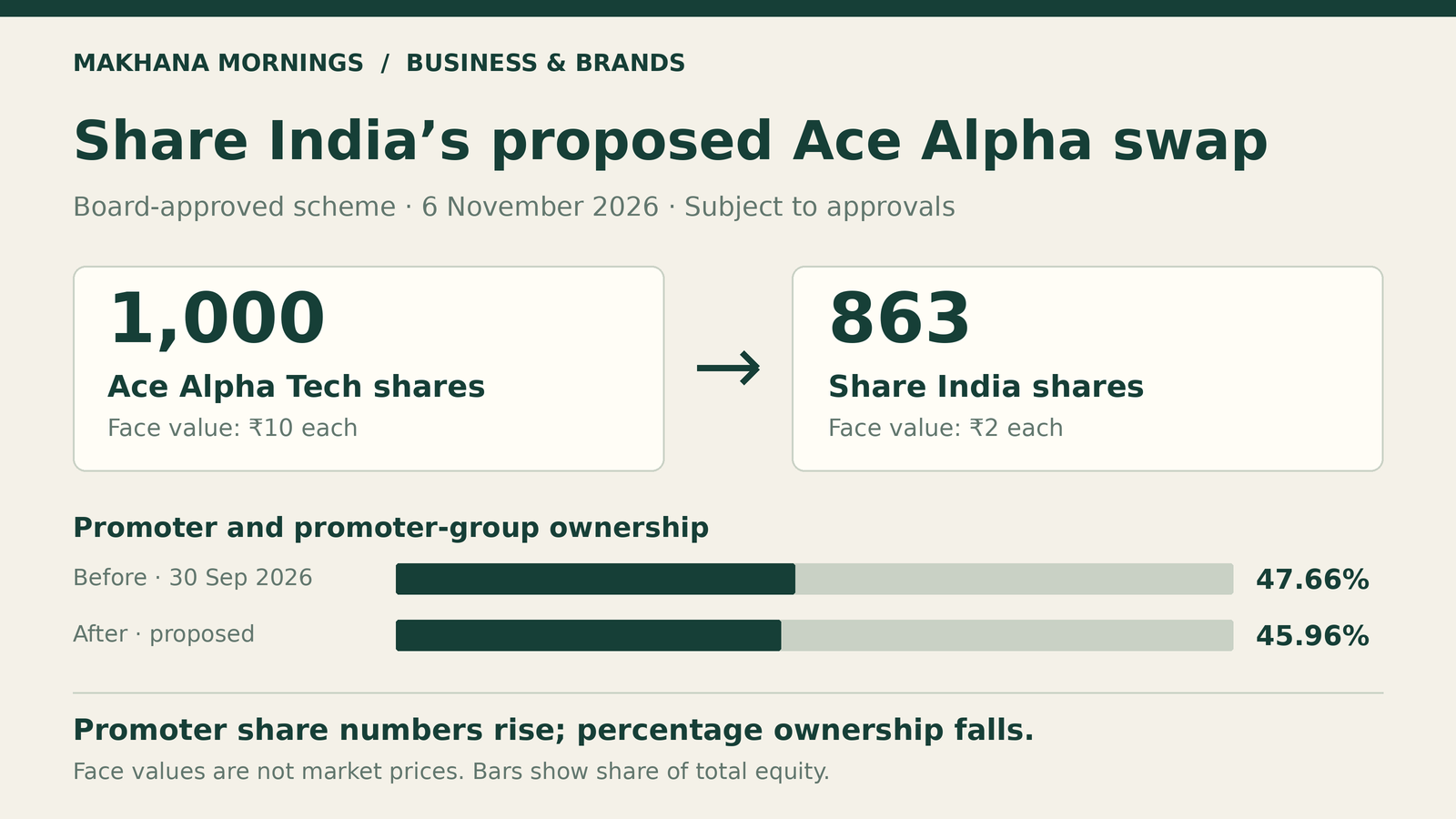
Share India Securities has approved a proposal to merge Ace Alpha Tech into itself, bringing a trading-software business into its broader financial-services operations. Ace Alpha shareholders would receive 863 Share India shares for every 1,000 shares they hold, subject to the scheme and required approvals.
The scheme approved on November 6, 2026 still needs clearance from the stock exchanges, SEBI, the National Company Law Tribunal and other applicable authorities. It does not complete the merger or put the combined business into operation.
The Breakdown
Ace Alpha develops and customises automated trading software, including systems that connect with order-management and risk-management tools. It serves institutional investors, high-net-worth individuals and retail traders, and also trades and invests in securities on its own account.
Share India already operates across broking, proprietary trading, depository services, portfolio management and investment-product distribution. It also has technology-led trading capabilities. The proposed merger would put Ace Alpha’s development work and Share India’s financial-market operations inside one corporate entity.
The swap offers Share India shares with a face value of ₹2 for Ace Alpha shares with a face value of ₹10. Those face values are accounting denominations, not market prices. The 863-for-1,000 ratio by itself therefore does not show whether shareholders are receiving a premium or a discount to the value of their holdings.
Fractional entitlements would be pooled in a trust, with the resulting shares sold in the market within 90 days of allotment under the scheme. That matters for investors whose holdings do not translate into a whole number of Share India shares.
More shares, a smaller percentage
The proposed ownership table puts Share India’s promoter and promoter-group holding at 45.96% after the merger, compared with 47.66% as of September 30. The public holding would rise from 52.34% to 54.04%.
The promoter group would nevertheless own more shares in absolute terms: about 10.94 crore after the merger, against 10.64 crore before it. A percentage holding can fall even while the number of shares rises when the company issues proportionately more shares to other holders. The 1.70 percentage-point reduction is therefore not evidence of promoters selling stock.
Share India says the scheme does not constitute a related-party transaction because Ace Alpha is not a related party at the time of the proposed transaction. It also discloses that certain Share India promoter and promoter-group members own Ace Alpha shares, with no other interest in that company. Both statements belong in the ownership picture.
The business test comes after integration
The commercial idea is to coordinate software development with the trading operations that use it. That could make it easier to direct technical and financial resources towards the same products and clients. Share India’s stated rationale also includes simpler administration and better use of management capacity.
These are expected benefits. The announcement does not quantify a cost-saving target or establish how much additional revenue the integration would generate. Combining corporate structures is one step; integrating systems, teams and product priorities is the work that would follow.
The Crunch
The proposal pairs a clear share-swap mechanism with an unproven integration case. The next milestones are the scheme application and approvals. For shareholders, the eventual value will depend on the terms that take effect and whether the combined business can turn its technology capabilities into stronger operating results.


Leave your thoughts