
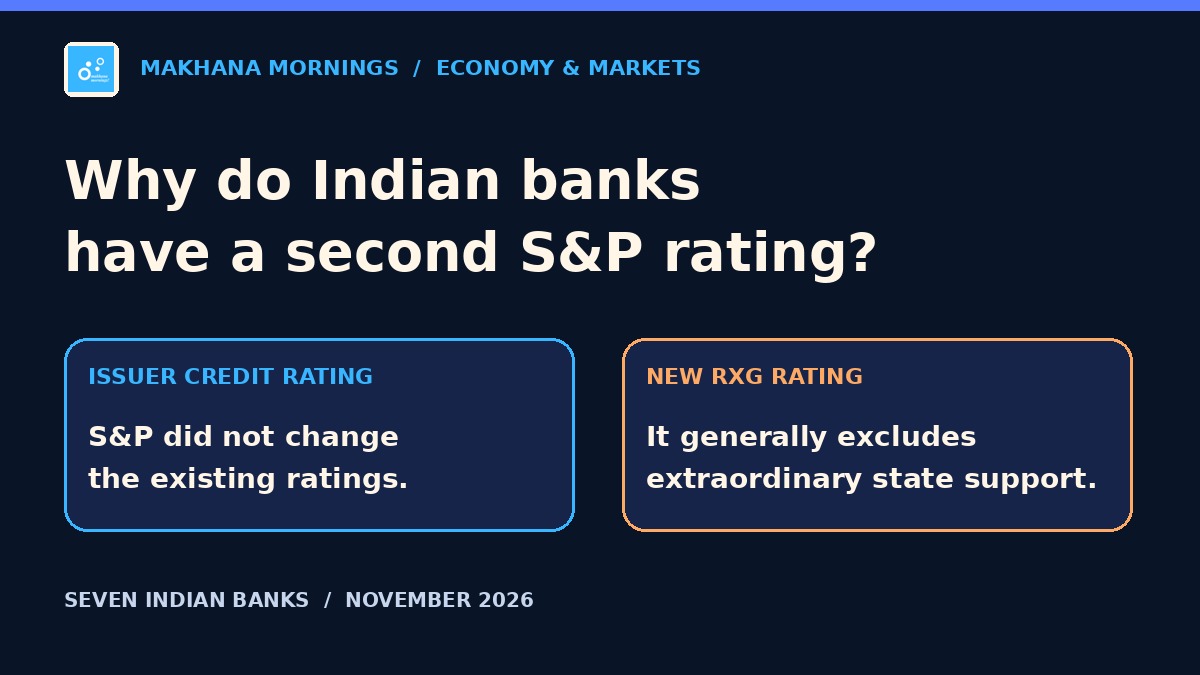
A bank can get a second credit rating without becoming safer or riskier overnight. On November 27, 2026, S&P Global Ratings assigned a separate measure to seven Indian banks, including Axis Bank, HDFC Bank and ICICI Bank. The agency did not change their existing issuer ratings. The difference lies in what the new rating is meant to count.
The second rating asks a narrower question
S&P calls it a rating excluding government support, or RXG. It generally sets aside the possibility of extraordinary government support. It is not necessarily a rating of the bank standing alone: the agency can still count support from a parent group or guarantor. It also allows for a government-owned public bank exception under the Basel framework.
Axis Bank and HDFC Bank received a long-term BBB rating on the new scale, shown as BBBrxg. ICICI Bank received the same grade for foreign currency only. Those are new ratings alongside the earlier ones, not three rating moves. S&P does not assign outlooks to this measure.
Why a bank lending to another bank might use it
Banks take on exposure to other banks when they lend to them or hold their debt. In jurisdictions that allow external ratings for regulatory purposes, Basel’s standardised framework can use eligible ratings when working out the risk weight for those exposures. A risk weight is the percentage of an exposure that goes into the calculation of risk-weighted assets, on which capital requirements depend. The framework generally does not allow these ratings to assume implicit government support, with an exception for government-owned public banks.
The publication of a new rating is not a change in bank capital
The RBI’s updated standardised credit-risk rules are due to take effect on April 1, 2027. They specify how external ratings determine base risk weights for qualifying rated bank exposures and treat equity, capital instruments and subordinated debt separately. A new S&P rating is not an RBI change to a particular bank’s capital requirement.
Whether the new rating affects a particular exposure depends on the local regulator’s rules and how the institution applies them. The rating is not a prediction of what any government would do in a crisis. It also does not change deposit insurance, which is a separate statutory protection. The key is to ask which rating you’re looking at and what it is designed to measure.



Leave your thoughts