
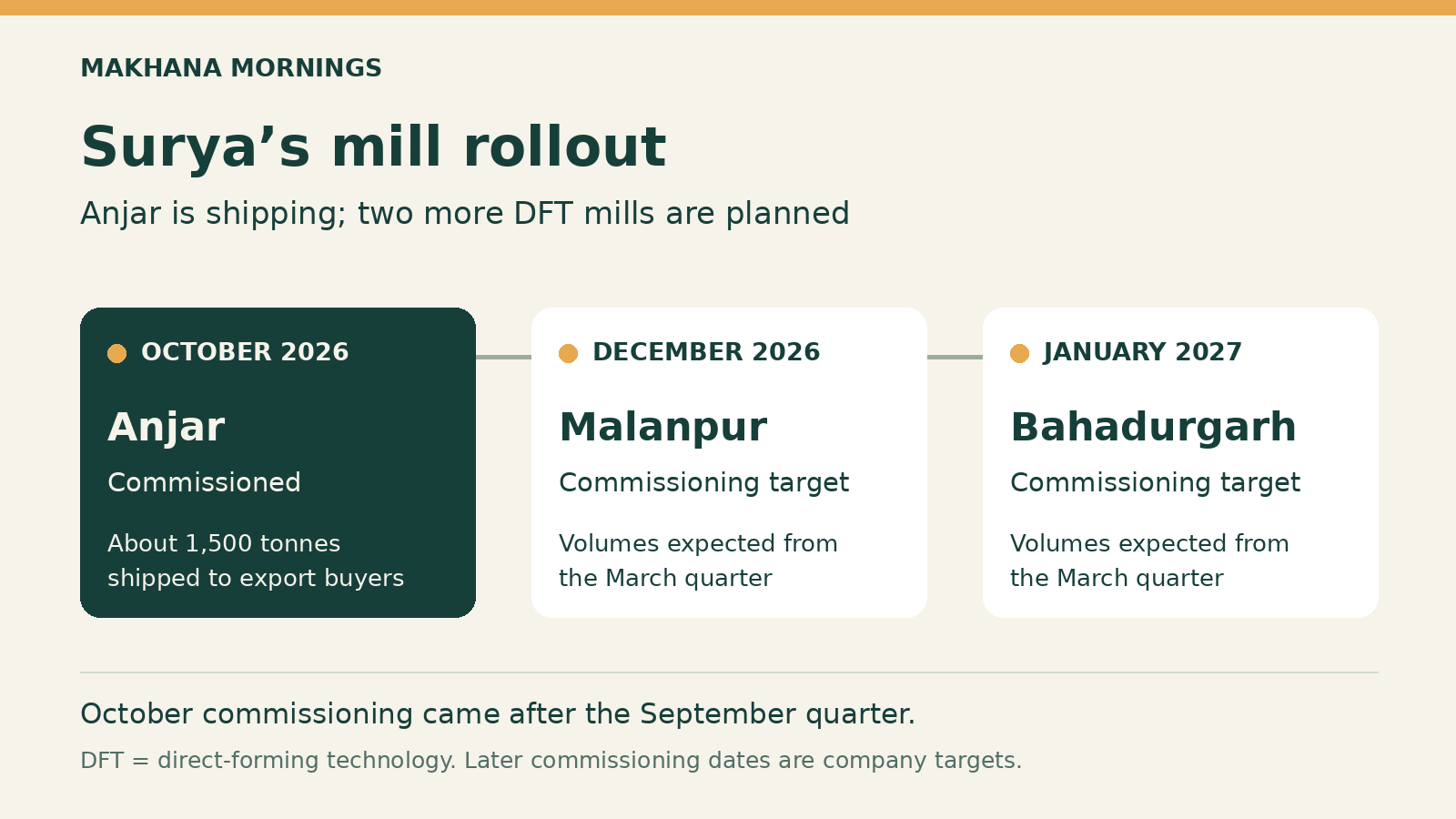
Surya Roshni’s new direct-forming technology mill at Anjar, Gujarat, began operating in October and has already shipped about 1,500 tonnes to export customers, the company said in its November 7 results update. Two more mills are targeted to follow at Malanpur in December and Bahadurgarh in January.
The rollout expands the company’s hollow-section pipe offering as it prepares to execute a larger export and domestic oil-and-gas order book. Anjar’s commissioning came after the September quarter, so its contribution belongs to the next stage of growth rather than the results just reported.
The Breakdown
Surya says its direct-forming range now extends from 80-by-80 millimetres to 200-by-200 millimetres, broadening its access to the hollow-section market. Management expects the Malanpur and Bahadurgarh mills to add volumes from the March quarter.
A separate expansion at Hindupur includes a first mill with annual capacity of 60,000 tonnes, targeted to become operational by March 2027. These remaining dates are management’s commissioning plans.
The company plans capital spending of about ₹150 crore in FY27 and another ₹150 crore in FY28, funded through internal accruals. Its wider ambition is to raise the share of value-added products above 50% of steel-pipe volumes within two years, from about 48% in the September quarter.
More tonnes, a smaller profit increase
The existing business is already selling considerably more. Steel Pipes & Strips volumes reached a record 2.67 lakh tonnes in Q2FY27, up 23% year on year. Revenue rose 37.6% to ₹1,941.16 crore.
The statutory segment result, measured before tax and finance costs, increased only 0.9% to ₹79.01 crore. The company separately reported EBITDA per tonne of ₹4,105, below ₹5,013 a year earlier but above ₹4,006 in the June quarter.
Management says the previous year’s comparison benefited from European and Canadian customers buying ahead of carbon-border rules and quotas. The current export increase also included about 17,000 tonnes of shipments deferred from the June quarter because of vessel availability and the Middle East situation. Both factors matter when judging how much of the reported growth represents a lasting change in demand.
Raw-material availability affected production choices too. Surya says it prioritised scarce hot-rolled coil for higher-margin products over fixed-price spiral orders. It is addressing a cold-rolled coil shortage by processing hot-rolled material at its separate new Bahadurgarh cold-rolling mill.
Orders now have to become profitable deliveries
The steel business entered the second half with an order book of about ₹1,200 crore. That includes roughly one lakh tonnes of export orders worth ₹850 crore, scheduled for execution in the December and March quarters. About 80,000 tonnes of those export orders are API pipes, alongside a domestic API order book of about 20,000 tonnes.
Management expects this work to improve use of pipe and coating capacity that was underutilised in the first half. It also says outstanding export orders reflect current freight rates. Those are reasons behind its expectation of better second-half profitability; the deliveries and resulting margins remain ahead.
The pressure was not confined to steel. Lighting & Consumer Durables revenue rose 16.8% to ₹507.32 crore, while its result before tax and finance costs fell 2.9% to ₹29.52 crore. Management cited higher input costs, producer-responsibility payments and increased brand spending.
Group earnings also reflect other income falling to ₹6.13 crore from ₹22.54 crore. Consolidated revenue rose 32.7% to ₹2,448.48 crore, while net profit increased 3.4% to ₹76.73 crore. The September-quarter results are unaudited and carry an unmodified limited-review report.
The Crunch
Anjar has moved beyond a commissioning timetable into shipments. The next milestones are the remaining mill starts, execution of the second-half orders and the profit earned from those deliveries. Together, they will show how much the expansion adds beyond a larger tonnage number.


Leave your thoughts