
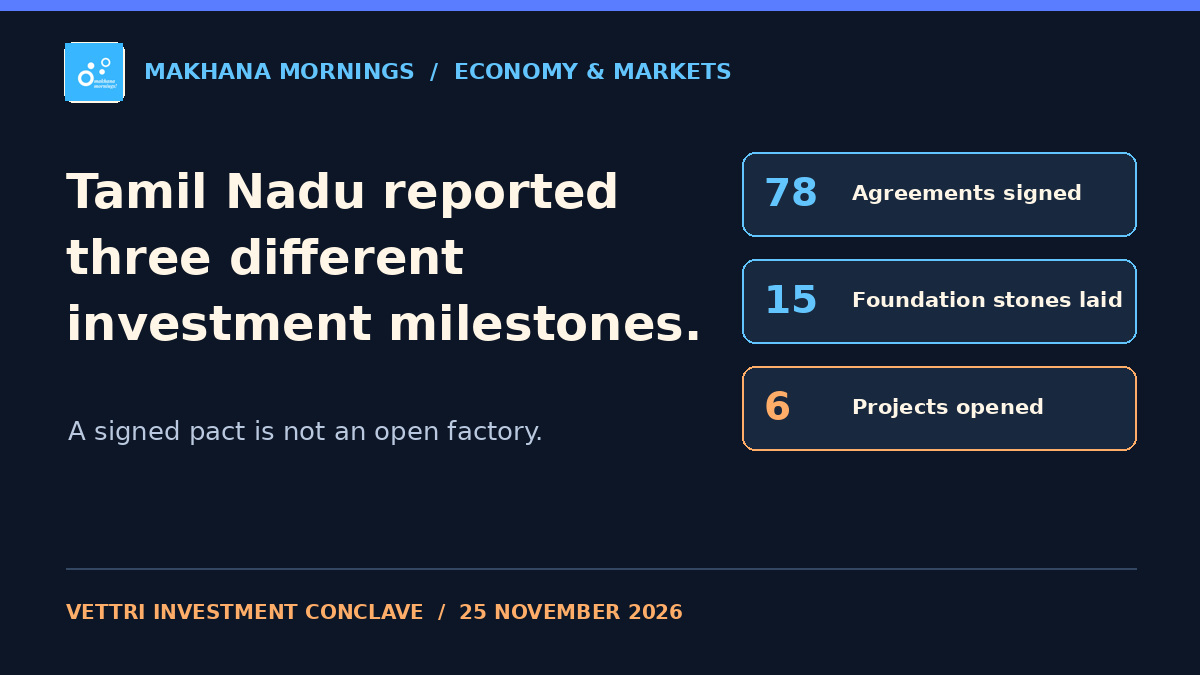
Tamil Nadu’s November 25 investment conclave had three kinds of milestones: agreements signed, foundations laid and projects opened. The biggest number came from the first group. The state reported 78 memorandums of understanding for ₹58,214 crore of proposed investment. It also marked the opening of six completed projects valued at ₹1,430 crore. Those figures answer different questions.
A signed agreement, a foundation stone and an opening are not the same thing
78 agreements signed, ₹58,214 crore proposed. An agreement records the investment plan. The 65,786 jobs associated with these agreements are projections, not people already hired.
15 projects reached the foundation-stone stage, with a reported value of ₹7,925 crore. That milestone does not tell us how much has been spent or when the facilities will start producing.
Six completed projects were inaugurated, with a reported value of ₹1,430 crore. That is a later milestone than a signing or a foundation ceremony. An opening still does not tell us what the site is producing or how many people it employs today.
The published figures describe stages marked at one event. They are not a single group of projects being followed over time, so adding the rupee values or dividing the six openings by the 78 agreements would be misleading.
WEG shows what a signing adds to a plan already announced
The proposed ₹2,000 crore WEG project in Dharmapuri was public before the event. The new step reported at the conclave was an agreement. The Brazilian equipment maker already has a manufacturing site in Hosur, which it dates to 2011. Dharmapuri is a proposed additional site, not WEG’s first factory in the state. Construction and production there are separate milestones to verify.
Royal Enfield offers another example. Its non-binding agreement lays out ₹1,000 crore of proposed spending over seven years on electric vehicle development, technology and manufacturing. The company already has an electric motorcycle lab and manufacturing setup at Vallam Vadagal. The pact does not specify an annual production target or a schedule for a new factory, so it is not evidence that either is in place.
A conversion rate depends on what the state counts as progress
In a November 14 review, the state said 83 of 112 earlier commitments had reached land allotment or a later stage. That is about 74% of that earlier group, not a count of operating factories and not a result for the 78 new agreements. Allotting land can clear an obstacle before a building goes up. It cannot establish that a line is running.
The next useful update would track the same projects by name across land allotment, construction, commercial production and hiring. That would show which proposals have become factories and which are still waiting for the next step.


Leave your thoughts