
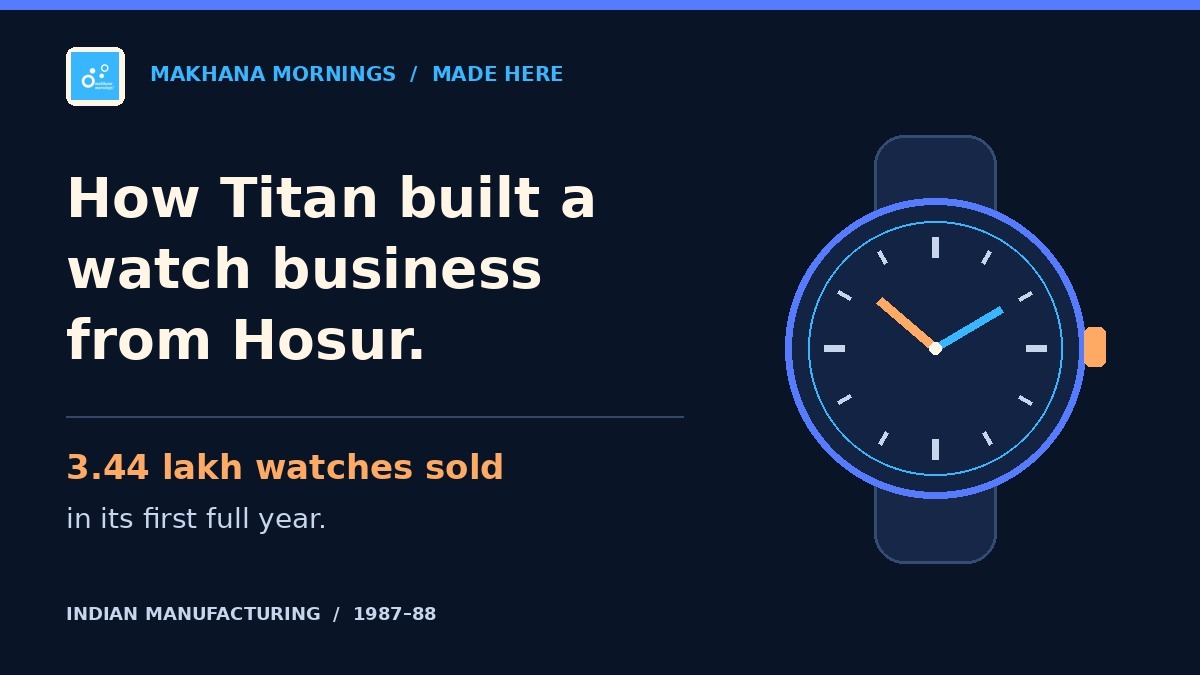
Titan sold 3.44 lakh watches in its first full year of operations. Yet its 1987–88 annual report says every watch still contained parts bought abroad. The company was making more of the watch in Hosur while keeping international suppliers for parts it still needed. Both were true at the same time.
That history is back in view after Made in India: A Titan Story won the best streaming-series award at the International Film Festival of India on November 28. The six-episode docudrama adapts Vinay Kamath’s book on Titan. The company’s early annual reports tell a quieter story about what it took to turn a watch design into a product people could actually buy.
Titan sold watches before it made most of their parts in Hosur
Titan’s 1986–87 report says commercial production of quartz analogue watches began in March 1987. The Hosur complex was formally inaugurated in March 1988, and commercial component production began the following month. By the time directors wrote their 1987–88 report, they said Hosur was making the bulk of the components and that technology transfer from France Ébauches was continuing.
The same report put import content at about 25% and described the difficulty of lining up supplies from several markets while keeping stock under control. It does not spell out the calculation basis for that percentage, so it should not be read as a count of imported parts. The commercial point is clearer: making most components locally did not make the remaining suppliers less important if a missing part could hold up assembly.
The watches needed a sales network as much as a factory
Titan’s 1986–87 annual report says its sales network already covered every state and union territory. That did not mean the company owned stores in each one. It meant a manufacturing operation in Hosur could reach buyers far beyond the factory. Its first full-year report records ₹19.13 crore in company income and 3.44 lakh watches sold, but it does not isolate how much of that came from the sales network, product design or local production.
The lesson is to ask two separate questions about a product made here: which parts can the company reliably make or source, and how will it get the finished product to buyers? A factory does not build the route to customers for you.


Leave your thoughts