
Your flight gets moved to an earlier departure. The airline calls, but instead of a familiar mobile number, your screen shows a number starting with 1601. As more businesses move onto the series, that prefix will give you a clue about why they’re calling.
On 27 November, the Telecom Regulatory Authority of India (TRAI) extended the 1601 series from utilities, logistics companies and couriers to eligible businesses including hospitals, diagnostic labs, airlines, online retailers and food delivery platforms. These numbers are for service and transaction calls, not sales pitches.
What 140, 1600 and 1601 mean
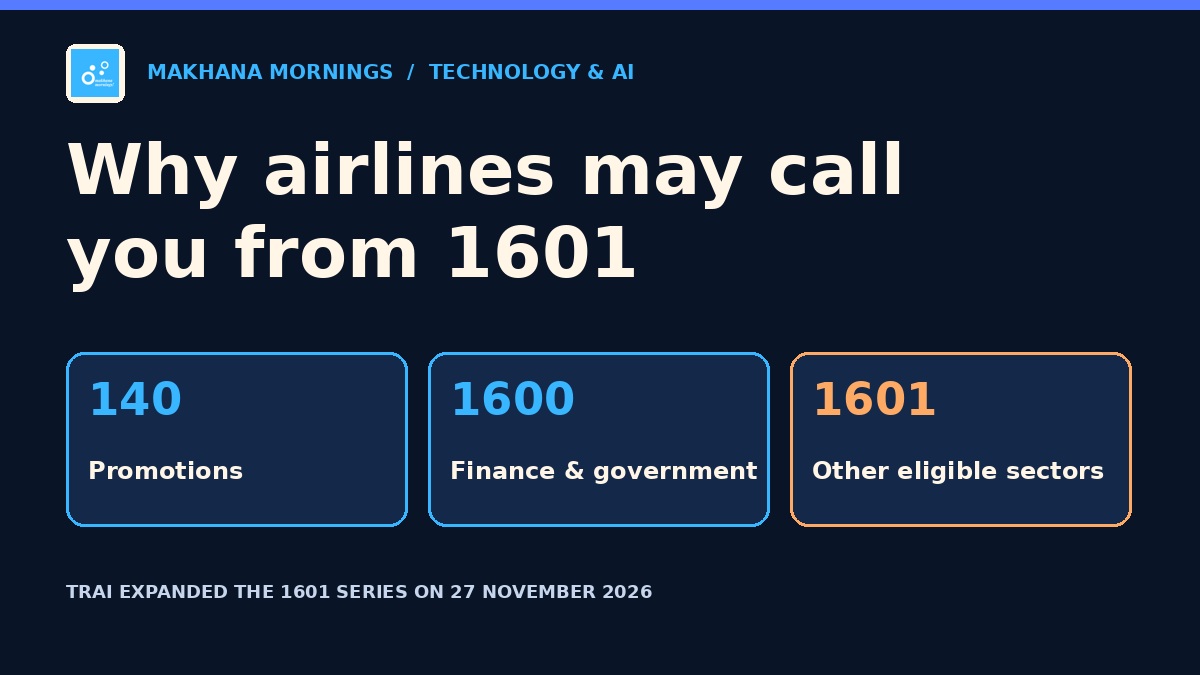
140 is for promotional calls. Think of a retailer calling to advertise a sale.
1600 is for service and transaction calls from banks, financial services firms and insurers, as well as government-to-citizen calls. A bank calling about an existing transaction is one example.
1601 is for service and transaction calls from eligible businesses in other sectors. That could mean a courier updating a delivery, a hospital rescheduling an appointment or an airline notifying you of a flight change.
Why the change won’t reach every business at once
For the newly added sectors, most eligible businesses must be registered as companies in India and have recorded at least ₹500 crore in annual turnover in one of the previous three financial years. Television distribution operators, including direct-to-home and internet TV providers, instead need at least one million subscribers in any month of the preceding year. The India registration requirement applies to them too.
TRAI gave telecom providers 180 days from the direction to move eligible companies onto the series and asked for progress reports every 15 days. That’s a rollout window, not a single date when every airline or hospital switches. A local clinic’s ordinary phone number isn’t automatically suspicious.
The prefix tells you the type of call, not what to do next
TRAI says the 1601 numbers are allocated to verified businesses. But a familiar prefix is not a reason to share a PIN or one-time password, or to make an unexpected payment. If a request feels unusual, hang up and check it through the company’s app or a number you looked up independently.
For a sense of how widely a dedicated series can already be used, TRAI counted 1.27 billion calls originating from 1600 in July–September 2026. That was before this expansion and says nothing about how many businesses have switched to 1601 or how much fraud the change might prevent.
Related: What India’s spam warnings, blocks and enforcement numbers actually count.


Leave your thoughts