
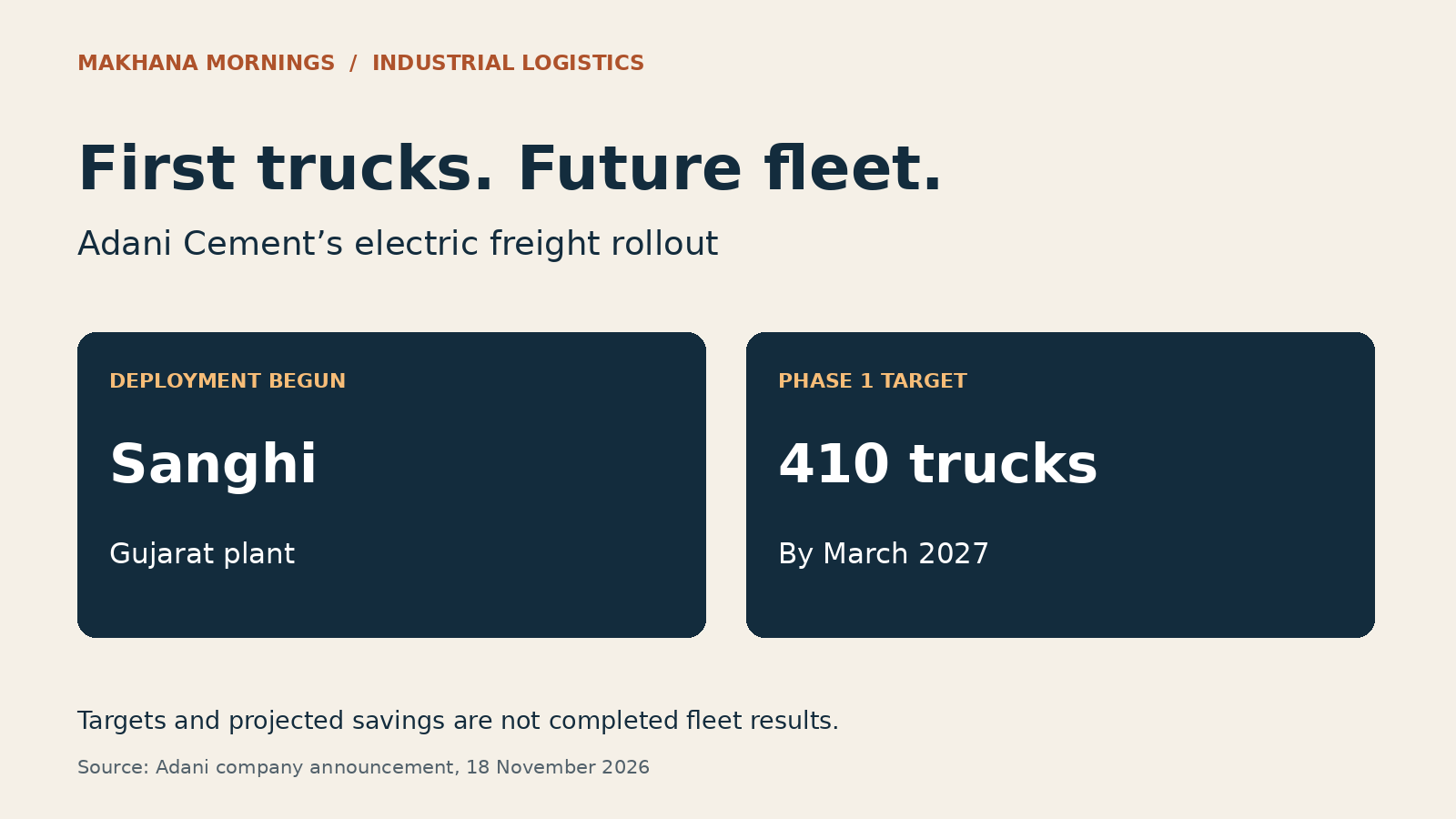
Adani Cement has begun deploying heavy-duty electric trucks for clinker and cement transport at its Sanghi plant in Gujarat. Its 18 November announcement puts the first rollout alongside a larger ambition: 410 trucks by March 2027. The distinction matters. Deployment has started; the full fleet is still a target.
The company also targets more than 2,000 electric vehicles carrying 10% of its road-logistics volume by 2030. Those are future milestones, not a description of today’s transport network.
For the planned 410-truck fleet, Adani projects annual savings of more than 25,000 tonnes of carbon dioxide and displacement equivalent to 11 million litres of diesel. These are company estimates, not measured results from the initial deployment.
The announcement does not specify how many trucks have started work, the investment required, individual routes, charging arrangements or a route-level operating-cost comparison. It says further routes and plants are planned.
For a cement producer, the business question is not simply whether an electric truck can move a load. It is whether the vehicle can complete the required trips at the right payload, recharge without disrupting dispatches and keep the delivered cost competitive. Purchase or leasing costs, electricity tariffs, charger availability and utilisation all belong in that calculation.
Moving away from diesel changes the cost exposure rather than removing energy costs. The emissions comparison also needs a defined boundary: no exhaust emissions during driving is not the same as no emissions across electricity supply, vehicle manufacturing and operation.
The useful next evidence will therefore be operational: trucks actually deployed, routes served, loads and kilometres completed, charging performance and measured costs. For now, Sanghi marks the start of a rollout, not proof that the planned fleet has delivered its projected savings.



Leave your thoughts