
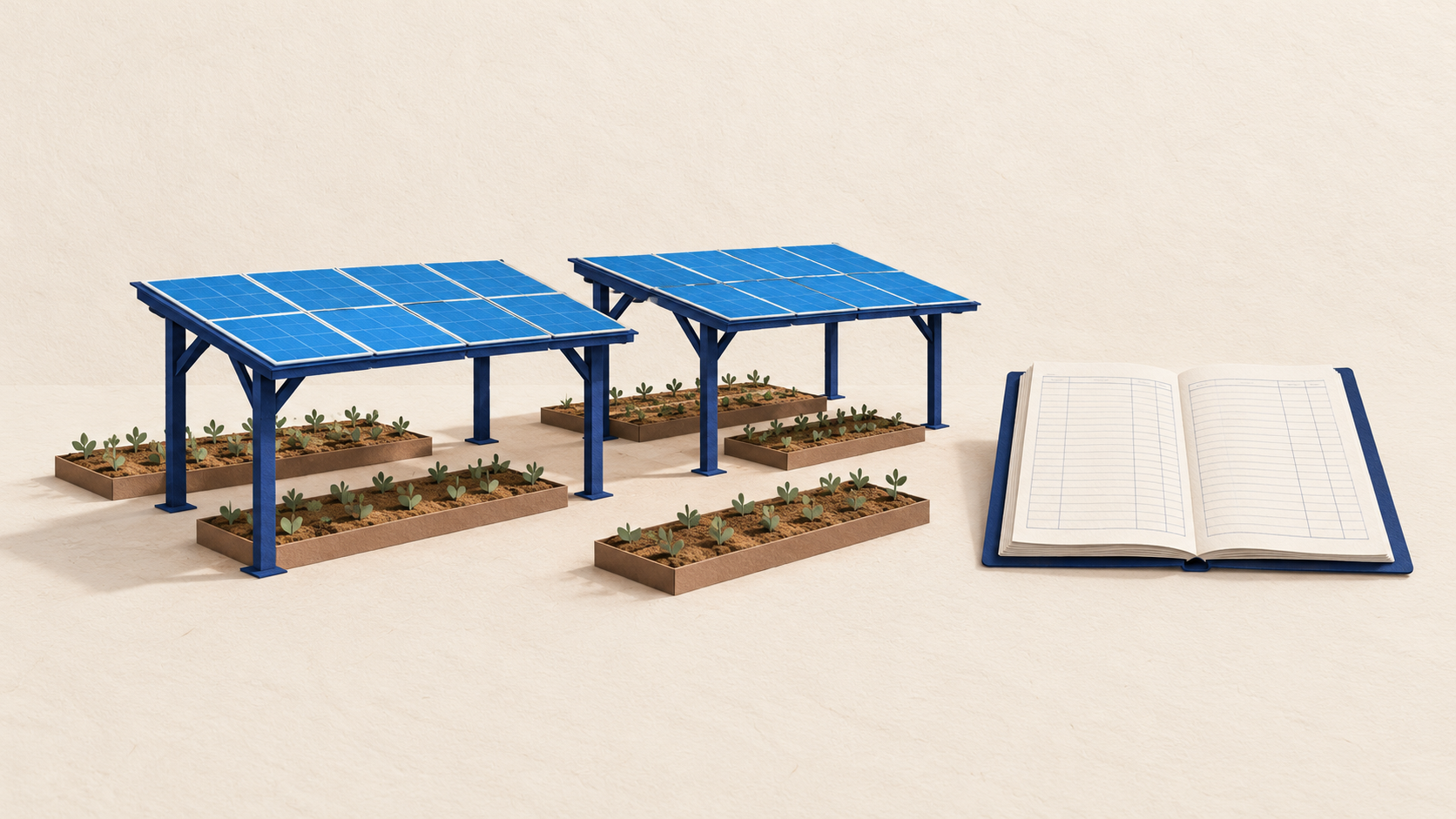
A farm producing crops and electricity has two potential revenue streams. The investment question is what remains after paying for a system that lets both activities work.
The Breakdown
On October 21, the renewable energy ministry said an agrivoltaics programme, combining cultivation and solar generation on the same land, would form part of the next PM-KUSUM phase. That phase is still being developed. Electricity procurement models involving distribution companies and state energy departments are also being worked on.
This announcement is a direction of travel, not a completed offer with guaranteed subsidy or income. Agriculture Minister Shivraj Singh Chouhan highlighted machinery access, panel spacing, drainage and farmers’ ability to change crops.
What the field experiment shows
A 2024 paper by Vinit Modi and colleagues examined a one-acre research site at Sardarkrushinagar Dantiwada Agricultural University in Gujarat. It compared green gram beneath eight different 9.24 kW solar arrangements with an open-field control; its electricity charts cover January to May 2021.
The open field recorded the highest crop yield. Transparent panels led crop yield among the panel setups but had the weakest power performance. The arrangement with the highest combined gross income differed from the one with the highest calculated net return, which had lower capital costs.
Those calculations included depreciation, interest, repairs and cultivation costs. This was one crop at one site, using historical costs and an assumed electricity sale price. It illustrates design tradeoffs, not a current income forecast or a recommendation for every farm.
Why This Matters
For a farmer or project partner, the practical questions belong in the same proposal: who funds the equipment, who maintains it, what cultivation remains feasible and on what terms electricity will be bought? A model that answers only the generation question leaves the business case unfinished.
The Crunch
Our reading: assess the farming plan, costs and contracts together. Adding electricity revenue starts the assessment; it does not settle how the investment pays for itself.