
Amazon’s latest Indian renewable-energy announcement contains two different commitments. Combining them carelessly would overstate what has already happened.
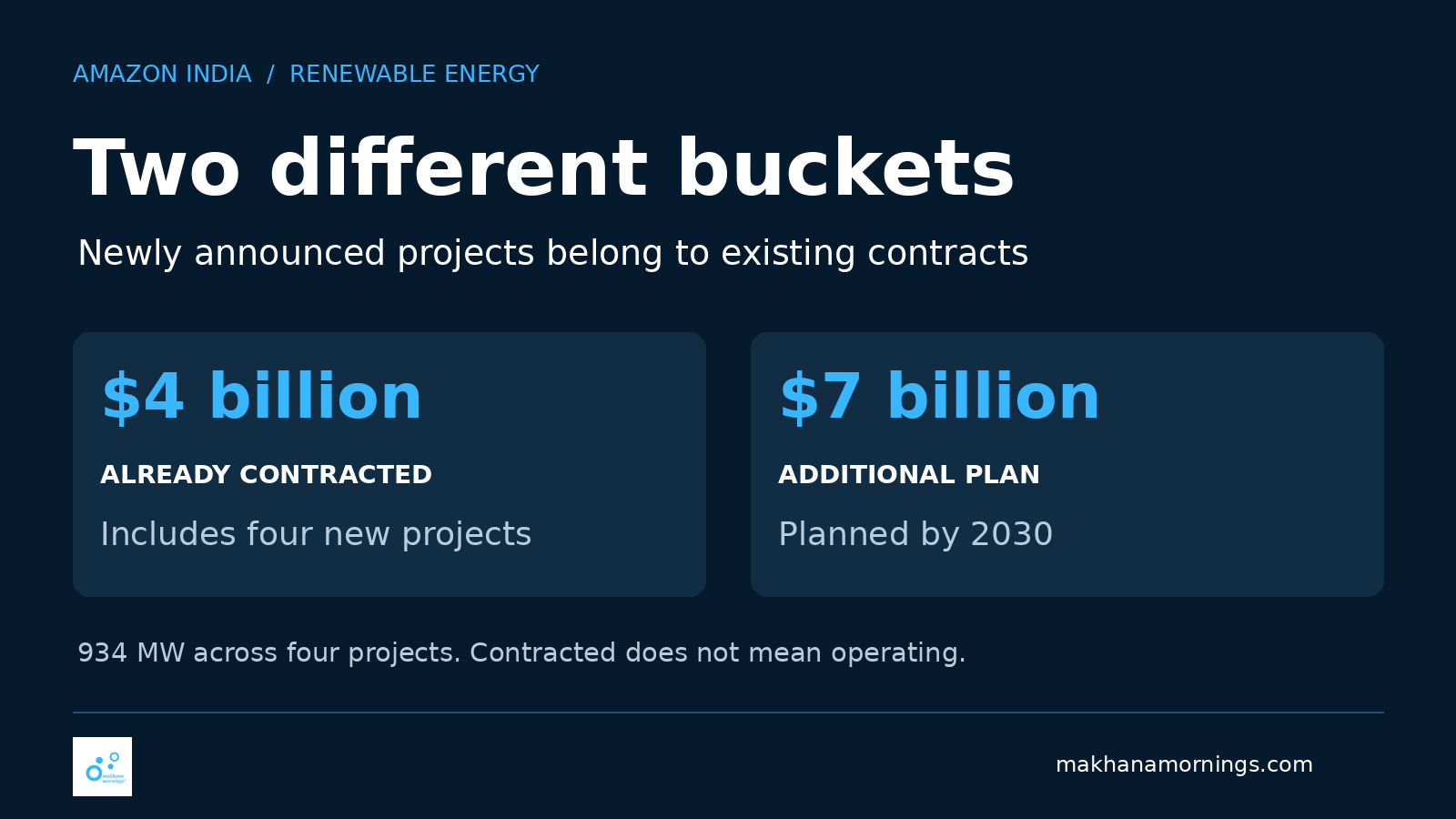
On November 17, Amazon said it plans an additional US$7 billion of renewable-energy investment in India by 2030, above US$4 billion already contracted. It also announced four wind and solar projects totalling 934 megawatts.
Those four projects belong to the existing US$4 billion contracted portfolio, the company says. They are not a separately identified deployment of the additional US$7 billion plan.
What the four projects cover
The projects comprise a 234 MW wind farm and a 200 MW combined wind-and-solar project in Karnataka, a 300 MW solar project in Madhya Pradesh and a 200 MW solar project in Rajasthan. Amazon says they were secured through power purchase agreements.
The company puts its full Indian renewable portfolio at more than 2 gigawatts once operational. That figure covers the wider portfolio, not just these four projects.
A contract is not operating capacity
The announcement does not provide individual commissioning dates, construction milestones or a detailed spending schedule. It therefore cannot establish how much new electricity is being generated today.
For readers tracking the energy build-out, the important distinction is between an investment intention, a signed power-purchase agreement and a commissioned project. Each answers a different question: what a buyer plans, what it has contracted and what can actually generate power.
The next useful checkpoints are project delivery and operating capacity. Adding the planned and contracted dollar figures does not turn them into money already spent, and a capacity announcement alone does not demonstrate round-the-clock electricity supply.



Leave your thoughts