
A manufacturer can plan its next production line before the existing one reaches full use. Supreme Petrochem’s latest ABS expansion illustrates why capacity, utilisation and the construction timetable belong in the same conversation.
In a 17 November exchange filing, the company disclosed a technology agreement with Italy’s Versalis for a second mABS line of 70,000 tonnes a year. The agreement was signed on November 12, with the signed copy received on November 17.
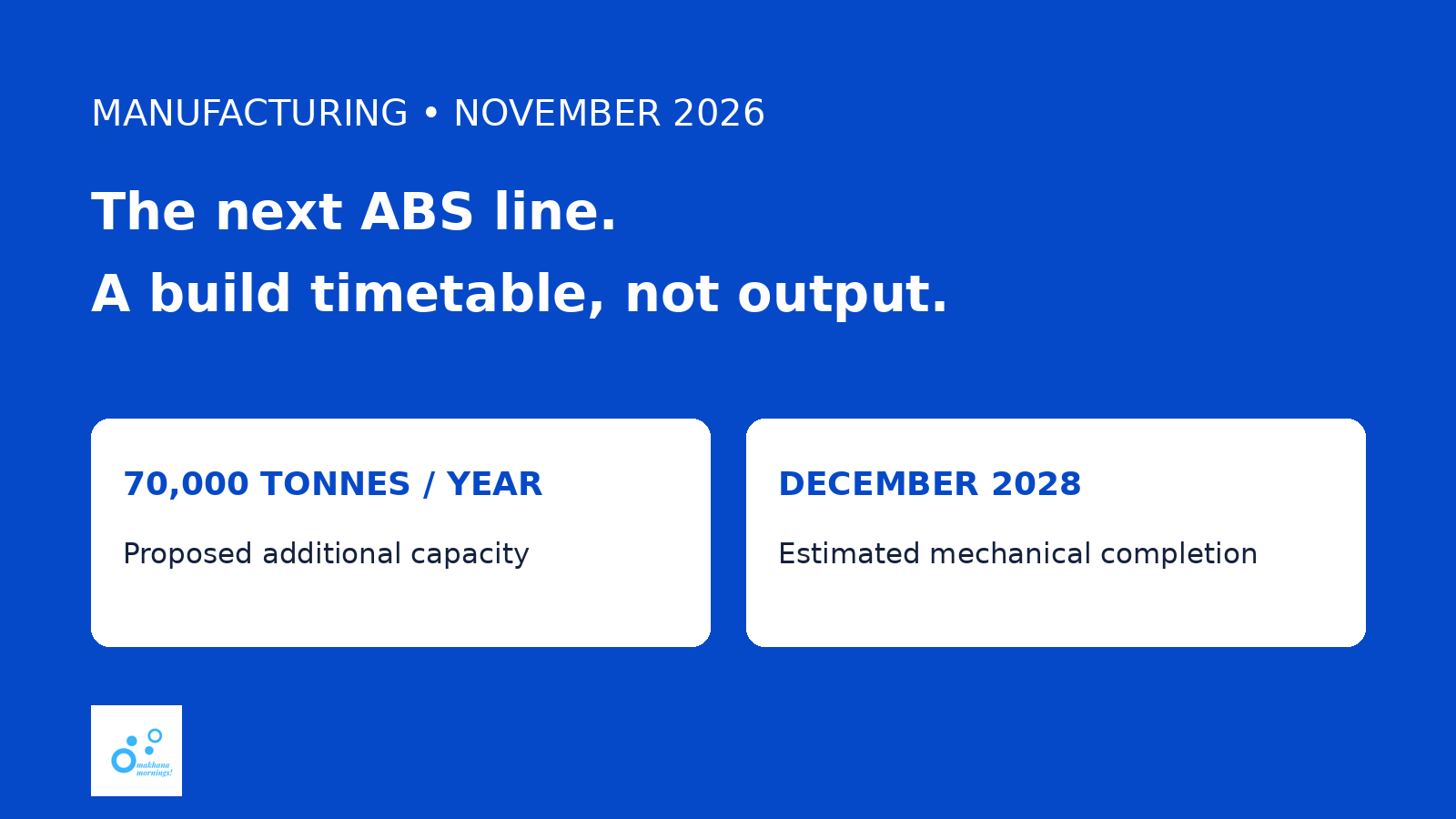
The proposed investment is ₹450 crore, financed through internal accruals. Mechanical completion is estimated for December 2028. That is a future construction milestone, not a statement that the additional capacity is producing or earning revenue today.
Read the existing line alongside the next one
The same filing lists existing capacity of 70,000 tonnes a year and utilisation of 60%. It does not specify the period used to measure that utilisation. The figure therefore should not be converted into an annual production estimate or treated, by itself, as evidence of weak demand.
Supreme Petrochem’s October 23 investor presentation says the first continuous-mass ABS plant was commissioned in September 2025. ABS, short for acrylonitrile butadiene styrene, is a polymer; the presentation describes the company’s ABS grades and compounds as part of its wider materials portfolio.
The expansion filing gives growing Indian demand for ABS products as the company’s rationale. That is management’s investment case, not a disclosed order book guaranteeing that the second line will sell its full output.
The business test comes after the capacity decision
For a long-lead manufacturing project, waiting until every existing tonne is sold can mean adding supply too late. Building ahead also carries execution and demand risks. The useful questions are how the current line’s utilisation develops, whether construction stays on schedule, and how future sales translate into cash after costs.
Internal funding describes the intended source of money; it does not remove the capital commitment. The agreement moves a planned expansion forward. Commercial performance will require separate evidence.


Leave your thoughts