
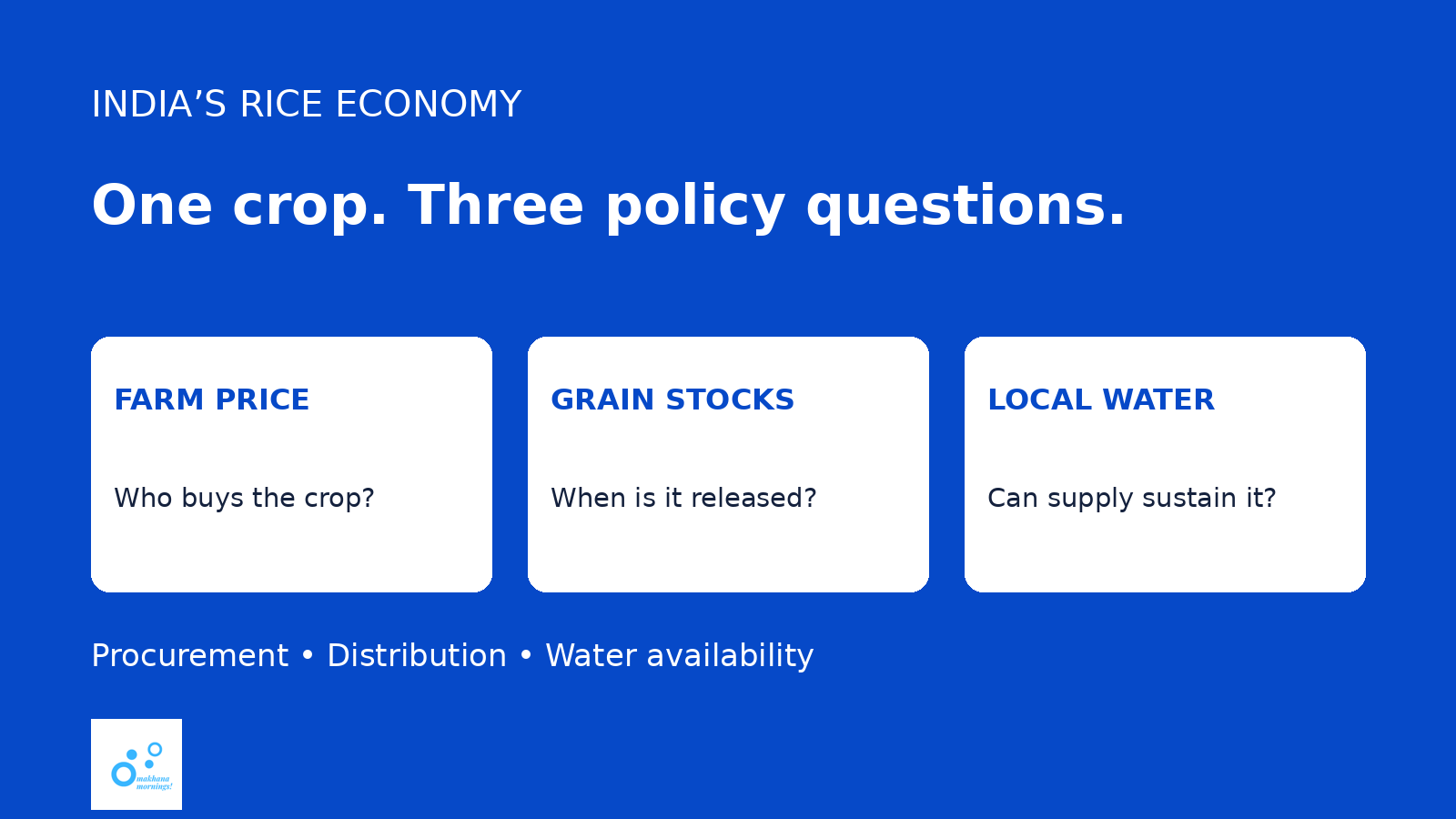
India’s rice system has to balance three things that are usually discussed separately: a dependable buyer for farmers, grain available for public distribution, and the water needed to grow the next crop. November’s government stock statement makes that balancing act tangible.
The farmer’s price and the public buyer
For the 2026–27 kharif marketing season, the minimum support price for common paddy is ₹2,441 a quintal, up ₹72 from the previous season. The Cabinet’s May 13 announcement puts the all-India weighted production-cost estimate at ₹1,627. Its stated 50% margin is a policy calculation, not a promise of that profit for every farmer.
The price has a procurement mechanism behind it. The food department describes an open-ended policy under which public agencies purchase grain meeting prescribed quality specifications at designated centres. Farmers can instead sell in the market. That conditional purchasing route matters: announcing a support price and actually finding a buyer are different steps.
The warehouse is a separate account
The Food Corporation of India’s November 1 opening-balance statement, prepared on November 11, records 370.05 lakh tonnes of rice in the central pool, equivalent to about 37 million tonnes. This excludes unmilled paddy held by FCI and state agencies. It is an inventory snapshot, not the season’s production or procurement total.
Buying grain and releasing it serve different purposes. MM’s earlier report on the expanded rice-sale target and stock reporting examined the release side. A sale can move grain out of storage; it does not establish whether the next crop fits local water availability.
The water account is local
In an August 4 parliamentary answer, the agriculture ministry said ICAR’s assessment identified 2.89 million hectares of rice in 68 districts receiving less than 650 mm of annual rainfall. That represented 5.67% of the rice area in the assessment, not all Indian rice farming. A separate analysis using groundwater-board and satellite data found mismatches between cropping demand and water availability in depleted states including Punjab and Haryana.
These findings support location-specific diversification, not a claim that MSP alone caused groundwater depletion. The policy test is therefore broader than reducing a stockpile: can alternatives suit the local water budget while offering farmers a credible route to buyers and income? Procurement, distribution and water policy need to answer that question together.




Leave your thoughts