
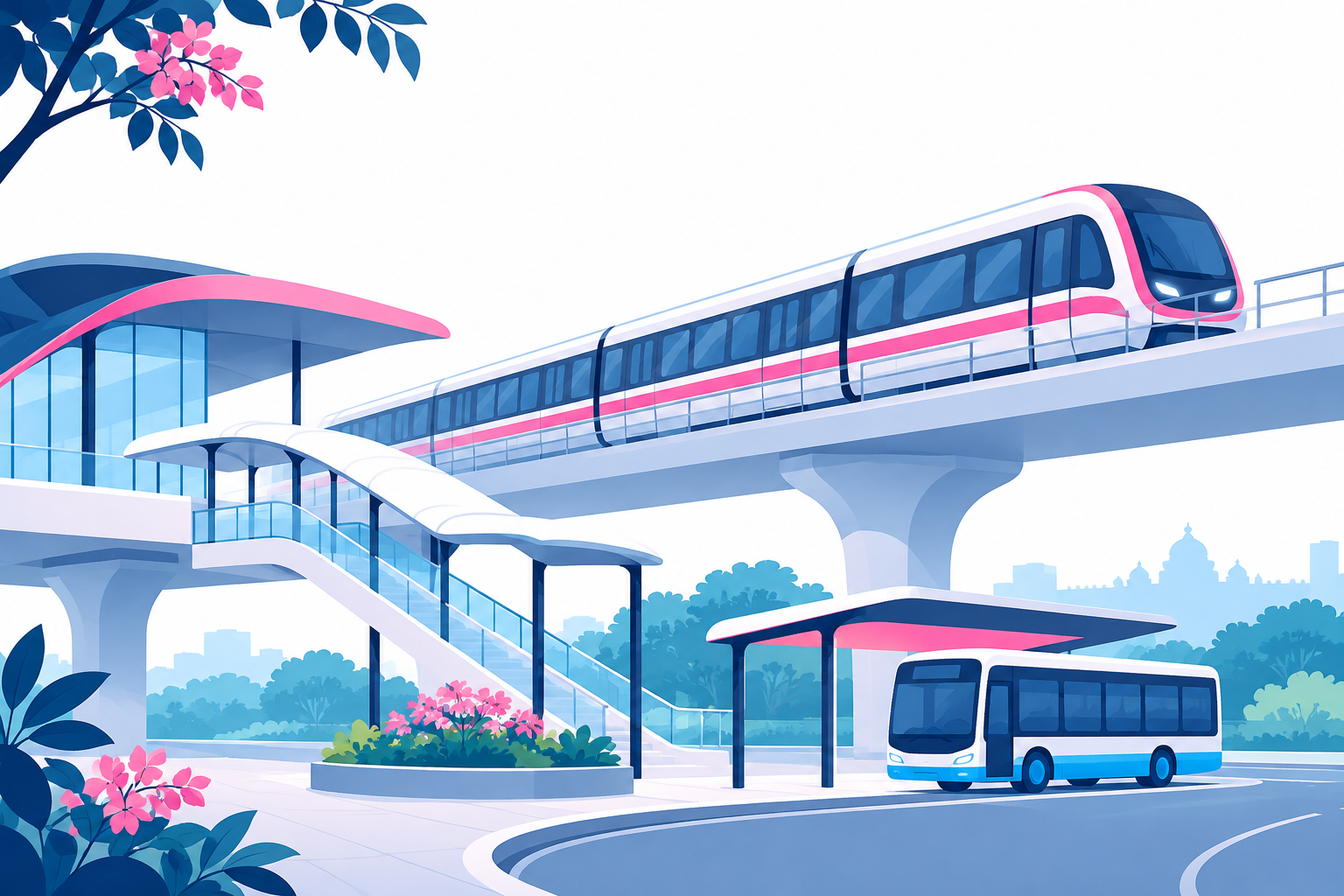
A new metro line changes the map immediately. Whether it changes someone’s daily journey depends on the timetable, the interchange and the trip to the station.
Bengaluru’s first Pink Line section was inaugurated on November 13, 2026. Passenger services between Kalena Agrahara and S G Palya (Suddagunte Palya) were scheduled to begin at 6 am on November 14. The announced opening covers the elevated section, not the entire planned Pink Line.

The Breakdown
The initial section spans 7.5 kilometres and six stations. Its interchange with the Yellow Line at Jayadeva Hospital gives it a role beyond journeys confined to the new stretch.
The announced timetable distinguishes weekday demand from weekend travel. Trains are scheduled every eight minutes during weekday peak periods and every 10 minutes off-peak. The Saturday and Sunday interval is 10 minutes, including the scheduled opening day. Frequency can change as the operator assesses passenger traffic.
Bus connections are part of the rollout too. Five dedicated feeder routes have been announced to improve access to Pink Line stations. That matters because a metro journey starts before a passenger reaches the platform and often continues after leaving it.
Automation does not mean no driver
The signalling system uses communications-based train control, which exchanges information between trains and trackside equipment. Alstom describes the initial operation as Grade of Automation 2: acceleration and braking are automated, but a driver remains responsible for important operating functions.
That distinction matters. An automated function is not the same thing as a fully driverless service. Nor does signalling capability, by itself, establish the frequency passengers will receive.
Why This Matters
For a commuter comparing routes, the useful measure is the complete door-to-door journey. A shorter rail segment may not save time if reaching the station or changing services takes longer. Conversely, an effective interchange can make a relatively short new section useful for a longer trip.
For employers considering transport arrangements, the announced route and connections provide a starting point for planning. They are not yet evidence that staff travel times or road congestion have fallen.
The Crunch
The inaugurated stretch is intended to create a new transport option in south Bengaluru. Its practical value should be judged through actual service reliability, connections and passenger use, rather than the inauguration alone.
Related categories: People & Work




Leave your thoughts