
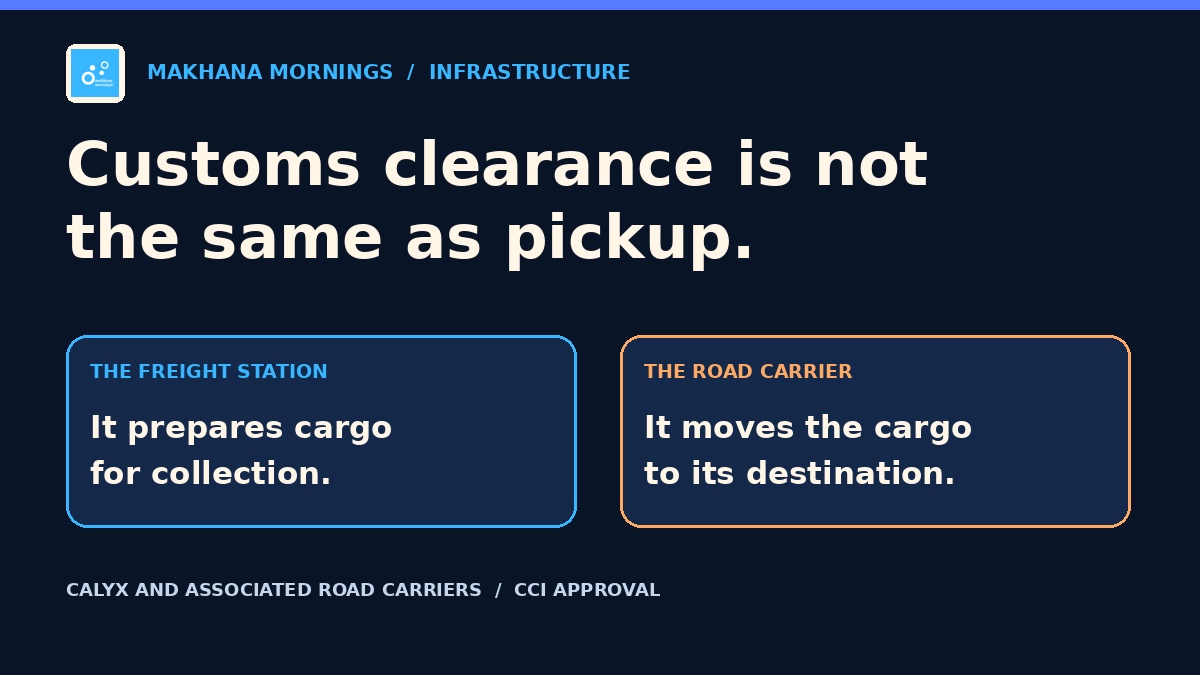
A container can clear customs and still miss its delivery slot. The truck has to arrive at the right time, the cargo has to be ready to collect, and someone has to resolve the delay if either step goes wrong. That handoff helps explain why a container freight station and a road carrier might fit together.
The Competition Commission of India announced on 25 November that it approved a proposed combination involving two Samara investment funds, Calyx Container Terminals and Associated Road Carriers. Under the proposal, the funds would acquire a stake in Calyx, Calyx would acquire a stake in Associated Road Carriers, and Calyx would then merge into the road transport company. The regulator’s announcement did not give the price or stake sizes, and approval does not mean the deal has closed.
A freight station and a truck solve different problems
A container freight station handles cargo at a fixed site. Depending on the shipment, it can provide space to pack or unpack a container and support customs examination. A road carrier moves the goods between locations. Putting the services under one operator could make it easier to coordinate when freight is ready and when trucks arrive, but ownership alone does not remove customs checks or guarantee a faster pickup.
Calyx is a licensed container freight station serving Chennai Port, according to Samara’s transaction counsel. In the 2025 National Time Release Study, customs-cleared import containers took an average of 110 hours and 15 minutes to leave the freight stations in the Chennai sample, compared with 88 hours and 28 minutes across the seaports assessed in that part of the study. This is not a measure of Calyx’s performance. The study notes that importers can use part of that interval as storage, so the whole wait cannot be treated as a trucking delay.
The test is the time between release and pickup
For a shipper, a useful measure is the time between cargo being available for pickup and the vehicle leaving the facility. Compare it alongside total charges and missed delivery appointments. Those measures would show whether the combination improves the trip itself, rather than just reducing the number of suppliers on an invoice.



Leave your thoughts