
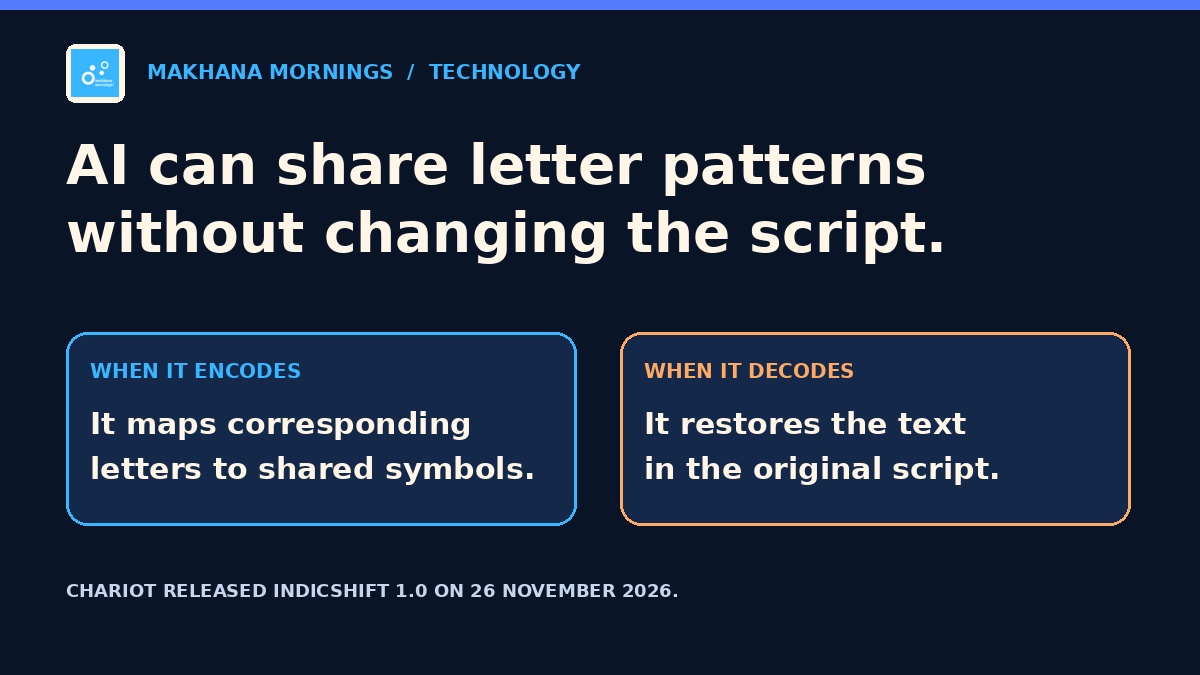
The letters क, ক and ਕ look different. Chariot’s new tokenizer can represent them using a shared internal symbol while keeping track of whether the original was written in Devanagari, Bengali or Gurmukhi. When the text is decoded, the original letter comes back. The reader’s language and script do not change.
Chariot released version 1.0 of IndicShift on November 26, in the same week it showcased its IndiaAI-supported Chariot-1 models. The tokenizer is publicly downloadable. It is not the language model itself.
A tokenizer decides how many pieces the model reads
A tokenizer breaks text into pieces called tokens. A piece might be a whole word, part of a word or punctuation. If a tokenizer has learned few useful pieces for a particular script, it may need more tokens to represent the same amount of writing. A model’s input limit is measured in those pieces, not in pages.
IndicShift first maps corresponding letters in several scripts to common symbols, with markers that remember when a script changes. It then breaks the transformed text into pieces. Because the mapping can be reversed, it can share patterns without turning Bengali into Hindi or replacing either script with English.
Fewer pieces do not guarantee better answers
If one tokenizer needs 1,000 tokens for a document and another needs 600, the second uses 40% fewer tokens for that document. Under an equal model input limit, that leaves more room for other text. Those figures are illustrative. The saving depends on the language mix, vocabulary and comparison tokenizer.
The technology ministry reported token savings from Chariot’s research. That is not a guarantee for every document or a like-for-like measure of output quality, latency or price. Using this tokenizer in a different pretrained model is not usually a drop-in change: that model was trained to interpret its own token IDs.
The Crunch
Chariot has made the text-splitting tool available for others to examine. That lets a team count pieces on its own documents. The next question is separate: can a model using those pieces consistently read names, addresses and mixed-language messages correctly in the work that the team needs it to do?




Leave your thoughts