
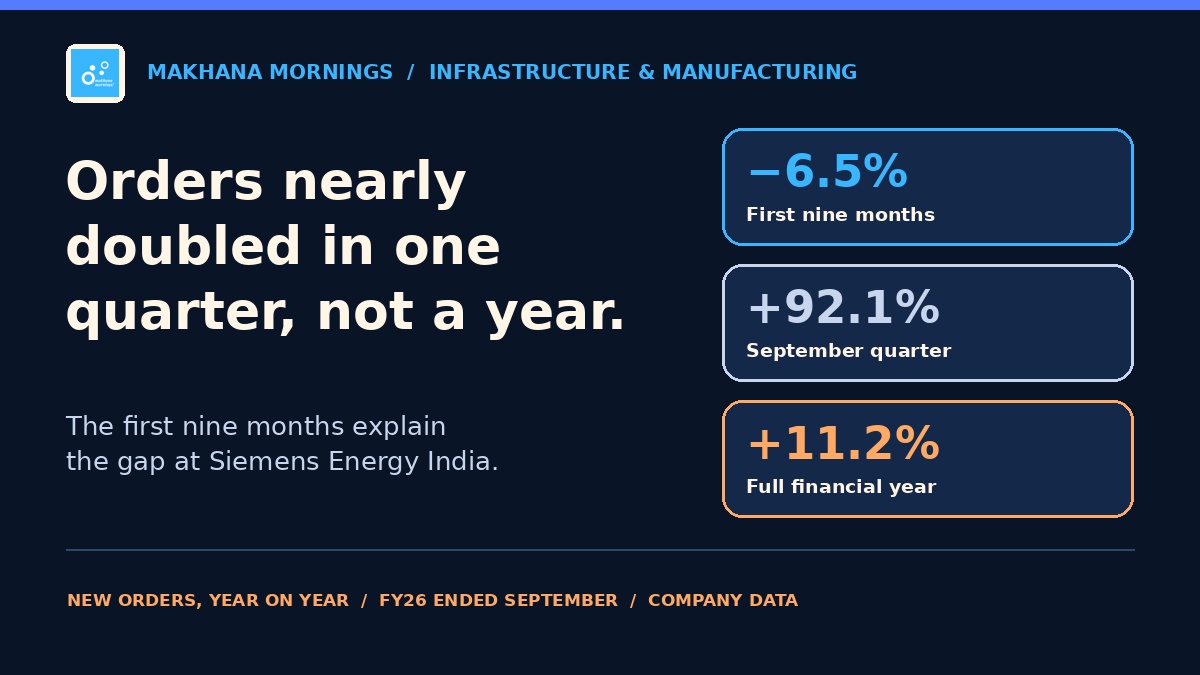
Siemens Energy India took nearly twice as much new business in its September quarter as it did a year earlier. But across the full year, new orders grew 11.2%. Both figures are correct. They tell you different things about the pace of demand.
The company’s 25 November results put September-quarter orders at ₹4,514 crore, up 92.1% from ₹2,351 crore. Across the financial year to September, orders rose to ₹14,579 crore from ₹13,112 crore.
The earlier quarters tell a different story
Subtract the September quarter from each full-year total. Orders in the first nine months were ₹10,065 crore this year and ₹10,761 crore a year earlier, a decline of about 6.5%. The September quarter more than made up for that difference. It does not, on its own, show that new work was rising at the same pace throughout the year.
An order still has to become revenue
Siemens Energy India reported ₹20,362 crore in orders still on its books at the end of September. That was up 25.6% from a year earlier. It also reported ₹10,243 crore in revenue for the full year. The backlog is work yet to be executed, not revenue already recorded or a promise it will all be delivered in the next two years.
The company also reported progress on expanding transformer and switchgear facilities and cited a ₹2,060 crore investment announcement for more large power transformer capacity. Its results release did not attribute the quarterly order jump to a single product or project.
The investor presentation filed on 27 November gives a clearer picture of the full year. Power Transmission orders rose from ₹8,430 crore to ₹10,030 crore, while Power Generation orders eased from ₹4,680 crore to ₹4,550 crore, using rounded segment figures. The annual increase was therefore concentrated in transmission. The segment totals still do not tell us which contract or product drove the September-quarter jump.
What to check next
Watch whether new orders stay elevated in subsequent quarters and whether the company delivers against the backlog. The first tells you whether demand is sustained. The second tells you how much work is turning into sales.
Related category: Business & Brands


Leave your thoughts