
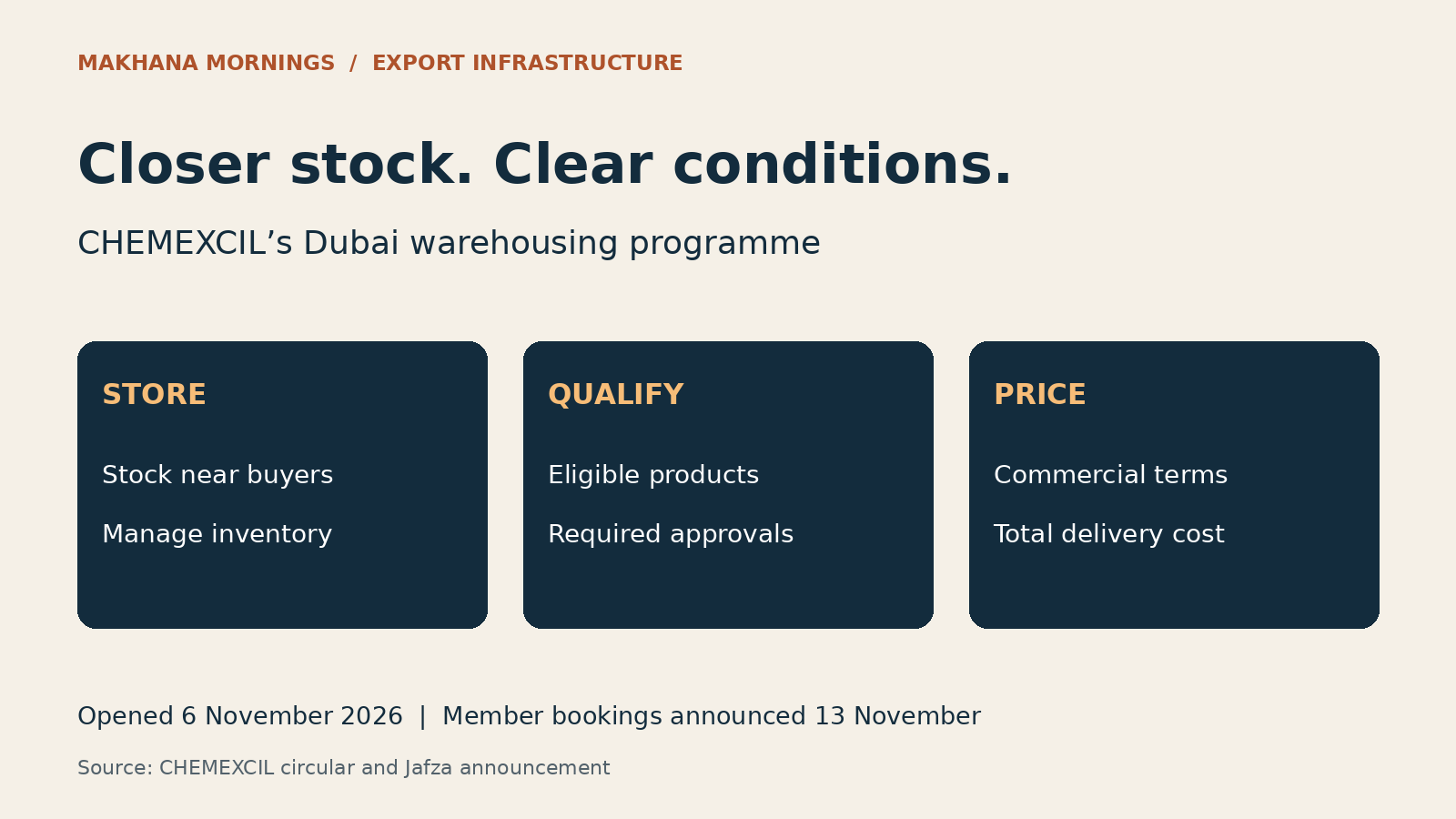
An overseas warehouse can shorten the distance between an exporter’s stock and its buyer. It does not remove the cost of holding that stock, or the checks needed to store chemicals safely. CHEMEXCIL’s new Dubai facility makes that trade-off concrete for Indian chemical exporters.
In a 13 November circular, the export promotion council said its first overseas warehouse at Jebel Ali Free Zone was inaugurated on 6 November 2026. Bookings are open, with discounted rates for council members. This is an existing opening receiving wider attention, not a facility launched today.
The initiative sits under FLOW, the Facilitating Logistics, Overseas Warehousing & Fulfilment component of India’s Export Promotion Mission. CHEMEXCIL describes access to storage, inventory management, shipping coordination, fulfilment and distribution support. Crucially, services remain subject to product eligibility, applicable approvals and agreed commercial terms.
Members seeking an offer must provide expected shipment volumes and storage requirements by cargo class, product details and Material Safety Data Sheets, plus shipment timing and storage duration. The circular does not publish a universal rate card or guarantee that every chemical can be accepted.
Jafza’s 16 November announcement sets out the operating partners: CHEMEXCIL brings exporters into the programme; Apex Logistics manages the programme, inventory visibility and fulfilment; MOL INDU provides chemical-grade warehousing operations; Jafza supplies the free-zone infrastructure and wider logistics setting.
The commercial logic is different from simply making an international shipment faster. Stock positioned near buyers can be dispatched against local demand without waiting for each order to travel from India. But the exporter must decide how much inventory to place abroad before the next sale arrives.
That decision ties up working capital and adds storage, handling and potentially unsold-stock costs. A useful comparison is therefore the total cost of serving an order, not the warehouse discount alone. Product compatibility, minimum charges, insurance, replenishment timing and responsibilities for customs and delivery also need to be settled in the commercial offer.
For smaller exporters, shared infrastructure may provide access without arranging a standalone overseas operation. The next evidence to watch is actual participation, inventory turnover and delivery performance. A warehouse creates an option to serve buyers differently; it is not proof of additional orders or savings already achieved.


Leave your thoughts