
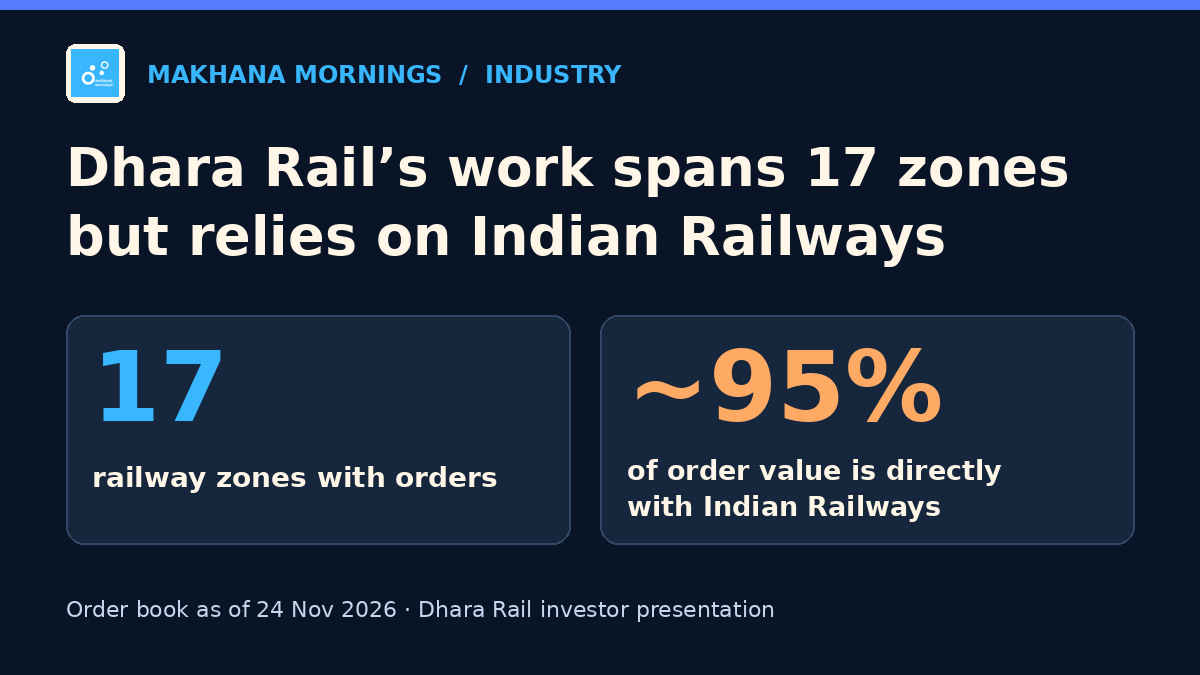
Dhara Rail Projects has work across 17 railway zones, but about 95% of its order book is directly with Indian Railways. Both statements can be true: a contractor can diversify across regions and workshops without diversifying away from its main customer.
A ₹2.46 crore work order disclosed on 24 November shows how the distinction works. Dhara will maintain roof-mounted air-conditioning units on certain self-generating mail and express coaches in Mumbai Division for two years. The equipment cools the passenger cabin; the contract covers maintenance, not the sale of new trains. Although the work is for railway coaches, the company says this particular order came from Daulatram Engineering Services, not directly from the Railways.
A wide spread across zones is not a wide spread across customers
In its 26 November investor presentation, Dhara reported ₹192.81 crore of work still to execute across 85 orders as of 24 November, including GST. Southern Railway was the largest zone by value, with ₹25.46 crore, or 13.2% of that balance. Western and Central Railway each accounted for about 11.4%.
That spread means the contractor’s order book is not dominated by a single zone. But the zones still sit within Indian Railways. If one workshop pushes back a maintenance job, work elsewhere can continue. A change that affects purchasing across the railway network is a different risk.
Work in hand is not the same as revenue already earned
Dhara puts the remaining order book at about ₹163 crore excluding GST. That is future work to deliver, not sales already recorded. It also separately identified ₹83.01 crore of tenders on which it had submitted bids and was still awaiting awards. Those bids do not belong in the secured order book.
For any contractor, look at three things separately: where the work happens, who signs the contract and how much work is still left to complete. Dhara’s example shows why a map can answer the first question while telling you very little about the other two.


Leave your thoughts