
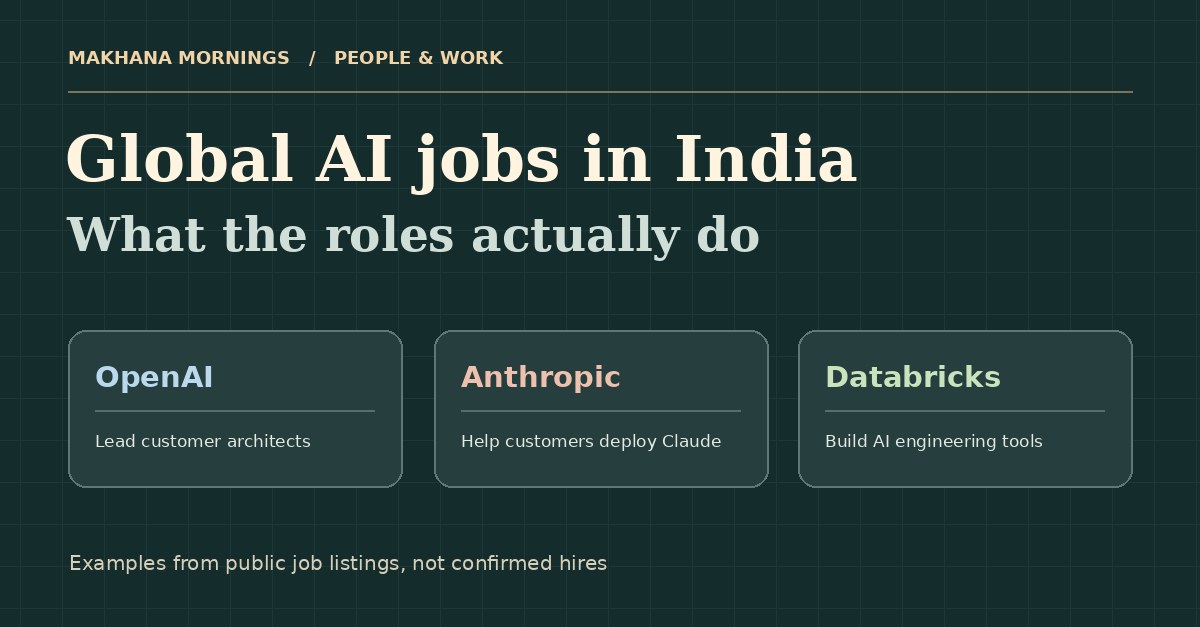
An AI job in India can mean leading a customer-facing technical team, helping an enterprise put a model into use, or building the tools that other engineers use to run AI systems. Public listings reviewed on 20 November from OpenAI, Anthropic and Databricks show those different kinds of work. They describe vacancies, not completed hires.
Helping enterprises put AI to work
OpenAI’s Bengaluru posting for a Manager, Applied AI Architect describes a leadership role in Technical Success. The manager would hire and coach customer-facing architects, decide where to allocate technical resources, and help large customers move from evaluating possible uses to running them in production. The posting gives the team responsibility for the technical approach, while sales leads handle the commercial strategy.
Anthropic’s Bengaluru Applied AI Architect listing describes a customer-facing individual role. It would help enterprises in India and across the Asia-Pacific region assess where Claude fits, design integrations with existing systems and develop tests for how well it works on a customer’s tasks. The company calls it a pre-sales position, but the responsibilities extend through deployment.
Building the tools behind deployment
Databricks lists a Bengaluru Staff Software Engineer opening for a team it says it is building to work on its AI engineering platform. The role would lead technical decisions and build software for tracking experiments, managing model versions and monitoring and evaluating AI agents once they are in use. That differs from owning an individual customer’s rollout: the engineer would build tools that many teams can use.
These postings show where the selected companies want technical ownership to sit. Two focus on guiding customers, including one role that manages the people doing that work. The other focuses on a shared engineering product. None of the three is described as a role training a company’s next large model, and the listings do not establish how quickly the teams will grow or how many people have joined.




Leave your thoughts