
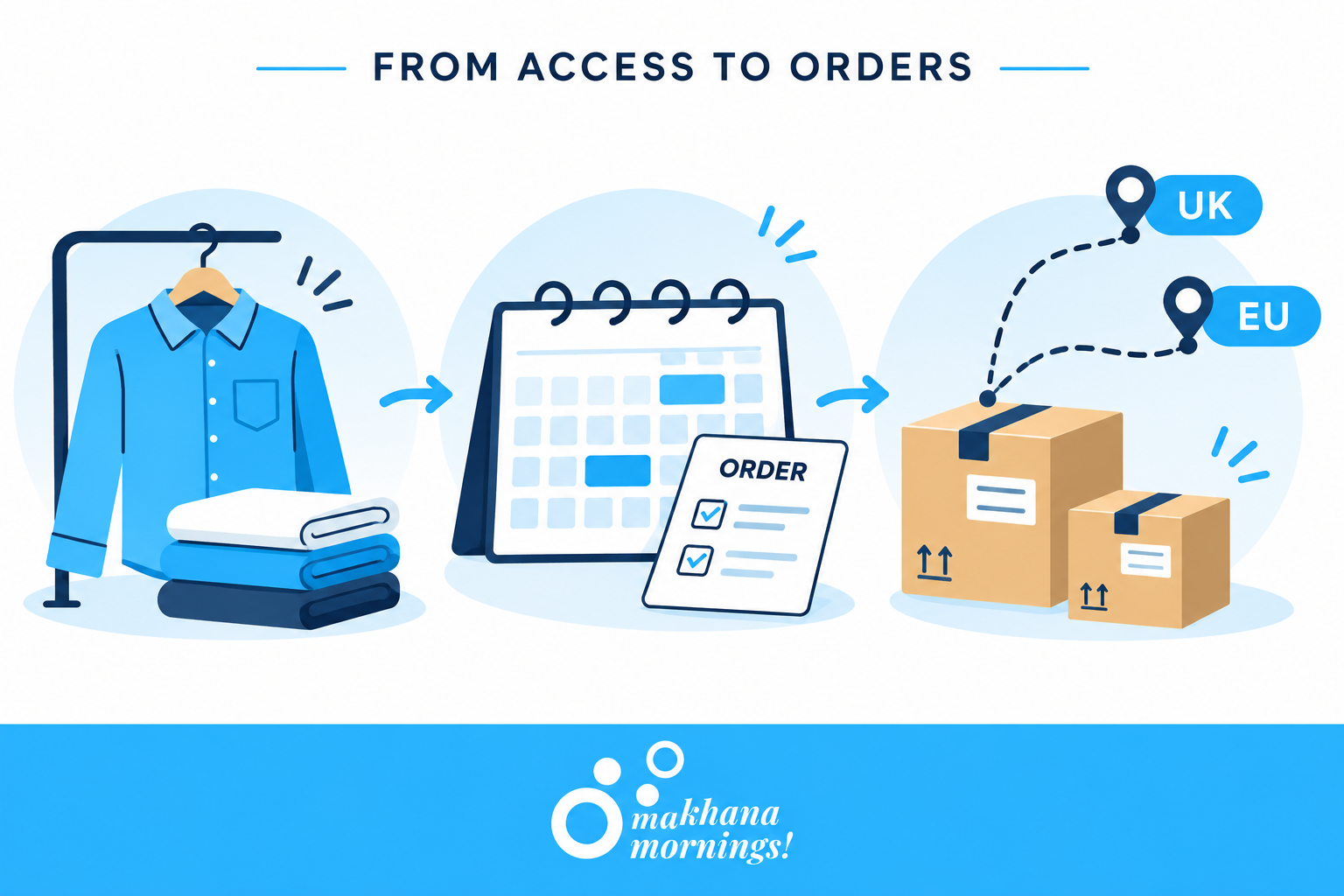
A new destination on an export map is not yet a new order book. For an apparel manufacturer, the harder question is how a change in market access becomes repeat business without weakening profitability.
Gokaldas Exports offers a current example. Its European business, including the UK, accounts for about 15% of revenue, management said on its November 6 earnings call. It envisages that share reaching roughly 25% over four to five years. That is a management ambition, not a completed shift.
The Breakdown
Management said orders are placed four to six months ahead, so the commercial effect of a trade agreement can lag its implementation. It also described plans to expand manufacturing in Bhopal and Ranchi.
The legal timelines are different. The UK–India Comprehensive Economic and Trade Agreement entered into force on July 15, 2026. Preferential treatment still depends on the applicable product schedule and origin requirements.
The EU–India agreement is not at that stage. Negotiations concluded on January 27, 2026, but the European Commission continues to list the free-trade agreement as concluded rather than in force. Its published text says binding effect depends on completing the necessary internal legal procedures. An expected implementation date is not a confirmed one.
Why This Matters
A buyer compares the delivered cost of a garment, not just the factory’s selling price. As an illustrative commercial calculation, a lower import duty can create room for a buyer to negotiate a lower price, a supplier to retain more margin, or both to share the saving. The division depends on the contract; it cannot be inferred from the tariff change alone.
Gokaldas’ management did not describe European customers as automatically more profitable. It said its choice of customers and products seeks to maintain a minimum margin, with broadly equivalent margins on the business it accepts in Europe and the US.
This makes order quality as important as order location. A proposed European contract should be assessed against its product specification, batch size, delivery commitment, payment terms and expected contribution after costs. A larger geographic share can coexist with better, unchanged or worse profitability.
The Big Picture
The company’s November 5 results release reported consolidated total income of ₹1,135 crore for July–September, up 13% from a year earlier. It attributed performance to factors including product mix, productivity and a tariff-affected comparison period. Those figures do not establish that a change in customer geography caused the growth.
Nor should the company’s India and Africa operating-business figures be read as the destinations where customers bought its garments. Where a garment is manufactured and where it is sold answer different questions.
The useful evidence now is the realised customer-market mix, repeat orders, delivery performance and profitability of those orders. These would show whether a diversification plan is becoming a durable business rather than simply a more varied sales presentation.
The Crunch
Market access creates an opening. The order book and its economics will show what the company makes of it.
Related categories: Infrastructure & Manufacturing; Economy & Markets




Leave your thoughts