
An AI system needs somewhere for its heat to go. Buying computing equipment and preparing a building to run it are connected decisions, but they are not the same purchase.
NSE’s November 9 announcement offers a concrete Indian example. The exchange says it has deployed direct-to-chip liquid cooling in its on-premises data centre to support AI workloads.
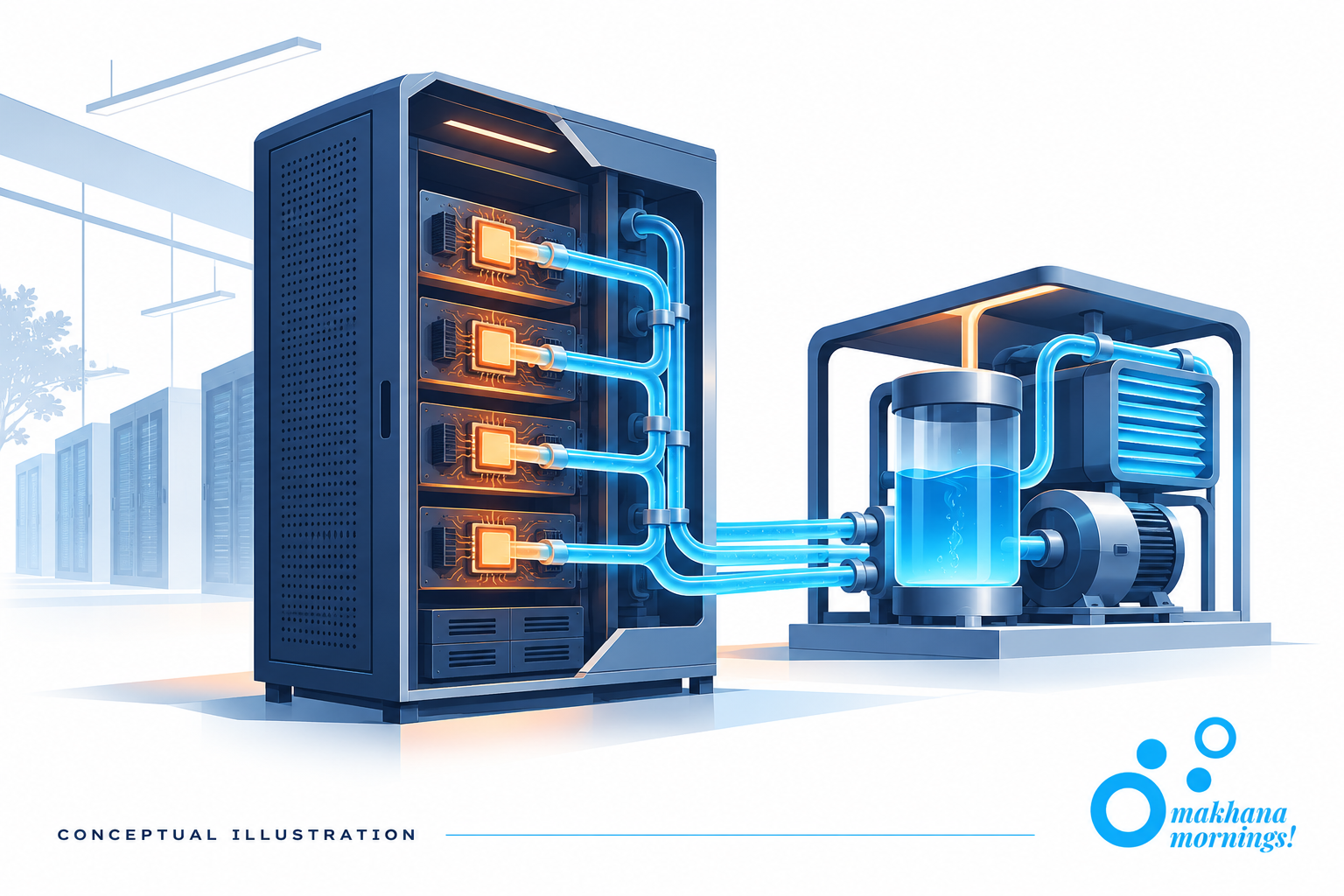
Cover: an original AI-generated conceptual illustration, not NSE’s equipment or an engineering schematic.
Breakdown
NSE says multiple graphics processing units, or GPUs, are already deployed. It plans to expand beyond 80 during the current quarter, while the cooling infrastructure is designed to scale to 224. The last figure is a design capacity, not a count of GPUs already installed.
The exchange also plans to extend the technology to its co-location data centre according to market participants’ needs. That is a future step, not a completed rollout. The announcement does not identify GPU models, equipment utilisation or measured energy and water savings.
Where the heat goes
Direct liquid cooling moves heat from computing equipment into a circulating liquid loop rather than first transferring it to room air. A coolant distribution unit can pass that heat into another cooling circuit. The facility must then remove the heat through its wider cooling system.
There is more than one arrangement. Some systems use chillers, and others combine air-cooled heat removal with cooling towers. A closed loop near the computing equipment therefore does not establish that the entire facility consumes no water. Nor does the phrase “liquid cooling” specify which arrangement NSE uses.
Why This Matters
For an organisation expanding AI infrastructure, the planning question is not simply how many processors it can buy. It must also decide how the equipment and the facility will work together, including how the cooling system will be operated and monitored.
There are two different tests for an efficiency claim. One asks how much energy cooling requires for a given computing load. The other asks how much energy the entire facility uses. Better performance on the first does not automatically mean a lower total on the second if the computing workload grows.
The Big Picture
This is a physical-infrastructure story, separate from the quality of an AI application’s answers. A cooling deployment does not establish better trading performance, more accurate market analysis or the success of a particular software product.
The Crunch
Follow the heat as well as the hardware. Design capacity, installed equipment and measured operating performance answer different questions. A useful assessment keeps all three in view.




Leave your thoughts