
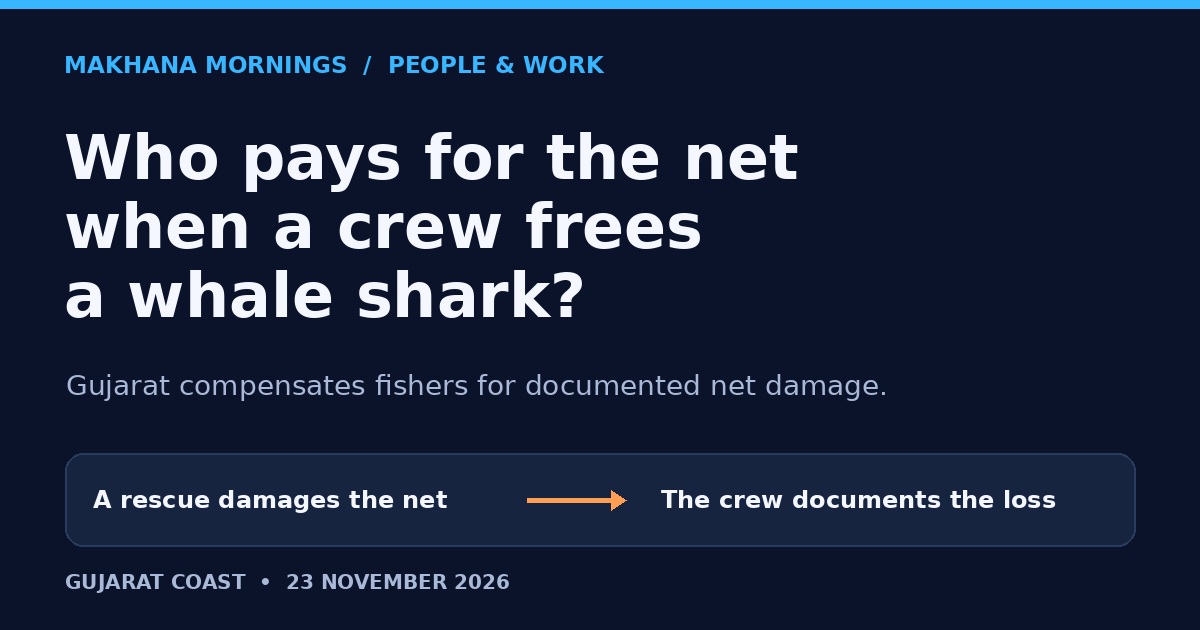
When a whale shark gets caught in a fishing net, freeing it can mean cutting the very equipment a crew needs to earn a living. Gujarat has a compensation scheme for damaged nets that helps shift some of that cost away from fishers. On 23 November, the Union environment ministry recognised a fishing cooperative in Mangrol with a Community Conservation Award for its work protecting whale sharks. The award is new; the compensation scheme is not.
A rescue can leave a crew with a repair bill
In one documented rescue off Veraval, a member of the fishing crew alerted the Gujarat Forest Department and the Wildlife Trust of India. A joint team assessed the animal and cut through the net to release it. That was a separate rescue, not one attributed to the award-winning Mangrol cooperative. It shows why the cost is immediate: even if the animal swims free, the crew still has damaged gear to repair or replace.
Gujarat pays for documented net damage
The state first announced compensation for damaged nets in 2006. Under a project run with the Gujarat Forest Department and Tata Chemicals, the Wildlife Trust of India distributed cameras so fishers could document rescues for the department. A forest official quoted in the Veraval case said Gujarat revised the compensation limit from ₹25,000 to ₹50,000 in February 2024. That figure was a ceiling reported for the programme, not a flat payment for every rescue.
A release count is not a population count
The Wildlife Trust of India, which helps run the project, reported more than 1,000 releases from accidental entanglements in Gujarat between 2004 and June 2025. That is a record of releases reported by the programme. It does not tell us how many animals survived later, whether the population grew, or how many rescues would have happened without compensation.
The useful distinction is between asking a crew to protect an animal and deciding who should pay when the crew does. Gujarat’s scheme targets an identifiable loss: the fishing net. It is not a payment for catching a whale shark, and it does not establish that every cost of a rescue is covered.

Leave your thoughts