
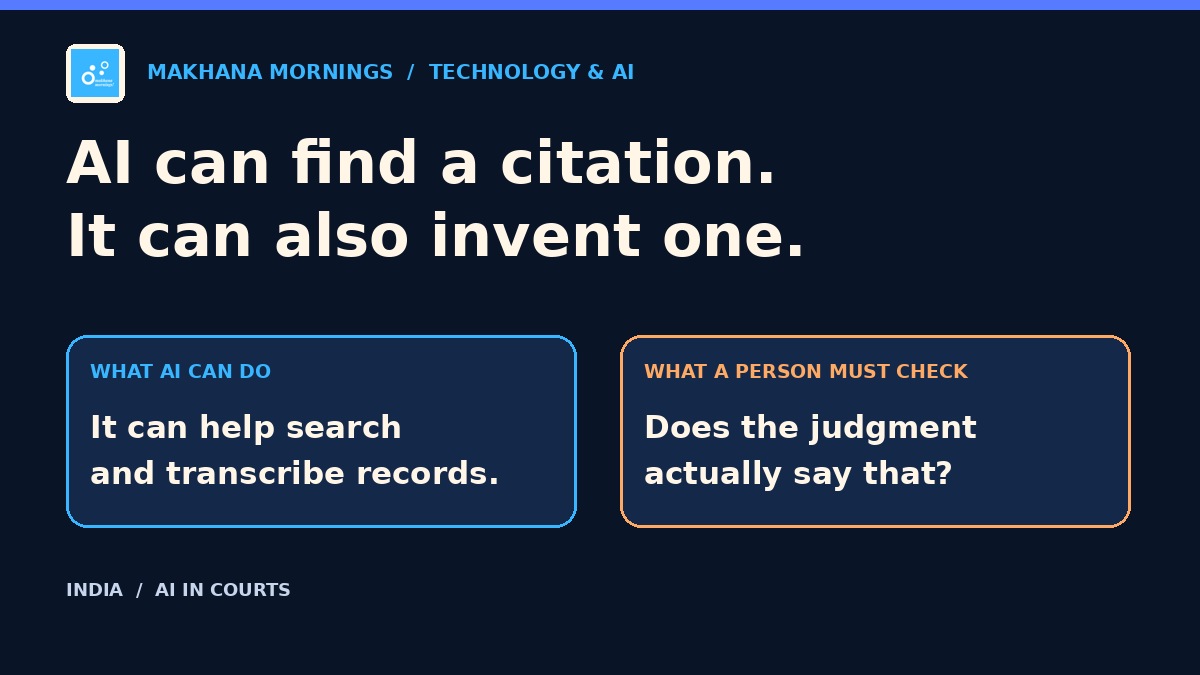
An AI tool that turns a judge’s dictation into text can save typing. An AI tool that suggests a case citation can create a different problem: the judgment may exist, but the paragraph it attributes to that judgment may not. The first tool helps produce a record. The second can change the reasoning in it.
Speaking at a legal technology summit in New Delhi on 28 November, former Chief Justice of India D. Y. Chandrachud argued that courts should use AI for support work while leaving decisions with judges. He singled out bail: a probability score, he said, should not decide whether someone loses their liberty. It was a policy argument, not a new court order.
Checking the citation is only the first step
The Supreme Court’s July judgment in an insolvency dispute shows why a quick search for the case name is not enough. The Court found that some authorities relied on by a tribunal did not exist and that other citations pointed to real decisions but were paired with passages that did not exist. It set aside the tribunal and appellate tribunal decisions and returned the insolvency application to the tribunal for a fresh decision. It did not ban legitimate AI assistance.
That distinction matters in a law firm or an in-house legal team. Finding a case and checking what it actually says are separate jobs. Before relying on a suggested precedent, the person reviewing it needs to open the original judgment, find the relevant passage and confirm that it supports the proposition in the draft.
Courts are already testing uses that help with the work
The Department of Justice told Parliament in March that an internal legal research assistant, LegRAA, had been developed to help judges find and analyse documents. Another tool, Digital Courts 2.1, included speech-to-text and translation to help with dictation. That reply described controlled pilots, not a nationwide rollout or proof that AI had reduced the backlog.
The Supreme Court’s AI committee separately published draft regulations for consultation in June. The draft would prohibit risk scoring for bail eligibility and other court processes, and keep judges responsible for decisions. It also proposes that courts be able to ask how material prepared with AI was checked. These are proposals in the published draft, not a newly implemented rule.
The useful test is whether someone can check the output
A transcript can be checked against what was said. A suggested citation can be checked against the original judgment. A score that claims to predict what someone will do if released does not have an equivalent source to open and check before the decision. The value of a legal AI tool depends as much on how its output can be verified as on how quickly it generates a result.


Leave your thoughts