
Look at a television in a shop. Its brand, engineers, factory and display suppliers need not belong to the same company. The box compresses that network into a few words.
For India, understanding that network matters more than winning an argument over whether a device is “made” or “only assembled” here. Assembly is manufacturing: the UN’s industrial classification explicitly includes making products from purchased components. The useful questions concern which work takes place locally, what capability it creates and how much value it adds.
In a July 2026 parliamentary reply, the electronics ministry reported electronics production of about ₹13.11 lakh crore and exports of ₹4.24 lakh crore for FY2025–26. Those are substantial production and trade flows. They do not, by themselves, reveal the Indian contribution inside each product.
In pictures
Swipe or scroll through the visual summary. The full explanation continues below.

Inside a made-in-India device
One label. Several kinds of work.
Makhanas Unpacked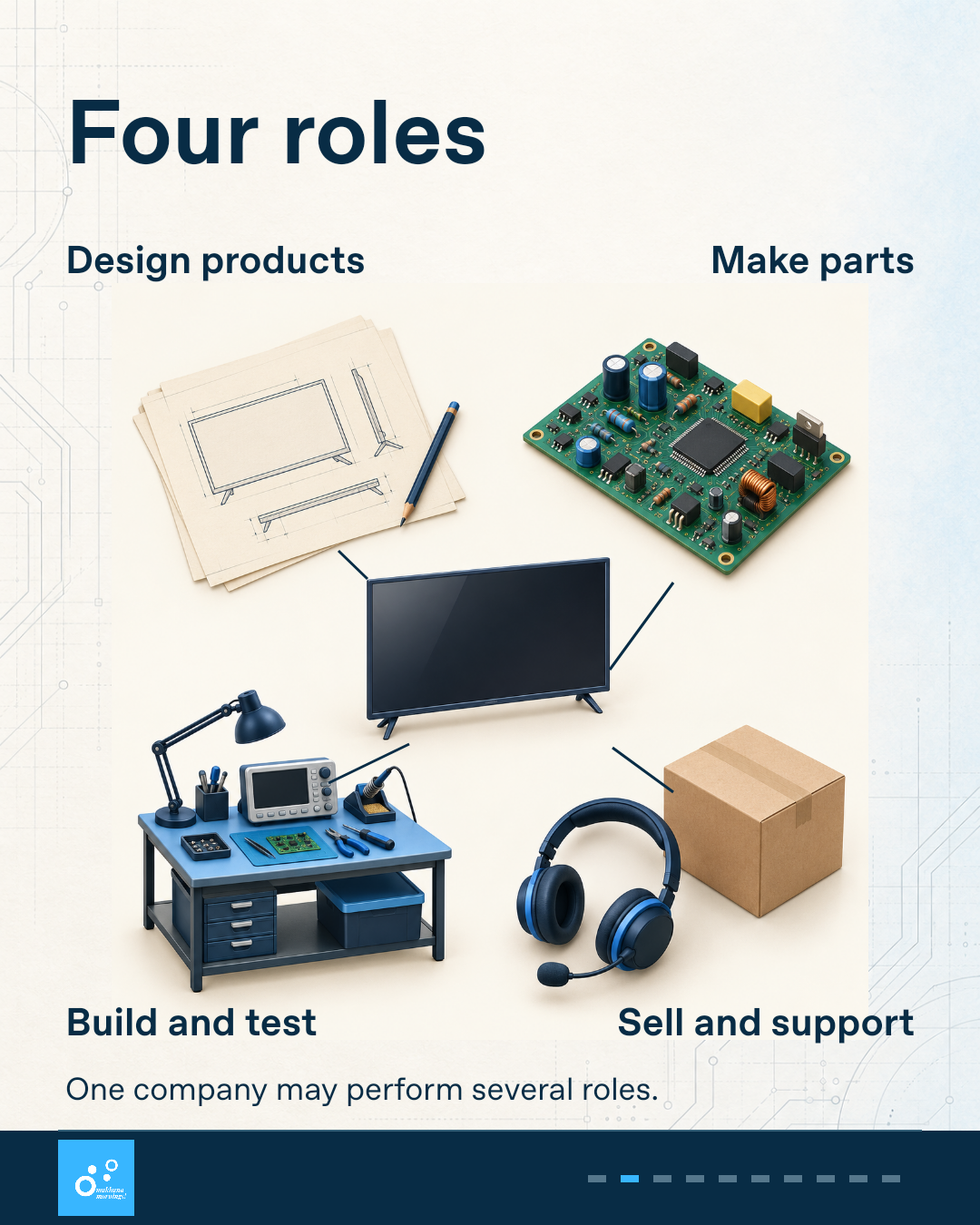
Four roles
Design products
Make parts
Build and test
Sell and support
One company may perform several roles.
Assembly is manufacturing
Bare board → components fitted and soldered → assembled board
Making the board and assembling it are different production operations.
An illustrative ₹100 export
₹60 imported parts
₹20 local subassembly
₹20 added by final factory
Invented, not a real device.
Local value, traced
₹20 subassembly = ₹10 imports + ₹10 local value.
Indian value added: ₹20 from final factory + ₹10 from local supplier = ₹30.
Includes pay, not just profit.
Illustrative; no taxes or distribution.
Now ask who brings the design
Local value is one question; responsibility is another.
Cyient DLM describes two routes:
Build-to-print: customer supplies the design.
Build-to-specification: supplier designs to customer requirements and manufactures.
A factory can help shape the product
Dixon’s FY26 report says most TV volumes use original design manufacturing (ODM): helping develop and build products for another brand.
Its TV software-platform integration does not mean it owns those platforms.
More responsibility brings more risk
Design spending may come before firm orders.
Cancelled orders can leave stock and idle capacity.
Flex’s FY2026 filing describes these risks.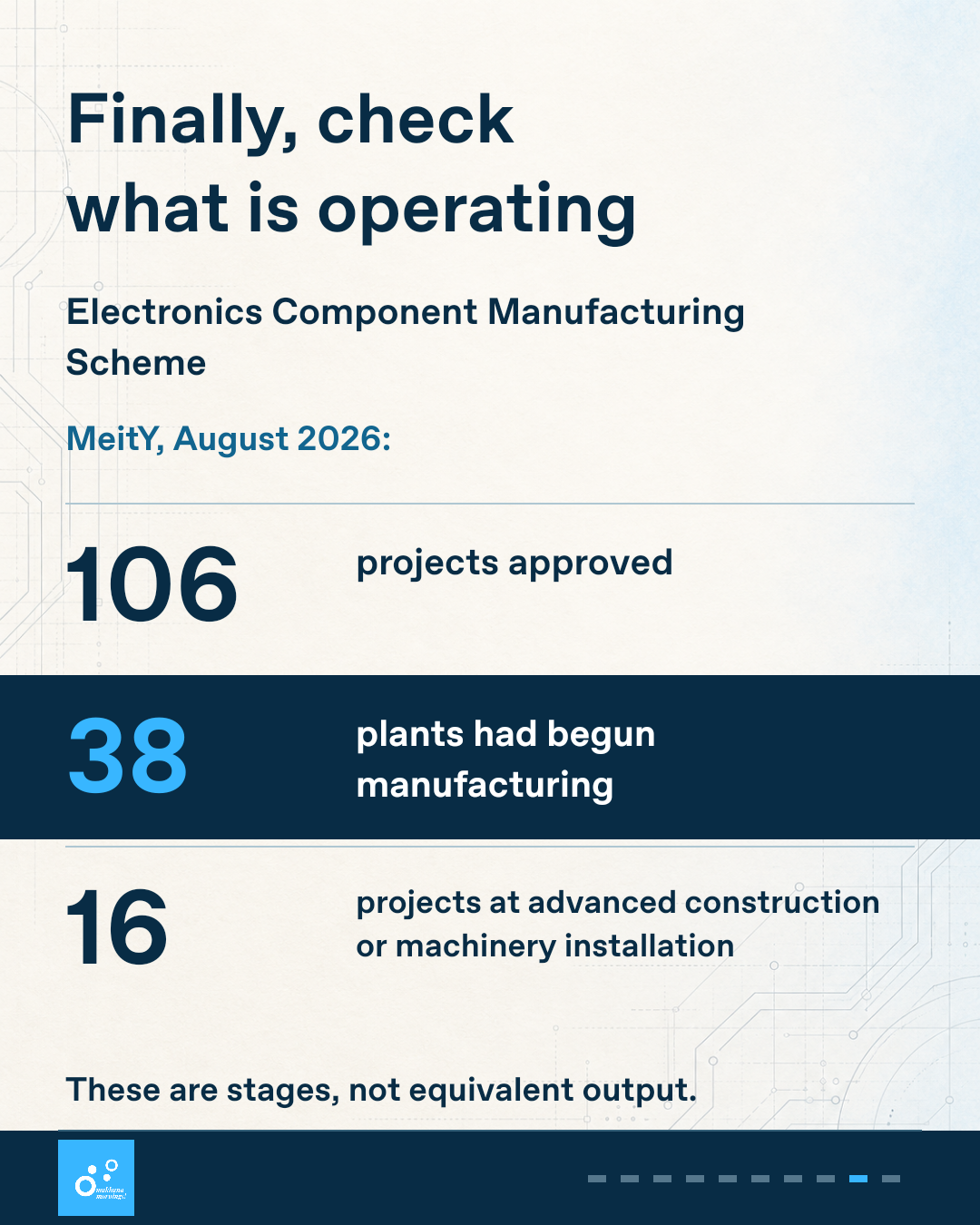
Finally, check what is operating
Electronics Component Manufacturing Scheme
MeitY, August 2026:
106 projects approved
38 plants had begun manufacturing
16 projects at advanced construction or machinery installation
These are stages, not equivalent output.
Ask three questions
What work operates here?
What value does it add?
Who controls the product decisions?
Competitive specialisation can be valuable without making every part locally.
Read the full explainer at makhanamornings.com
A device is a network of businesses
A device needs product design, components, manufacturing and a route to buyers. One business may perform several roles; others specialise.
Even “making a circuit board” can describe different work. A bare printed circuit board is manufactured first; components are then mounted and soldered onto it. The assembler needs both a list of parts and instructions for where they go. Component selection, placement, soldering and inspection must work together. Buying the bare board while assembling it locally still involves manufacturing, but it does not establish that the board or its chips were also produced locally.
This is why a single ladder from “basic assembly” to “advanced design” can mislead. A supplier may become excellent at a demanding production process without launching a consumer brand. A design business may serve global customers without owning a factory. The question is what it can reliably do, and what customers are willing to buy from it.
The design file changes the relationship
Cyient DLM distinguishes build-to-print, where the customer supplies a product design, from build-to-specification, where the supplier designs and manufactures to customer requirements. The latter extends its development responsibility, through testing against requirements. That does not automatically transfer ownership of the customer’s brand or every piece of intellectual property.
Dixon’s FY2025–26 annual report offers a consumer-electronics example. The company says most of its television volumes are now based on original design manufacturing, or ODM. It describes capabilities across platforms including Google TV, Tizen, Fire TV, webOS and Linux. Under this model, a manufacturer helps develop products that another brand sells. The disclosure does not mean Dixon owns those operating systems.
Consider a customer requesting a different screen size and lower power use. Someone must choose compatible parts and software, test performance and make production economical. Agreements determine who can reuse the design, approve substitutions or sell it elsewhere.
More responsibility also carries costs. Global manufacturer Flex’s FY2026 filing warns that it may spend on design before receiving firm purchase commitments. A technically successful design can still fail to generate enough sales to recover the investment. The same filing describes how customer cancellations can leave manufacturers with inventory and underused facilities. These are disclosed risks of the business model, not a prediction about Dixon or Cyient DLM.
Follow the value, not just the invoice
Domestic value added measures local contributions after tracing imported content throughout the chain, including imports in local purchases.
An invented ₹100 export: the final factory uses imported parts costing ₹60 and a locally purchased ₹20 subassembly, adding ₹20. That supplier imports ₹10 and adds ₹10. Indian value added: ₹30; imports: ₹70. Assume no other inputs, repeat border crossings, taxes or distribution margins.
Value added also differs from profit. It includes the income generated in production, including employee compensation. And “domestic” describes the economy in which the contribution arises, not the nationality of the shareholders: a foreign-owned factory can contribute to India’s domestic value added. Who ultimately receives its profits is a separate question.
Technology, design and branding can influence commercial returns. WIPO’s 2017 smartphone study also distinguishes value capture from pure profit: it includes money to fund research, marketing and other costs. A retail price minus a parts bill is therefore an incomplete profit calculation.
More local parts must work commercially
An Indian component supplier needs a reason for customers to keep ordering. A nearby factory can help, but demand must be large and dependable enough to support equipment, skilled people and process development. NITI Aayog’s 2024 electronics study identified input costs, logistics and financing among the obstacles to competitiveness. These are reasons to examine the economics of each component, rather than assume proximity alone will make it cheaper.
Imagine a new connector plant built to serve one device model. If that model sells poorly, the plant may struggle to spread its fixed costs across enough units. Serving several customers could make the investment more resilient, provided their specifications can be met. Conversely, buying a competitively priced imported component can help an Indian manufacturer win orders for the work it already does well.
The aim need not be a device with every input sourced within one border. Useful progress can include better production processes, competitive components, stronger engineering or a product brand that customers choose. Each route requires investment and has different risks. Increasing the local share at a cost that destroys demand would not necessarily increase the total value created in India.
India’s Electronics Component Manufacturing Scheme supports a wider supplier base, including circuit boards, subassemblies and production equipment. Its progress needs careful reading. In August 2026, MeitY reported 106 approved projects and said 38 plants had begun manufacturing, with another 16 projects at advanced construction or machinery-installation stages. Those dated categories describe different stages of execution.
A scheme approval records a project’s acceptance into the programme; a manufacturing start shows that production has begun. Assessing its contribution still requires product-level evidence: output that meets customer specifications, recurring orders and the imported inputs used. Neither the number of approvals nor announced annual capacity supplies those answers.
Read the next factory announcement differently
Start with three questions. What work is actually operating here? What value does that work add after purchased inputs? What decisions and commercial responsibilities does the business control? Then look for evidence over time: usable output, repeat customers, engineering capability and returns that justify continued investment.
The Crunch
India can gain from assembling devices, supplying their parts and helping design them. The gains become clearer when production scale, domestic value added and commercial control are examined separately. The strongest story is a capability that customers keep paying for, wherever the rest of the supply chain happens to be.