
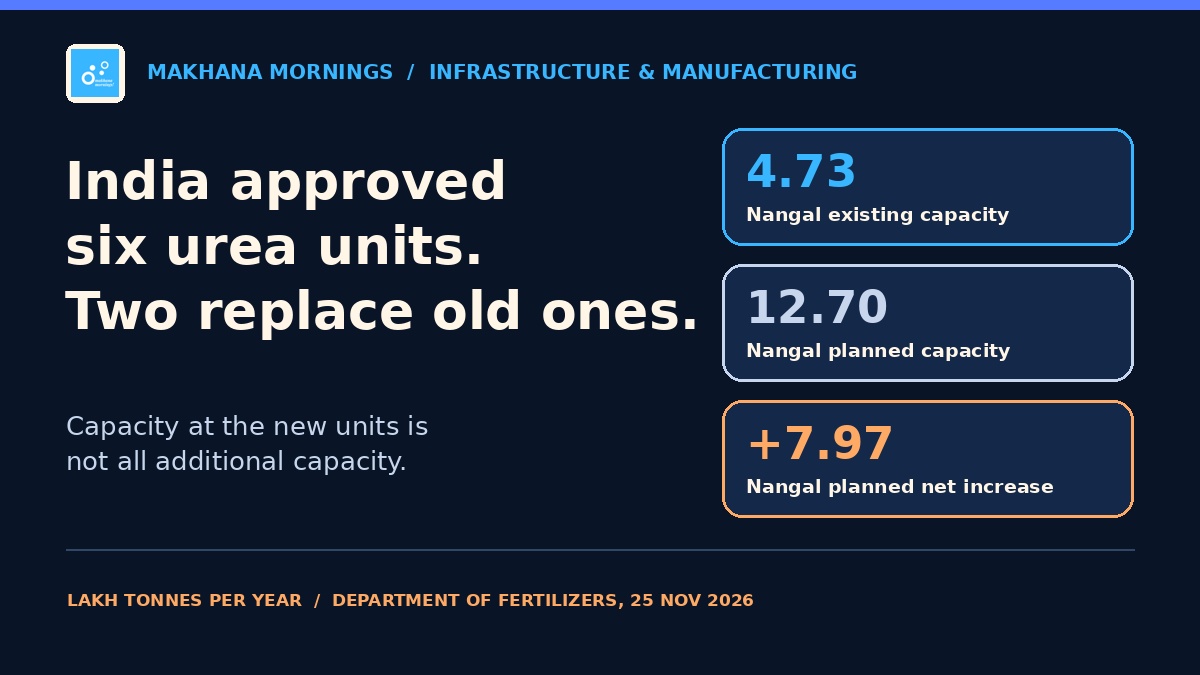
Six new urea units do not mean six full units’ worth of extra capacity. Two of the projects approved by India’s fertiliser ministry replace plants that already make urea.
The ministry announced the six approvals on 25 November under its 2026 investment policy for urea. Each unit is designed for 12.7 lakh tonnes a year. That adds up to 76.2 lakh tonnes of planned capacity across the new units. It is not the net increase over what the six sites can produce today.
What changes at Nangal
At Nangal in Punjab, the new unit would be able to make 12.7 lakh tonnes a year, compared with 4.73 lakh at the plant it replaces. That is 7.97 lakh tonnes of additional annual capacity. Madras Fertilizers lists its existing Chennai capacity at 4.87 lakh tonnes in its latest annual report, so that replacement would add about 7.83 lakh tonnes a year. The projects in Shahjahanpur, Panagarh, Gadepan and Jagdishpur expand existing sites. If those four add their full stated capacity and both old units retire, the six projects imply a net gain of about 66.6 lakh tonnes a year, not 76.2 lakh. That is a capacity estimate, not a production forecast.
Capacity is not output, and approvals are not spending
The ministry put the estimated investment at about ₹54,000 crore, using a cost benchmark of about ₹9,000 crore per project. That estimate is not money already spent. Nor do the approvals say when the plants will begin supplying farmers or how much they will produce in their first year.
The ministry puts annual consumption at around 400 lakh tonnes and reports domestic production of 293.3 lakh tonnes in FY2025–26. Those figures explain why more domestic supply matters, but subtracting one from the other does not give an exact import total. The consumption figure is approximate, and imports and inventories are separate measures.
The short-term supply picture runs on a different timetable. On 27 November, National Fertilizers invited bids on the government’s behalf for 15 lakh tonnes of imported urea, with 8 lakh tonnes intended for west-coast ports and 7 lakh for east-coast ports. The quantities can change. Bids close on 8 December, and 31 January is the deadline to ship from the loading ports, not the date the fertiliser reaches farmers. The tender is not an award; its final volume, price and arrival dates are not yet known.
What to watch next
Follow two dates at the replacement sites: when the old unit stops and when the new one can reliably produce. For all six, look for actual output and deliveries after commissioning. Those figures will show how much extra urea reaches the market, which the approval alone cannot tell us.
Related category: Economy & Markets




Leave your thoughts