
A village can have a tap in every home and still lose its water supply when a pump fails. Someone has to identify the fault, get a replacement part and pay for the repair. Installing a connection does not settle who does that work.
Jal Jeevan Mission 2.0 is trying to address one part of that problem. On 25 November, the Department of Drinking Water and Sanitation signed an agreement with the Directorate General of Training to train and certify at least one lakh candidates in operating and maintaining rural piped water. The department estimates an outlay of about ₹111.93 crore for the training programme.
The course is built around the system, not just the tap
The 165-hour course pairs 120 hours of instruction with 45 hours of training at functioning rural water schemes. It is an optional course for current and former fitter and plumber trainees at participating government training institutes. It covers pumps, basic electrical work, distribution pipes and water-quality monitoring.
A plumber might handle a leaking connection. If pressure drops across several lanes, the fault might instead be at a pump, valve or main. The training is designed to give operators enough familiarity with the whole system to decide what to check first.
Damaged pipes and pump failures were the most common reasons
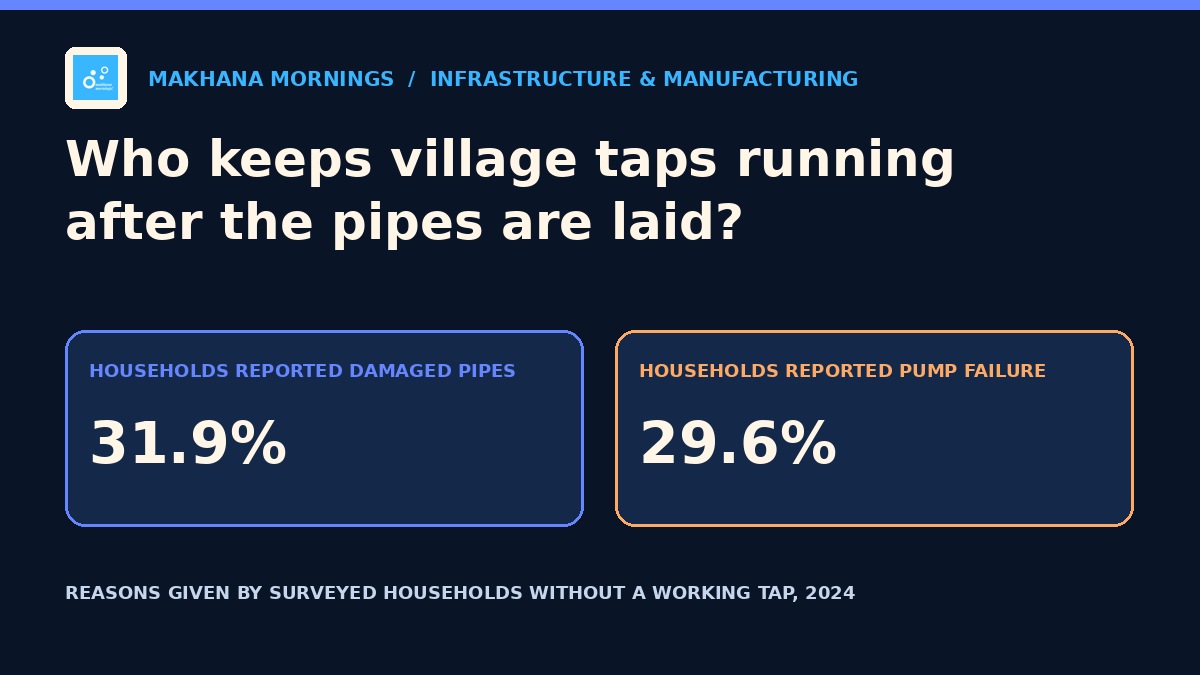
The 2024 Jal Jeevan Mission survey covered 237,608 households in 19,812 Har Ghar Jal villages. Among respondents asked why their tap did not work, 31.9% cited damaged pipes and 29.6% cited pump failure. The answers are household reports from that survey, not national outage rates or an engineering audit.

See this graphic in One Chart.
A training certificate is not a maintenance budget
At a regional conference that ended in Agra on 27 November, officials discussed how Gram Panchayats and local communities can take responsibility for running water systems. The training agreement calls for a list of certified candidates to be made available to districts and village councils. States and Union Territories can engage workers according to their rules and needs. One lakh is a training target, not a count of hires or a promise of paid jobs.
Amarpur in Haryana’s Palwal district offers one example of how to pay for smaller repairs. At a June 2026 government forum, village representatives said they collected ₹7,000 to ₹8,000 a month in water charges and used the money for pipeline maintenance and leak repairs. In a system that serves several villages, the national maintenance manual’s model leaves local pipes with the village council and shared pumps and mains with the public engineering department or water board. Exact responsibilities and budgets vary by scheme; Amarpur’s collections do not show that a village can pay for a major pump replacement.
The practical question is what a village council can do when a pump stops. A trained operator can diagnose a fault, but someone still needs the authority and funds to buy the part or call in a specialist. The results to look for are how many trained people get paid work, how long faults take to fix and how reliably water reaches homes after the handover.



Leave your thoughts