
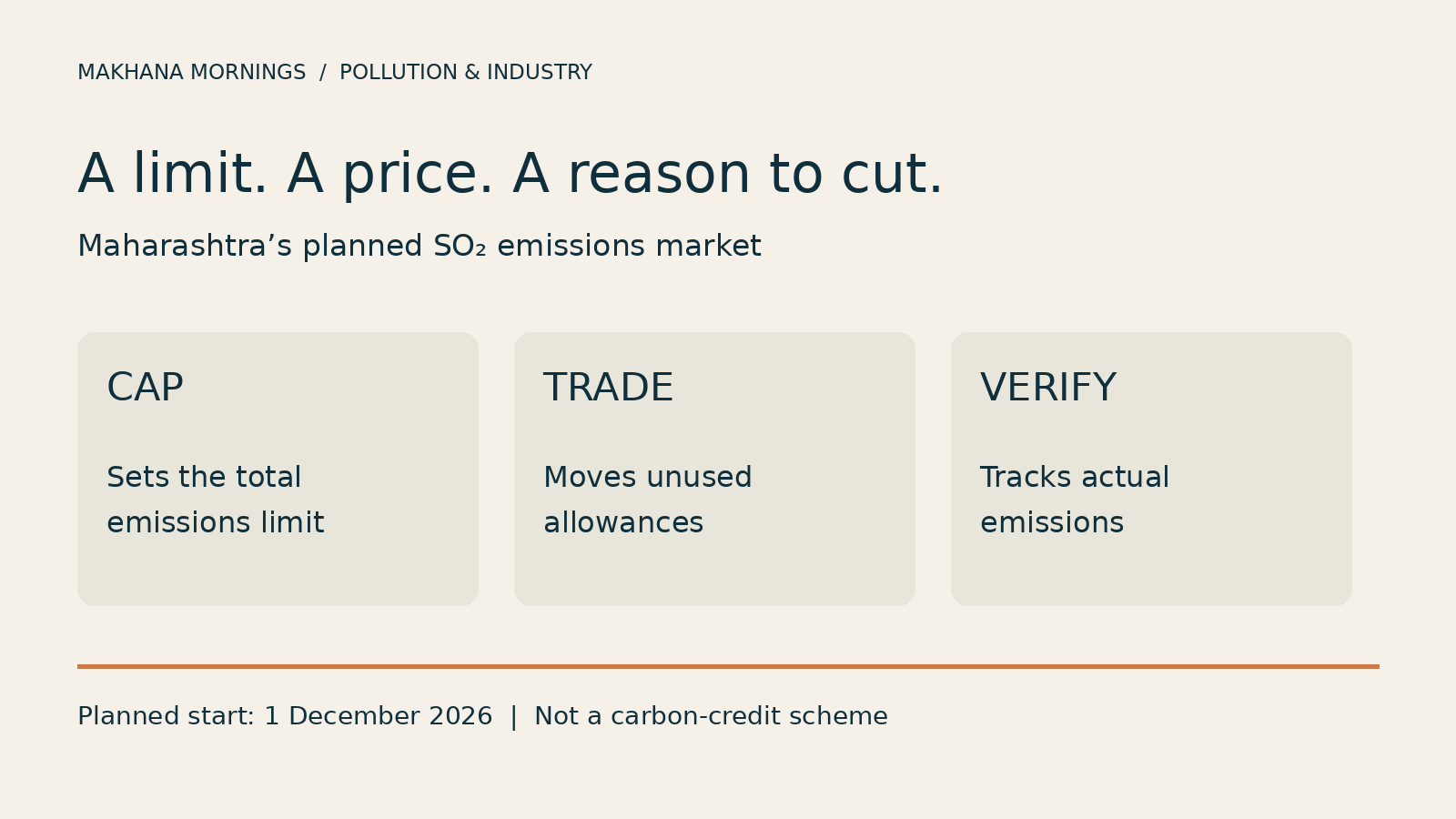
Maharashtra’s planned sulphur dioxide trading market changes the financial incentive for industrial pollution control. Under the model, a plant that cuts emissions can sell unused allowances, while another can buy allowances to cover its emissions within the market’s overall limit.
The Energy Policy Institute at the University of Chicago, whose Emissions Market Accelerator is helping run the scheme, said in a November 16 announcement that trading is due to launch on December 1. It describes coverage of 104 industrial facilities across 17 sectors. That is a planned market start, not evidence that participating factories have already reduced pollution.
The cap and the trade do different jobs
The cap limits aggregate emissions across participating plants. Trading gives plants flexibility over where reductions happen: a facility that can reduce pollution cheaply has an incentive to do more and sell spare allowances. A higher-cost facility can buy permits instead, but those purchases do not remove the overall cap.
This is a market for a specific air pollutant, sulphur dioxide, rather than a carbon-credit programme. It should not be confused with India’s separate carbon-market framework. Evidence from other pollution markets offers context, not a guaranteed result for Maharashtra.
Inspection targeting is a separate initiative
Alongside the market announcement, the Maharashtra Pollution Control Board and the University of Chicago Trust have agreed to develop and test an AI-assisted inspection approach. The university’s November 16 description says the project will help identify facilities regulated under the Air Act for inspection. Wider coverage remains conditional on the pilot succeeding.
Selecting a site for inspection is not the same as finding a violation. Nor does an AI risk score replace evidence, an inspector’s work or the applicable regulatory process. The announced purpose is to direct scarce inspection resources, not to automate penalties.
The two initiatives therefore address different tasks. The market changes the incentive to reduce emissions; inspection targeting helps decide where to look. Neither can be assessed simply by counting permits traded or inspections scheduled.
The evidence to watch
For the market, useful evidence will include verified emissions, compliance with the cap and the cost of achieving reductions. For the inspection pilot, the relevant test is whether targeting improves detection compared with the existing approach, not whether a model can produce a ranking.
Our reading is that measurement connects both programmes. A permit price is meaningful only when emissions and compliance are credibly tracked. For businesses, the announcement makes pollution-control costs and data quality part of the same operating decision; it does not yet establish a measured reduction in either costs or pollution in Maharashtra.


Leave your thoughts