
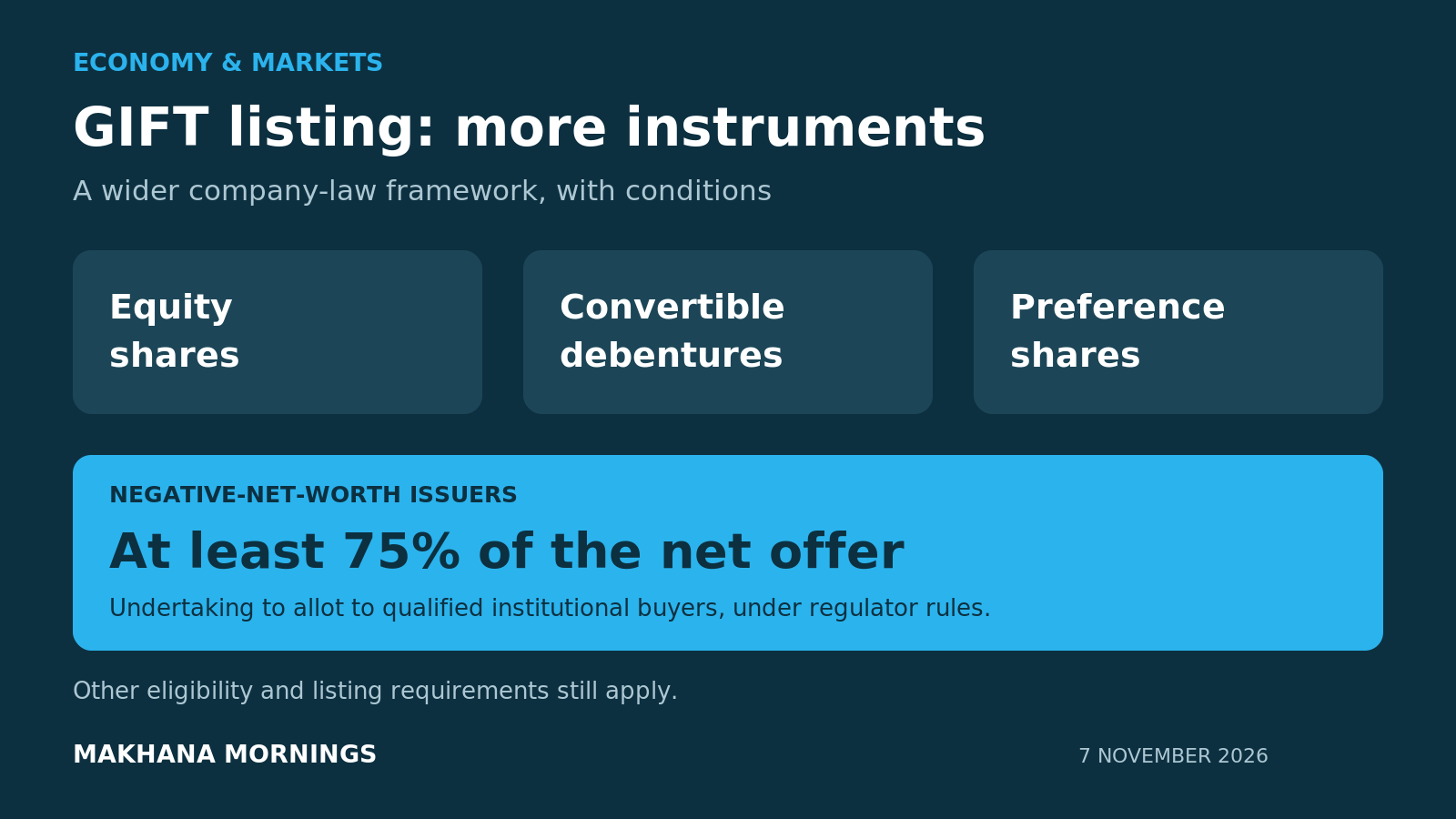
The Ministry of Corporate Affairs has widened the company-law framework for listing Indian companies’ securities on GIFT City’s international exchanges. The rules now cover equity instruments, including equity shares, convertible debentures and preference shares, rather than equity shares alone.
The amendment is dated November 3 and takes effect upon publication in the Official Gazette. It also changes several eligibility conditions, including a conditional route for companies with negative net worth.
The Breakdown
The permitted exchanges named in the framework remain India International Exchange and NSE International Exchange, in an International Financial Services Centre in India. The amendment does not open listing on any overseas exchange a company chooses.
A company with negative net worth can qualify under the revised provision if the issuer undertakes to allot at least 75% of the net offer to qualified institutional buyers, in accordance with the relevant securities regulator’s rules. The threshold applies to the net offer. It is not evidence that institutional investors have committed to buy it.
For specified creditor-payment defaults, the company must first make good the default and then wait until more than six months have elapsed since doing so. The earlier waiting period was two years. This covers dues to banks, public financial institutions, non-convertible-debenture holders and other secured creditors.
Annual-return and financial-statement filing defaults are treated separately: the restriction now refers to a default that has not been made good. The creditor-default waiting period should not be read across to these filing defaults.
More options, with conditions attached
The rules separately cover unlisted public companies within IFSC jurisdiction, subject to the IFSCA Act and regulations under it. Other eligibility restrictions and applicable listing requirements remain. The prospectus-filing form, LEAP-1, has also been replaced.
For a business planning a fundraise, a wider choice of instruments can matter because investors do not all want the same rights or economic exposure. Choosing an instrument means deciding how its terms fit the company’s financing needs and what an investor is being asked to accept.
The negative-net-worth provision makes institutional participation central to that particular route. A company still needs to present a credible case about its operations, finances and proposed terms. Regulatory eligibility cannot establish the price investors will pay or the amount an offer will raise.
The Crunch
The change gives eligible issuers more room to structure a listing within the GIFT framework. The practical test is whether an issuer can meet all applicable conditions and attract demand on workable terms.
A broader set of permitted instruments and a shorter post-cure waiting period can change financing options. They do not, by themselves, deliver a completed listing or fresh capital.



Leave your thoughts