
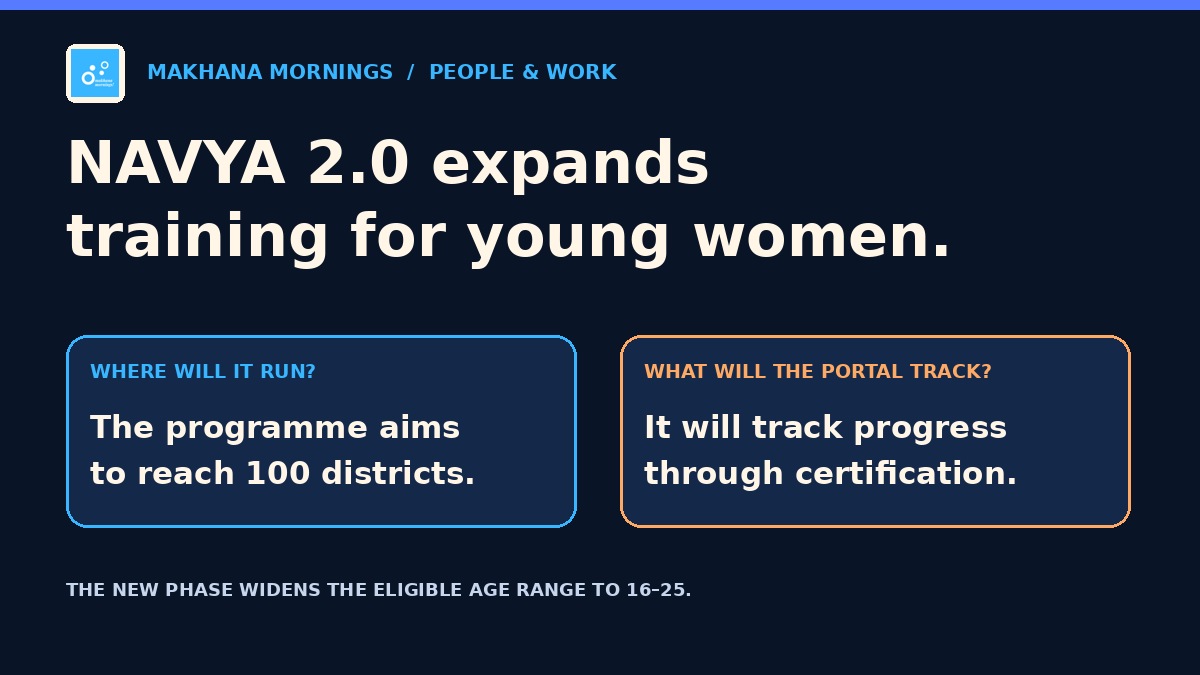
A training certificate can tell an employer what someone learned. It does not tell us whether she started a job. That distinction matters for NAVYA 2.0, the vocational programme for adolescent girls and young women that India’s women and child development and skills ministries launched in Haridwar on 28 November.
The new phase widens the age range from 16–18 to 16–25 and plans to reach 100 districts across 24 states and Union Territories, with a focus on underserved areas. The launch did not announce course start dates for every district or a single enrolment window.
What the programme will track
District officials received a common operating procedure in October. The ministries say the Skill India Digital Hub will track registration, attendance, training progress and certification. A district can use that information to see whether a participant made it through training. A digitally verifiable certificate also gives her a way to show an employer what she completed.
The pilot trained girls for roles such as drone assembly technician and solar installation helper. A government factsheet recorded 1,105 girls trained by 31 August 2026. That is a training count from the first phase, not a count of people who found work, and the pilot’s course list is not a promise that every new district will offer the same options.
What would show that training led to work?
A district could report how many people completed training, then how many of those completers started a job, a paid apprenticeship or a business. A follow-up after three or six months would answer a different question: how many were still working? Publishing both counts, with the number of completers as the denominator, would make it easier to compare results without mistaking a larger batch for a better outcome.
The Crunch
NAVYA 2.0 gives more young women a route into training and gives districts a way to track progress through certification. The next test is whether participants can use what they learned to find and stay in work.



Leave your thoughts