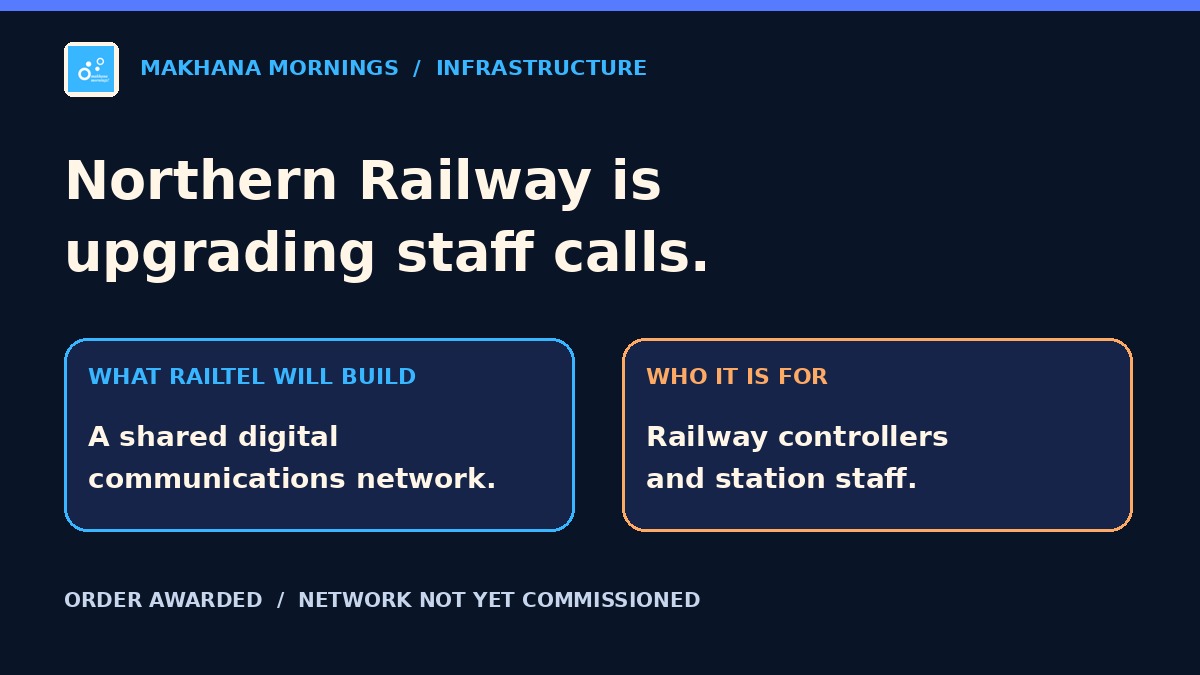
When a railway controller needs to speak to a station, that call depends on the railway’s communications network. Northern Railway has awarded RailTel an order to build a shared digital backbone and carry those control calls over it.
RailTel disclosed the letter of acceptance on November 28. It puts the estimated order value at ₹145.75 crore including tax and lists November 26, 2027 as the execution deadline. The award covers supply, installation, testing and commissioning. That is an order to do the work, not evidence the network is already operational.
The railway is changing how it carries staff calls
Voice over Internet Protocol, or VoIP, sends voice as digital data. It can run on a private railway network without sending staff calls through the public internet. The shared backbone is the communications layer that carries those calls and can support other authorised services. It is not a system that decides whether a train may proceed.
The Railway Board adopted this backbone technology in 2020 for new or replacement railway telecom projects. A proof-of-concept test used by the railway’s standards body asks vendors to show that a controller can actually establish a call with an intermediate station. That is a more useful distinction than whether the equipment has simply been delivered.
This order is for railway operations, not passenger Wi-Fi
The disclosure is about Northern Railway’s backbone and control communications. It does not say how many stations are in scope, set a public launch date or announce changes to passenger connectivity. Indian Railways has used digital control calling elsewhere, including a Mysuru Division pilot, so this is not a national first.
The next milestone is commissioning. For a railway, putting communications equipment in place and proving that the staff who need it can use it are two different stages of the same project.