
What should happen before information returns to Earth, and what belongs in a ground-based data centre?
A computer in orbit can do two different jobs: process information collected by a satellite, or provide computing capacity for work sent up from Earth. The distinction matters when assessing the promise of a data centre in space.
On October 30, Google reported that its Suncatcher prototype had run an onboard Gemma 4 model and returned a poem to Earth. The satellite launched on October 1. This was an experiment, not a commercial computing service.
The Breakdown
Google is investigating whether orbital infrastructure could support larger AI workloads. Its next tests concern radiation and thermal stress, with two interconnected satellites planned for 2027.
Cooling is a specific engineering problem. Google describes using heat pipes and radiators: without airflow in a vacuum, the heat produced by a processor needs a different route out. A successful answer from a model does not establish how long the hardware can sustain demanding work.
An Indian experiment asks a different question
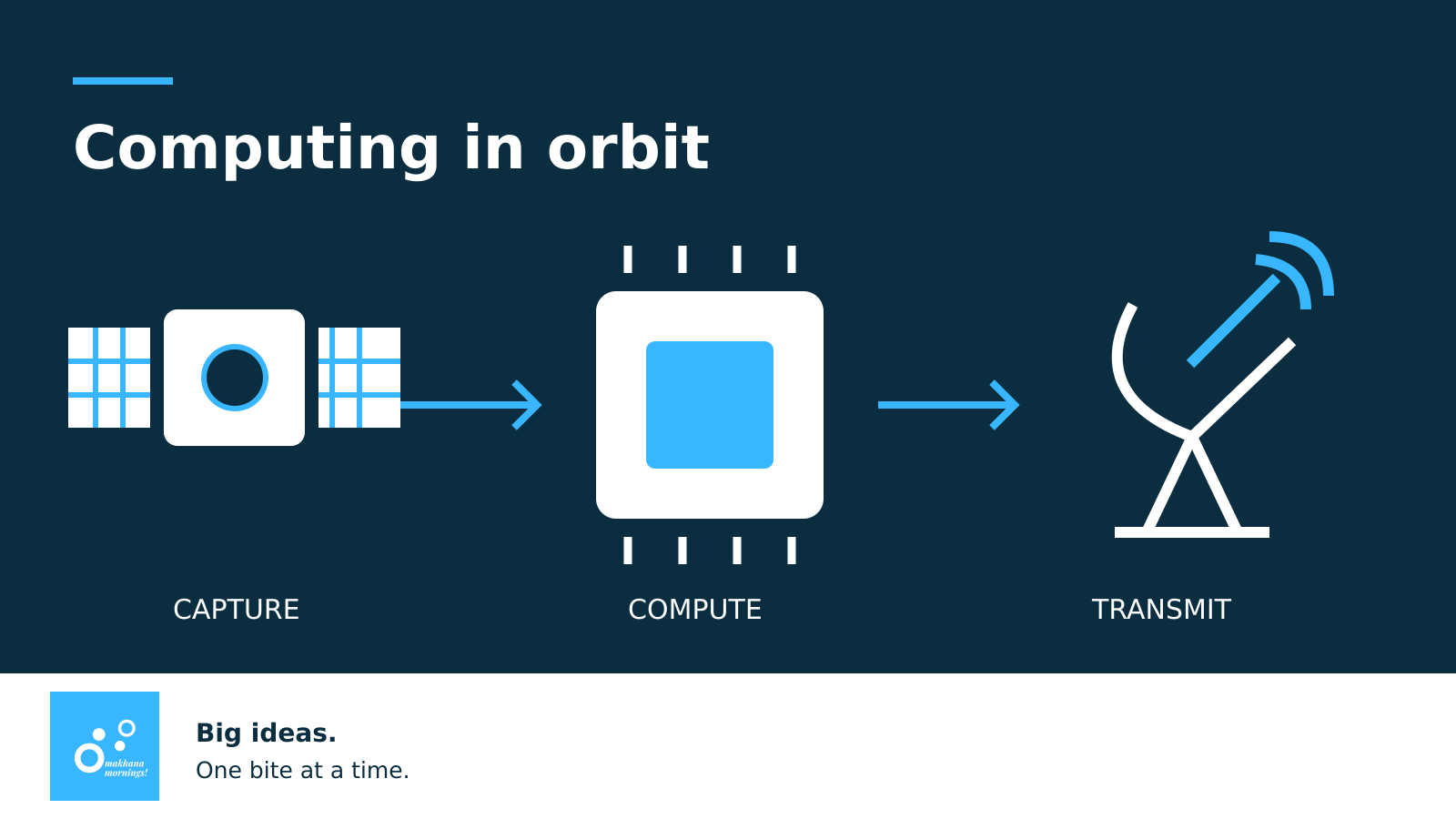
India’s TakeMe2Space describes an approach that captures satellite imagery, processes it onboard and transmits selected results. Its proposed advantage begins with the location of the data, rather than the idea of replacing a terrestrial cloud service.
Consider a hypothetical system looking for a particular feature in an image. Sending the relevant result instead of the complete image could reduce the information that must travel to Earth. But the decision about what to discard becomes part of the product: a missed feature might require another image or a different processing method.
TakeMe2Space’s earlier MOI-TD launched on December 30, 2024. Its account records successful model upload, code execution and result transmission, with the demonstration declared successful on January 20, 2025. It also records a camera problem. These were experimental results, not proof of a fully functioning imagery service.
The company’s current mission register separately lists MOI-1A, launched on October 1, 2026, as lost in orbit. It gives November as a tentative date for MOI-1B. Those statuses should not be confused with the earlier demonstration or with future constellation plans. No cause of the loss is established here.
Why This Matters
For Indian space businesses, the useful question is which task needs to happen before data returns to the ground. For a buyer of general AI computing, it is whether an orbital system can deliver dependable capacity at a workable total cost. These are different customer problems, even when both projects use processors in space.
The Crunch
Judge the chain of work: collection, computation, communication and delivery. Demonstrating one link is valuable. Turning all four into a repeatable service is the business challenge. The two programmes illustrate different approaches, not a partnership or a common commercial timetable.
Related categories: Business & Brands

Leave your thoughts