
A battery-storage contract is not just a purchase of batteries. It also buys the work needed to connect them to a power system, prove that they function together and keep them running.
Pace Digitek’s latest award at Khavda illustrates that distinction. On 16 November, the company disclosed a ₹2,691.3 crore letter of award, including GST, from NTPC Green Energy. The scope includes equipment, integration, installation, civil works, testing, commissioning and 15 years of operations and maintenance.
Two ratings, two different questions
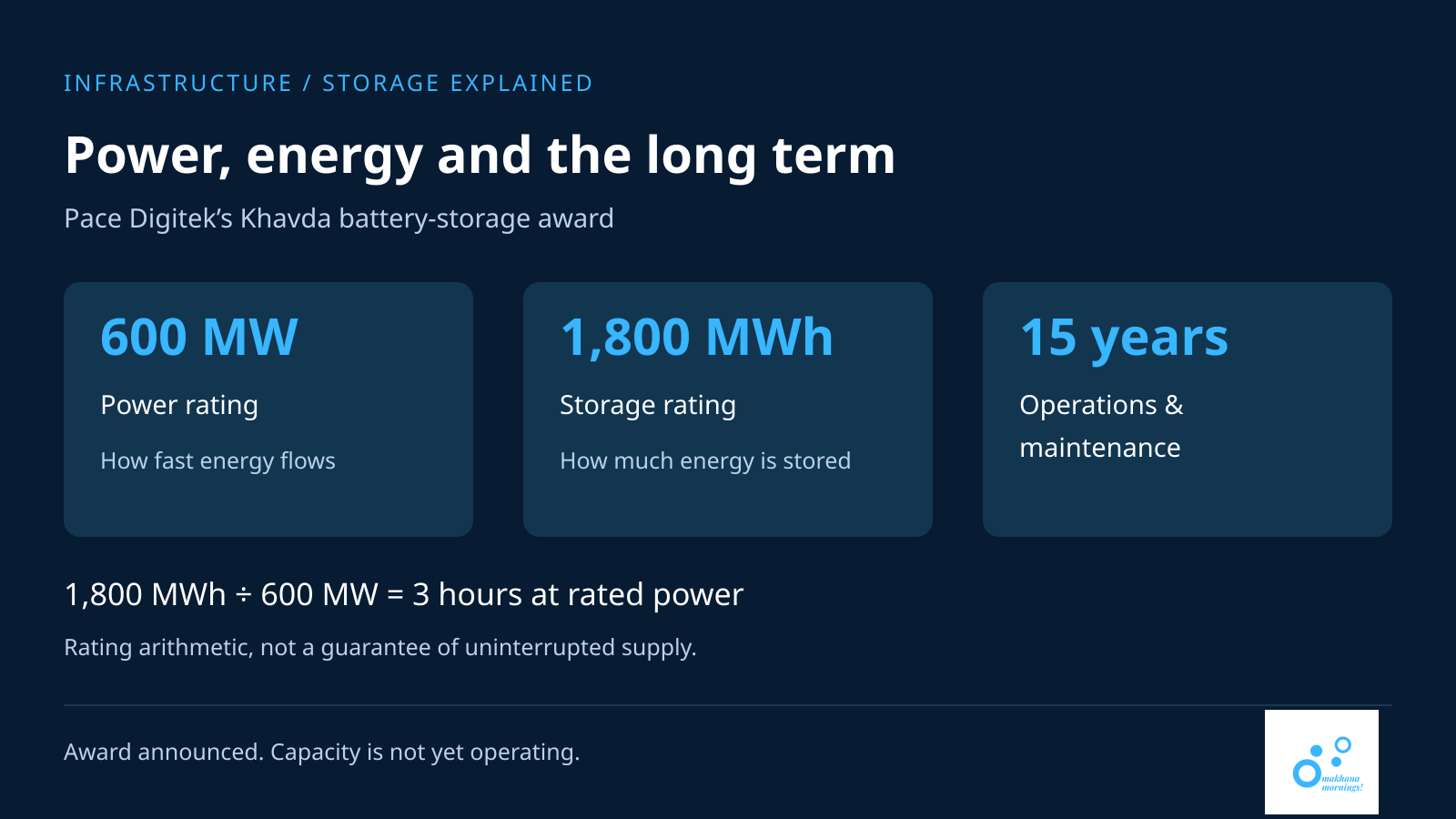
The award covers two blocks of 300 MW and 900 MWh each at the NTPC REL Khavda Solar Plant in Gujarat. Together, they amount to 600 MW of power and 1,800 MWh of energy capacity, within a larger 3,300 MWh battery-storage project. Pace’s announcement is not an award for that entire larger project.
Megawatts describe the rate at which a system can deliver power. Megawatt-hours describe the quantity of energy it can store or discharge. Dividing the energy rating by the power rating gives a useful duration measure: 1,800 MWh divided by 600 MW equals three hours.
That arithmetic describes the stated ratings, not a promise of round-the-clock electricity. A battery must first be charged, and real operation depends on its usable energy, losses and dispatch conditions. Storage can move electricity from one time to another; it does not create an unlimited supply.
The contract extends beyond construction
Pace’s filing gives September 2027 as the execution deadline. That is a scheduled milestone, not evidence that these batteries are already operating. The separate 15-year maintenance responsibility extends the commercial scope beyond bringing the installation into service.
This matters when reading the headline value. A package that includes civil works and long-term upkeep cannot be treated as a quotation for battery hardware alone. Nor is its full value immediate revenue or profit. The disclosed amount also includes tax.
Why the distinction matters
For solar-linked infrastructure, the practical question is not simply how much generating capacity is installed. It is also whether electricity can be made available when the system needs it. Storage adds a time dimension to that problem.
From the buyer’s perspective, installation and ongoing operation are connected responsibilities: commissioning establishes that the system works, while maintenance supports its continued use. The award’s bundled scope makes that connection visible. It does not, by itself, tell readers the future operating performance or the contractor’s margins.
The Crunch
Khavda’s new award is a commitment to build and maintain storage, not a declaration of live capacity. Read the MW, MWh, execution timetable and maintenance term together. Each answers a different question that the rupee headline alone cannot.



Leave your thoughts