
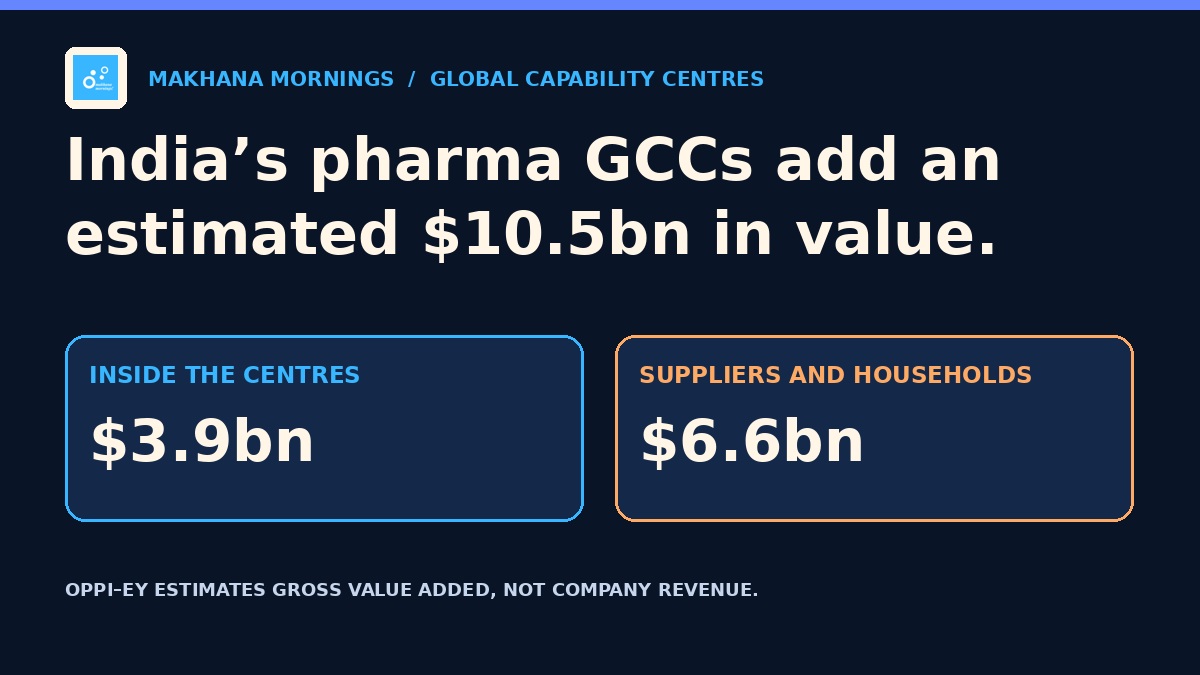
A pharmaceutical company’s India centre does work for global operations. It also buys services from local suppliers, and its employees spend part of their wages. The centre’s own work generates direct value. The other two channels create value elsewhere in the economy. That is the distinction behind a $10.5 billion estimate for India’s pharmaceutical global capability centres, or GCCs.
The $10.5 billion covers three layers of activity
In its November 2026 report with the Organisation of Pharmaceutical Producers of India (OPPI), EY estimates $3.9 billion of direct gross value added. It adds $3.2 billion of indirect value from suppliers and $3.4 billion of induced value from household spending. Suppliers and spending together account for $6.6 billion, or about 63% of the total. These are estimates of value created, not a tally of company revenue or money paid into India.
Gross value added measures the value of output after subtracting the goods and services used to produce it. To estimate the direct contribution, the report applies the wider Indian GCC sector’s direct value added per employee to the pharma segment. It is not a financial census of pharma centres. The report separately estimates that those centres directly employ about 120,000 people.
Presence and responsibility are different measures
The same report finds that at least 16 of the world’s 20 largest biopharma companies by 2025 revenue have an Indian GCC or an equivalent operation. That tells us how widespread the model is among that group. It does not say how much work each centre owns. The report describes work in areas such as clinical development, regulatory affairs and safety monitoring, but an India team preparing a regulatory submission and a team responsible for the global process have different mandates.
For anyone tracking the sector, the report answers two distinct questions: how far the economic activity extends beyond the centre, and how many large companies have a presence. Neither number alone tells you what decisions the India team gets to make.
See how the $10.5 billion estimate breaks down in One Chart.


Leave your thoughts