
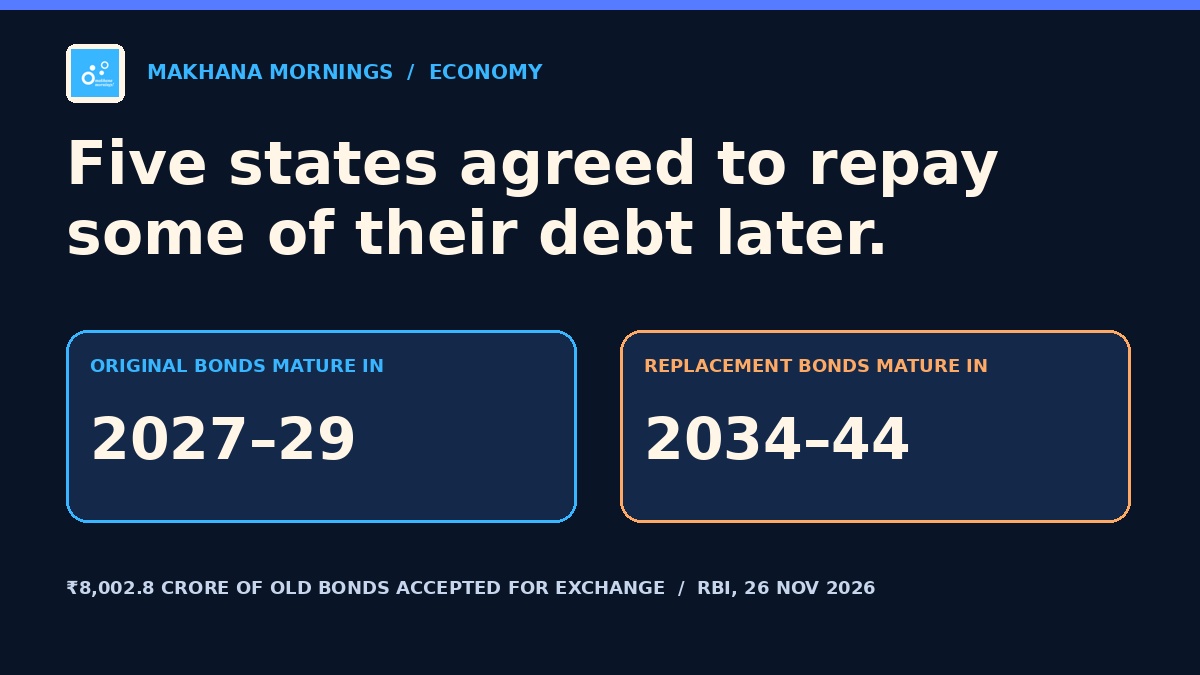
At the RBI’s first state-bond switch auction on 26 November, five Indian states accepted ₹8,002.8 crore of near-term debt, measured at face value, for exchange into bonds due much later. The auction results show which repayments are set to move and by how much. The exchange was scheduled to settle on 27 November.
Five states agreed to move some repayments out of 2027–29
The auction was open for up to ₹10,800 crore of existing securities across ten bond lines. The results show ₹2,222 crore accepted from Tamil Nadu, ₹1,950 crore from Rajasthan, ₹1,844.8 crore from Madhya Pradesh, ₹1,381 crore from Uttar Pradesh and ₹605 crore from Punjab. Those amounts measure old bonds accepted for exchange, not fresh funding for state budgets.
The old bonds mature between April 2027 and May 2029. The replacement bonds mature between 2034 and 2044. Punjab accepted ₹605 crore of offers to switch its April 2027 bond into a 2043 bond, but accepted no offers for its March 2028 bond.
The new bonds can have a different face value without raising fresh cash
An investor sells one security back to the same state and buys another from it in the same transaction. The amounts exchanged depend on the prices of the two bonds, not just their face values. For the successful Punjab switch, Punjab accepted ₹605 crore of old bonds in return for about ₹632.25 crore in replacement bonds, both at face value. The ₹27.25 crore difference is not money transferred to Punjab. The RBI describes the operation as broadly cash neutral, with settlements for accrued interest and rounding.
A lighter repayment year does not mean a lower borrowing cost
A state that moves a principal payment out of 2027 has less to repay or refinance in that year. It still owes the principal on the replacement bond and pays interest on its terms. To judge the trade-off, compare the interest payments, the price of the new debt and the year in which the replacement principal falls due. The size of the switch alone cannot show whether the state saved money.
The Crunch
Read the ₹8,002.8 crore as old principal accepted for exchange. The meaningful change is to the states’ repayment calendar, not the amount of new cash available to spend.


Leave your thoughts