
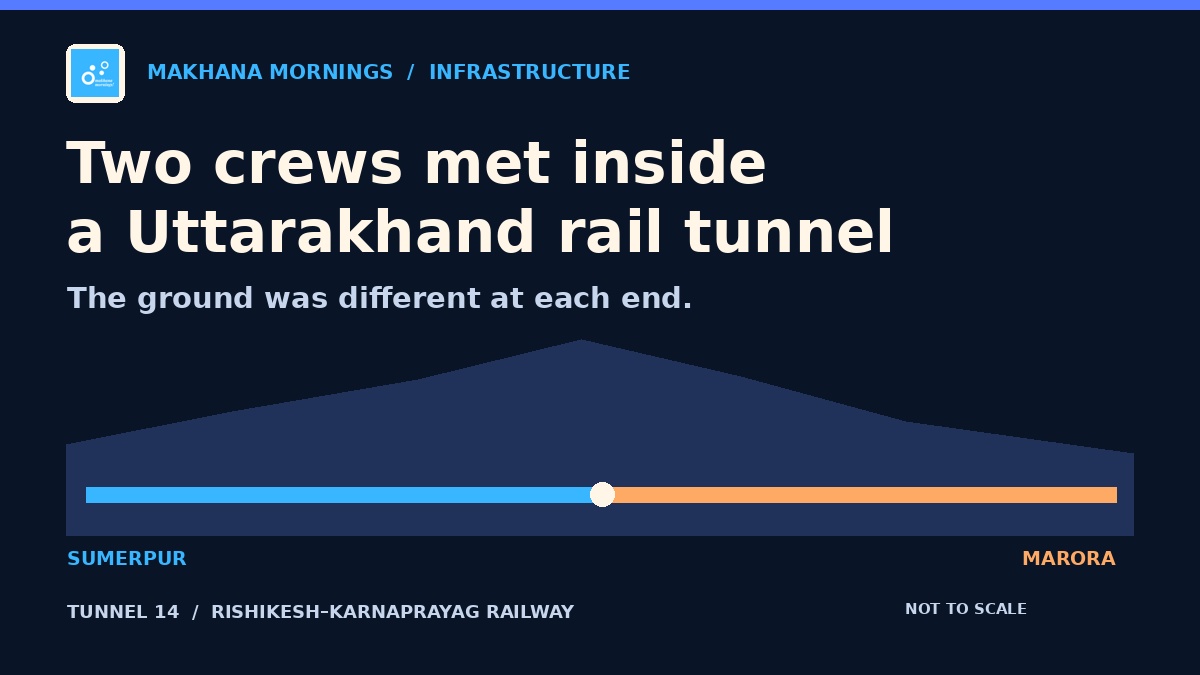
Digging a tunnel from two ends gives engineers two places to work. It does not give them the same ground at each end. On the Rishikesh–Karnaprayag railway in Uttarakhand, one team had to excavate under homes through loose soil. At the other end, crews had to stabilise a slope before the main excavation could begin.
The Ministry of Railways said the two excavations met on 27 November at Tunnel 14 in Rudraprayag district. It gives the main tunnel’s length as 6.59 kilometres. The breakthrough joins the two excavated sections. It is not an announcement that trains can run through it.
One entrance had loose ground beneath homes
Near Sumerpur, a 110-metre stretch of the three-track tunnel passed beneath an inhabited area with just 20 to 30 metres of soil and rock above it. Instead of opening the full cross-section at once, crews used smaller excavations in stages. Opening a smaller area at a time gives crews a chance to support the ground before exposing more of it.
At the other entrance, the slope had to hold first
Near Marora, engineers used deep, narrow piles, rock bolts and grout to stabilise the slope. Grout fills gaps and helps bind loose material. The railway ministry said this work let crews start the main excavation from that side in March 2024.
The next milestone is a tunnel ready for railway use. Excavation makes a continuous passage, but permanent civil works, tracks and systems still need to be ready before trains can run. That is why a breakthrough is a useful construction marker, not an opening date.



Leave your thoughts