
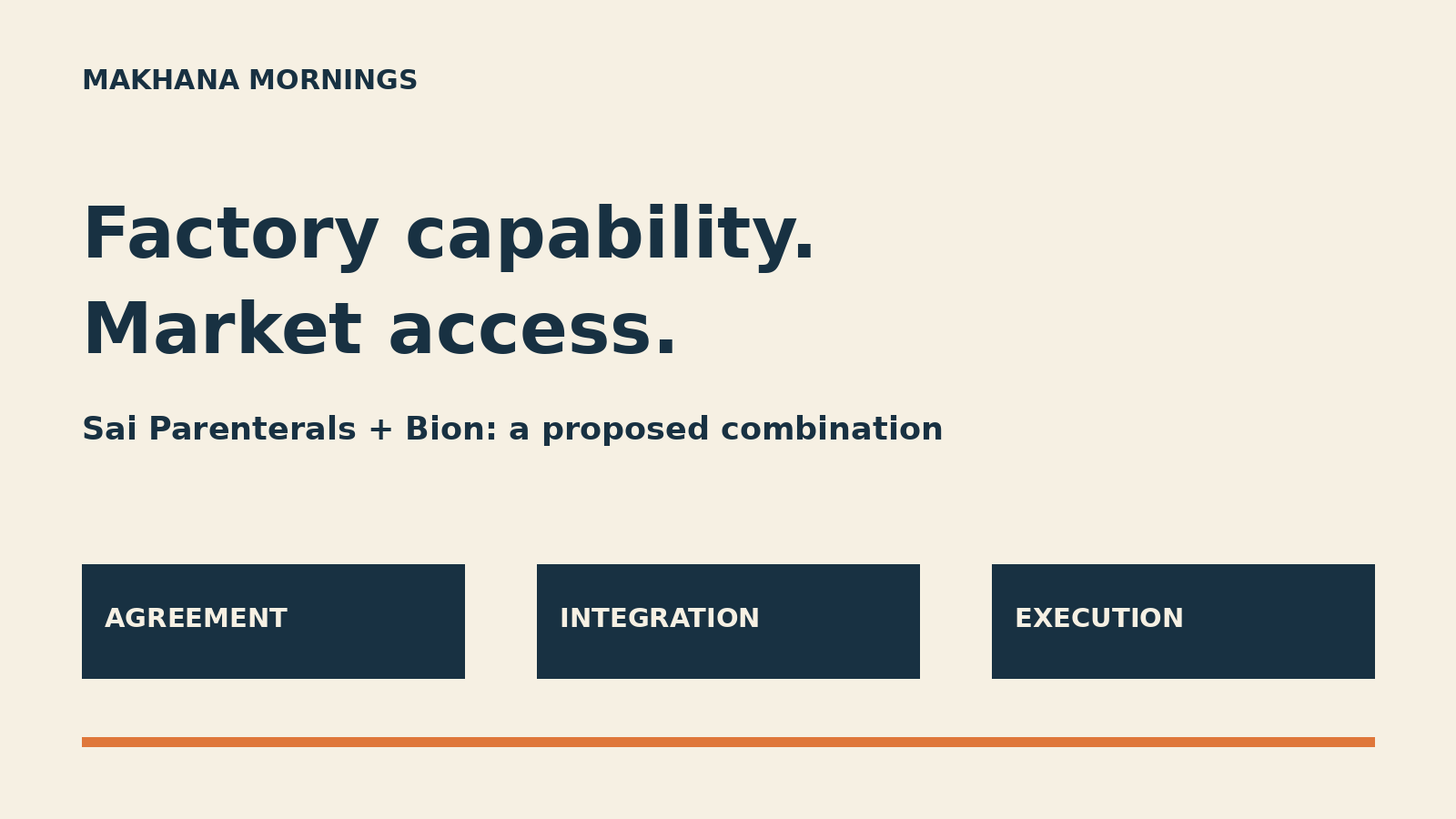
Sai Parenterals has signed a definitive agreement to acquire a majority stake in Bion Therapeutics India through its wholly owned subsidiary SP Analytics. The proposed combination connects two different parts of a pharmaceutical business: the ability to develop and manufacture products, and the organisation that takes branded formulations to prescribers.
In its November 17 exchange filing, carrying a November 16 release, Sai describes an all-cash transaction expected to close before the end of November. Bion becomes a step-down subsidiary only on completion. The release does not disclose the purchase price or exact percentage to be acquired.
According to Sai, Bion has 16 branded formulations, approximately 250 field staff and a presence across 12 states. It says Bion currently uses contract manufacturers and plans to move production progressively into Sai’s facilities after the acquisition. Existing Bion management is expected to continue leading the business.
A distribution capability, not just a product list
These details explain the strategic logic without proving the financial result. A manufacturing platform needs products and customers; a branded prescription business needs reliable supply and a field organisation. Combining them can bring more activities under common ownership, but it also creates a demanding integration project.
The commercial network is not an interchangeable piece of machinery. Its usefulness depends on people staying, relationships continuing and the portfolio remaining relevant. Meanwhile, bringing production in-house requires an orderly transfer of products and processes. Neither step follows automatically from signing an agreement.
Management presents better supply control and margins as expected benefits. They are not results already delivered by this acquisition. Without a disclosed purchase price, integration budget and subsequent operating evidence, the announcement cannot establish the return on the deal.
Sai also identifies opportunities to expand the portfolio using overseas dossiers, subject to Indian regulatory approvals. A dossier available within a group is therefore not the same thing as a newly authorised Indian product. Manufacturing credentials and commercial reach should not be read as evidence of a medicine’s clinical superiority.
For readers following the business, the next checkpoints are completion, further transaction particulars, retention of the sales organisation and progress in the manufacturing transfer. Later financial disclosures can show whether a wider product pipeline and market access translate into additional sales and sustainable margins.
The agreement is a move to connect factory capability with a prescription-market route. Execution, rather than the announcement alone, will determine how much value that connection creates.
Leave your thoughts