
A financial institution holds a corporate bond but needs cash for a few days. It can sell the bond today and agree to buy it back at a set price. For the institution, that is a way to raise short-term cash without giving up the bond permanently. For the cash provider, it is a short-term loan backed by the bond. The transaction is called a repo.
A clearing house can stand between the two sides, collect collateral and manage what happens if a party cannot pay. That is the role AMC Repo Clearing Limited plays for the corporate-debt repos it clears. SEBI is now asking whether the mutual fund industry should have a seat on the board of a clearing house like this, and what that seat should be allowed to do.
The fund managers and the funds play different roles
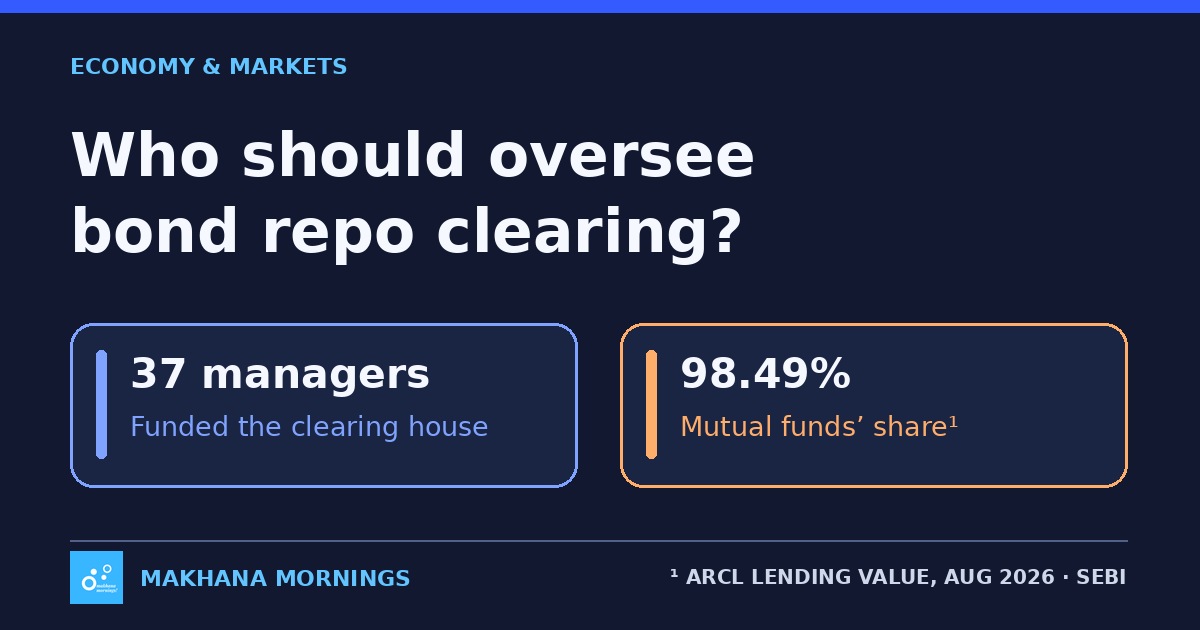
Thirty-seven asset management companies contributed ₹150 crore in initial share capital to AMC Repo Clearing, which began operating in July 2023. That was money from the fund managers as shareholders, not the value of their schemes’ repo trades. The mutual fund schemes themselves were major lenders: they accounted for 98.49% of lending value on the platform in August 2026. That is the share on this platform in one month, not across India’s entire repo market.
SEBI would give the industry a voice, not a vote on its own risks
SEBI proposes allowing the chief executive of the Association of Mutual Funds in India to sit on a recognised corporate-bond repo clearing house’s governing board as a non-independent nominee. The appointment would need prior SEBI approval and could be tied to further capital contributions by fund managers. Public-interest directors would still have to number at least as many as non-independent directors.
The nominee would sit on none of the risk management, members or regulatory oversight committees. At board level, the nominee would step aside on risk rules, defaults, the settlement guarantee fund and decisions about individual participants. The nominee would not see data about individual market participants.
What to watch before the rules change
The trade-off is whether the industry can help fund and build the platform without setting the safeguards for the trades its funds dominate. SEBI is taking comments through 11 December. The proposal has not created a seat or appointed anyone. Watch whether the final rules keep the capital contribution and the conflict safeguards linked.




Leave your thoughts