
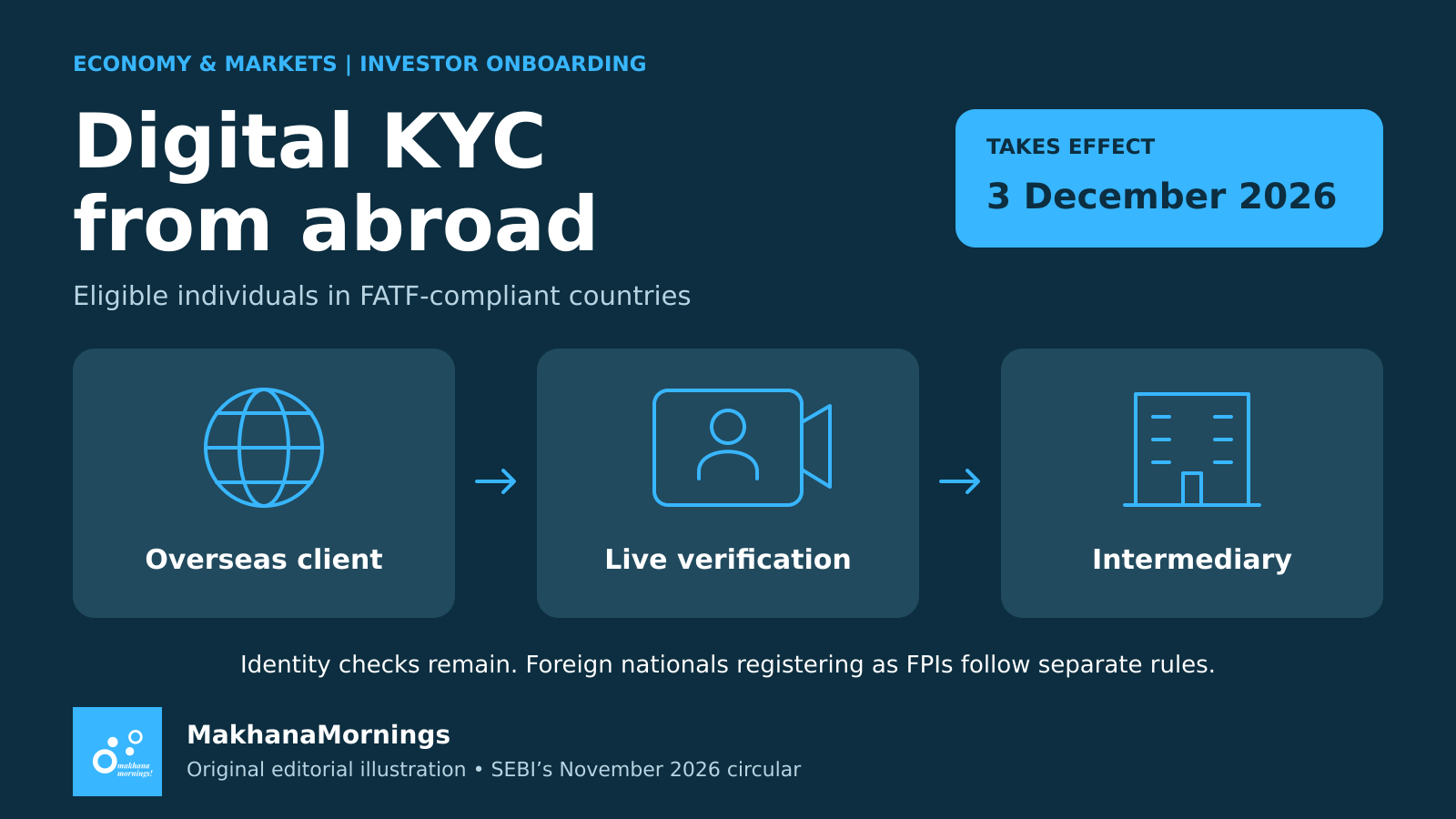
Digital onboarding has carried an awkward condition for overseas investors: the client had to be physically in India. A new SEBI circular relaxes that requirement for eligible individuals from December 3, 2026.
The change covers individual persons resident outside India, including non-resident Indians, Overseas Citizens of India and foreign nationals. To use the overseas digital route, the client must be located in a country that meets the circular’s Financial Action Task Force, or FATF, compliance condition.
The Breakdown
SEBI’s November 4 circular allows intermediaries to accept KYC information and supporting documents digitally from eligible clients abroad. It also applies to re-KYC for clients in FATF-compliant countries.
The identification requirements remain substantial. The intermediary must collect the client’s PAN and check it against the Income Tax database, without insisting on the original PAN card or a copy. A passport copy is required, along with an OCI card where applicable. The current address recorded for an overseas client must be an overseas address.
Digital submission still needs acceptable evidence. The circular provides routes for original-document verification, verifiable electronic documents and copies attested by specified authorities. A scanned document alone does not automatically satisfy every requirement.
When physical in-person verification is not feasible, the intermediary must use video verification. An authorised official must be present. The process includes live location and time records, checks against spoofed connections, matching the client’s image with the submitted records, face-liveness controls and encrypted transmission. It is also subject to concurrent audit.
Why This Matters
For an eligible client abroad, the change removes a geographic obstacle from a process that can otherwise be completed remotely. The benefit will depend on the intermediary’s implementation and the client’s documents; the circular does not promise instant account opening.
It also addresses repeated paperwork. An intermediary must retrieve available records from a KYC Registration Agency, or KRA, and the Central KYC Records Registry. Existing records can be reused, with additional details sought for reasons such as changes, incomplete information, expired documents or further due diligence.
KRAs will mark individual attributes as validated when they are checked against official or source databases. Records can be shared with another intermediary even if every attribute has not been validated. That portability leaves the receiving intermediary responsible for its client’s KYC, including enhanced checks appropriate to the risk.
The Big Picture
The overseas route has defined boundaries. Clients in FATF-non-compliant countries remain subject to the existing KYC process. KYC completed before the new circular takes effect also remains governed by the earlier provisions.
There is a separate exception for a foreign national seeking registration as a Foreign Portfolio Investor, or FPI. That registration continues under the FPI master circular and its amendments. The new individual-client process should not be presented as a replacement for it.
For brokers and other intermediaries, the preparation extends beyond adding a document-upload button. Their video systems, record retrieval, validation labels and audit arrangements need to work together. They retain the final responsibility even when another regulated entity performed the earlier KYC.
The Crunch
From December 3, eligible overseas individuals gain a digital route that can meet them where they live. Its usefulness will come from combining that access with reliable document checks and reusable records. The effective date, country condition and client category determine who can use it.




Leave your thoughts