
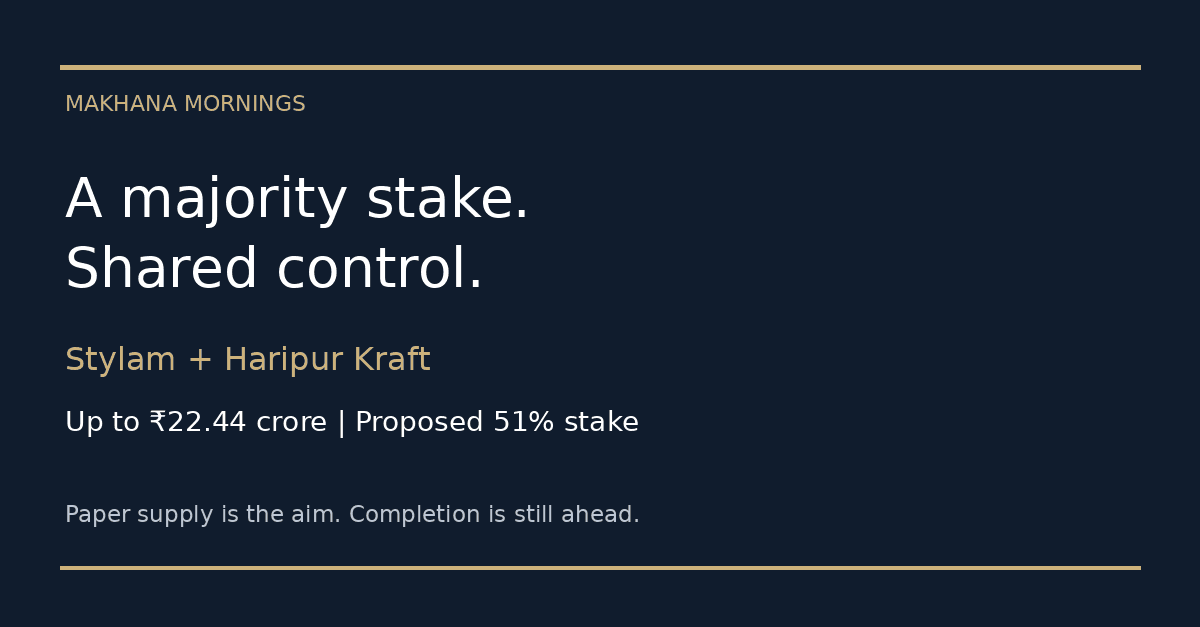
Stylam Industries has approved a proposal to acquire a 51% stake in Haripur Kraft Co., a paper-making partnership firm, through a capital contribution of up to ₹22.44 crore. The board decision, disclosed on November 19, is an approval to proceed, not confirmation that the investment has closed.
The transaction puts a laminate manufacturer closer to an important input. Kraft paper is a primary raw material for Stylam’s laminates. The company says the investment is intended to strengthen supply, improve quality control and reduce exposure to price volatility and disruption. Those are expected benefits, not reported savings.
The ownership percentage does not tell the whole governance story. According to the exchange filing, Haripur Kraft will be jointly controlled by Stylam and the existing partners, who will retain 24.5% each. A 51% stake should therefore not be described as unilateral control.
The proposed cash contribution is capped at ₹22.44 crore and will be paid into the firm in one or more stages under the deed. That is different from assuming the entire amount will be paid to departing owners. Completion is expected on or before January 31, 2027, subject to the deed’s conditions. Stylam says no governmental or regulatory approval is required.
Haripur Kraft manufactures semi-kraft paper and paper products at Baddi in Himachal Pradesh. Its stated capacity is 125 tonnes a day, which is not a measure of actual output. The filing reports FY2025–26 turnover of ₹82.50 crore, compared with ₹97.95 crore a year earlier and ₹69.28 crore in FY2023–24.
The business question is whether investing upstream delivers a more dependable input supply at an acceptable total cost. Ownership brings exposure to the paper operation as well as access to its production. The filing does not quantify future procurement savings, utilisation or the investment’s return.
For readers tracking the deal, the next useful evidence is completion, the practical operation of joint control and demonstrated supply or cost improvements. The board approval establishes a plan for backward integration; it does not yet establish those outcomes.
Leave your thoughts