
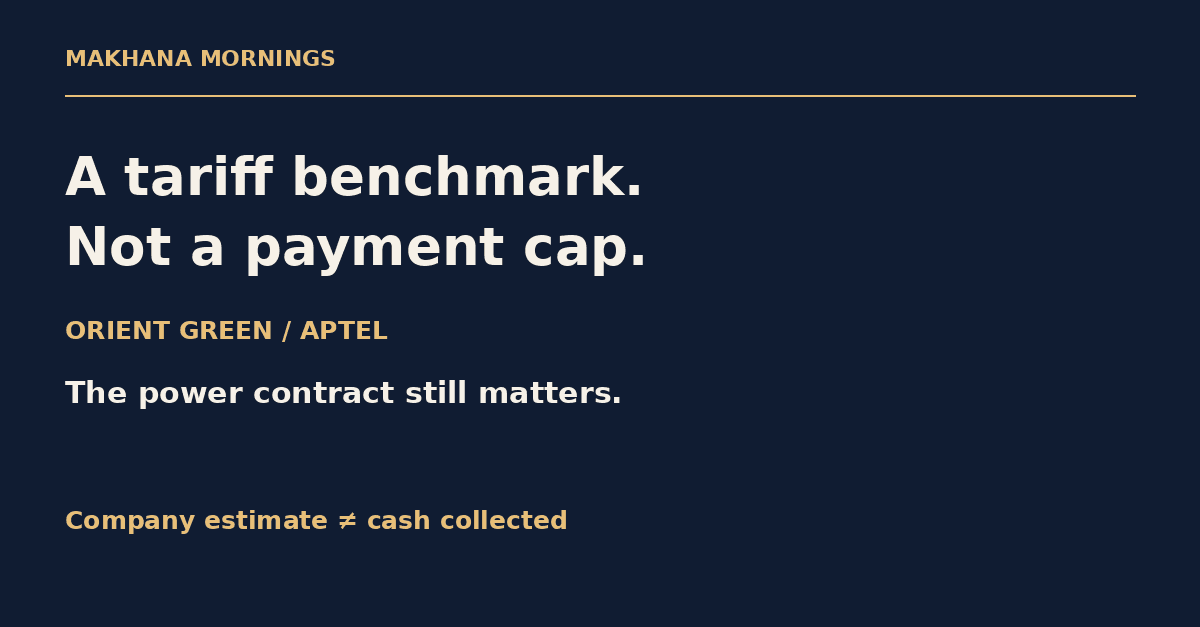
A wind farm can generate more electricity than the assumption used to set its tariff. Whether the buyer must pay the full rate for that additional electricity depends on the contract, not simply on the benchmark used in the tariff calculation.
That distinction sits behind a November 17 ruling by the Appellate Tribunal for Electricity (APTEL). In a November 19 exchange filing, Orient Green Power said its subsidiary Beta Wind Farm expects about ₹12.98 crore in receivables following the decision. That is the company’s estimate, including interest, not cash already collected.
What the ruling changes
The tribunal set aside an Andhra Pradesh regulatory restriction that linked full payment to a cumulative 23% capacity utilisation factor (CUF), with ₹0.50 per unit beyond it. CUF measures generation relative to what a plant could produce at full capacity over the period.
The judgment’s reasoning is specific to the power-purchase agreements before it: their delivered-energy provisions did not impose that normative-CUF ceiling. A benchmark used in calculating a generic tariff could not simply become a new payment restriction. The tribunal directed payment at the applicable tariff, with interest under the relevant agreements.
This was enforcement of existing contracts, not a fresh tariff-setting exercise. Nor is it a universal ruling that every generator must be paid for unlimited output regardless of its contract. The judgment preserves the distinction between a tariff assumption and agreed delivery limits.
The company’s number is not a collection receipt
Orient Green said the dispute concerned Beta’s 50.4 MW Andhra Pradesh wind project, operating under a 25-year agreement signed in May 2013 at ₹4.70 per unit. The withheld principal relates to electricity supplied during July 2016–July 2017.
Its estimate comprises ₹5.93 crore of principal, ₹3.09 crore of interest claimed through March 2022 and another ₹3.96 crore through October 2026. The tribunal did not quantify a ₹12.98 crore award in its operative order; it linked interest to the relevant agreements. Collection and implementation still matter.
Why the distinction matters for business
Renewable-power economics involve more than installed capacity and a headline tariff. The definition of payable energy, restrictions in the agreement and the timing of settlement can affect how generation becomes revenue and, eventually, cash.
For readers assessing this announcement, three questions should stay separate: what the contract entitles the generator to receive, what the company estimates it is owed, and what the buyer actually pays. A favourable ruling can improve the first two without completing the third.
Sources: Orient Green Power exchange disclosure, November 19, 2026; APTEL judgment dated November 17, 2026, Appeal 600 of 2023 and connected appeals, particularly paragraphs 33–57, 69–71 and the operative order.



Leave your thoughts