
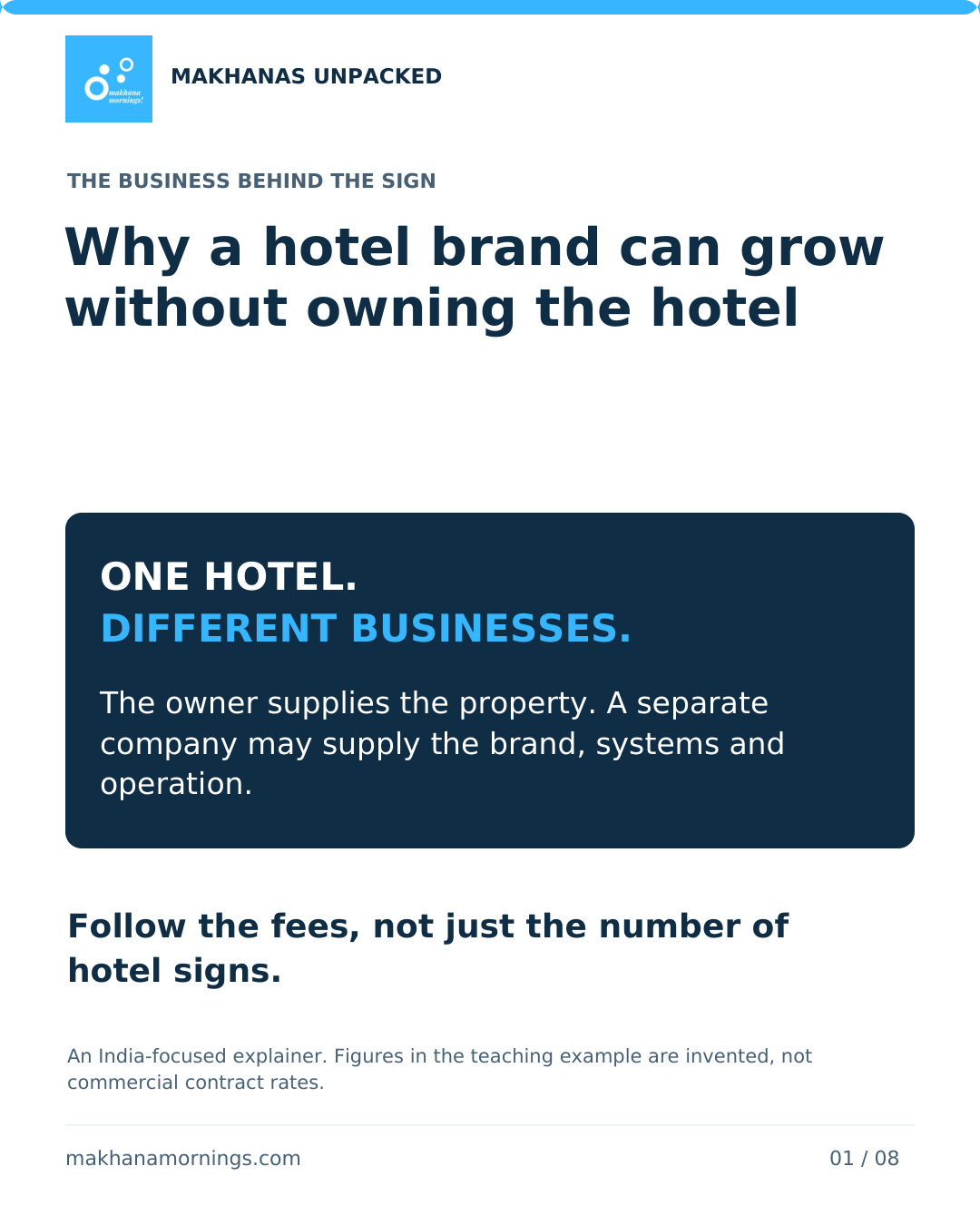
A hotel can collect ₹10 crore from guests without the company whose name appears above the entrance recording ₹10 crore of revenue.
That is the distinction behind asset-light hotel growth. The building, the business operating inside it and the brand attracting guests do not always belong to the same company. Understanding who earns which rupee is more useful than simply counting hotel signs.
The Breakdown: hotel sales are not automatically brand sales
IHCL’s FY2025-26 annual report describes management arrangements as long-term contracts with hotel owners. The group supplies hotel-management services and permission to use its trademarks and other intellectual property. Management and incentive fees are linked to revenue and profit, subject to the contract’s conditions.
Its consolidated accounts separately recorded ₹685.27 crore of management and operating fees for the year ended March 31, 2026. That is fee income, not the total amount guests spent at those managed properties. The report says this fee business also includes brand fees from Taj-branded residences.
This distinction matters when a chain announces another hotel. The announcement could represent another owned asset, another lease or another contract generating fees. Those additions do not bring identical revenue, capital requirements or risks.

Management is not the same as franchising
Marriott’s disclosures provide a useful international comparison, not a description of every IHCL contract. Under management agreements, Marriott operates hotels and typically earns a revenue-linked base fee plus a profit-linked incentive fee. Hotel owners generally bear the hotel’s operating costs.
Franchising is different: third parties receive permission to use the brand and systems. The franchisor need not be the company running the hotel day to day.
So branded, managed and owned are not interchangeable. An owner can employ a separate operator while licensing a recognised brand.

Follow a hypothetical ₹10 crore
Consider an invented management contract. None of these percentages represents IHCL’s or Marriott’s actual tariff.
A hotel earns ₹10 crore annually. Assume its operating expenses, excluding management fees, are ₹7 crore. The contract charges a base fee of 3% of hotel revenue, or ₹30 lakh, and an incentive fee of 10% of the surplus after operating expenses and the base fee.
The incentive calculation is ₹10 crore − ₹7 crore − ₹30 lakh = ₹2.70 crore. Ten per cent is ₹27 lakh. Total fees are ₹57 lakh, leaving the hotel ₹2.43 crore before the additional items excluded from this illustration.
Those exclusions matter: financing, tax, depreciation and capital expenditure have not been deducted. The ₹2.43 crore is not the owner’s final profit or freely distributable cash.

The downside does not disappear
Now keep hotel revenue at ₹10 crore but increase operating expenses to ₹9 crore.
The base fee remains ₹30 lakh. The remaining surplus falls to ₹70 lakh, producing a ₹7 lakh incentive fee. Total fees become ₹37 lakh, and the hotel retains ₹63 lakh before the excluded items.
Under this invented formula, the provider’s fees fall by roughly 35%, while the hotel’s remainder falls by roughly 74%.
That is the point of separating revenue-linked and profit-linked payments. They respond differently to rising costs. Actual contracts can contain thresholds, owner-return provisions and other conditions, so this is a teaching example rather than a standard industry formula.

Fee revenue is not pure profit
The brand company’s ₹57 lakh in the first example is fee revenue, not pure profit. It still has costs associated with providing its services and maintaining its organisation. Asset-light describes how a business uses capital; it does not mean cost-free or risk-free.

Why would the owner pay?
The brand has to contribute something worth buying.
IHCL’s development offering describes support spanning design, procurement, training, distribution, marketing and loyalty. Those capabilities can help an individual property access systems and customers it would otherwise have to build or obtain separately. They are the services offered, not a guarantee of higher profits.
Our business interpretation: the owner must assess the incremental value after fees and required spending, not merely the prestige of the name. The brand company must deliver enough value to retain owners while protecting the guest experience across its network.

The Crunch
Asset-light growth does not remove the hotel’s need for capital. It changes which business supplies that capital and which business earns fees for operating or branding it.
For an Indian hotel group, more properties can mean a larger fee business without equivalent property ownership. But hotel revenue, brand-company revenue and owner returns remain three different numbers. Follow the contract before comparing them.

Leave your thoughts