
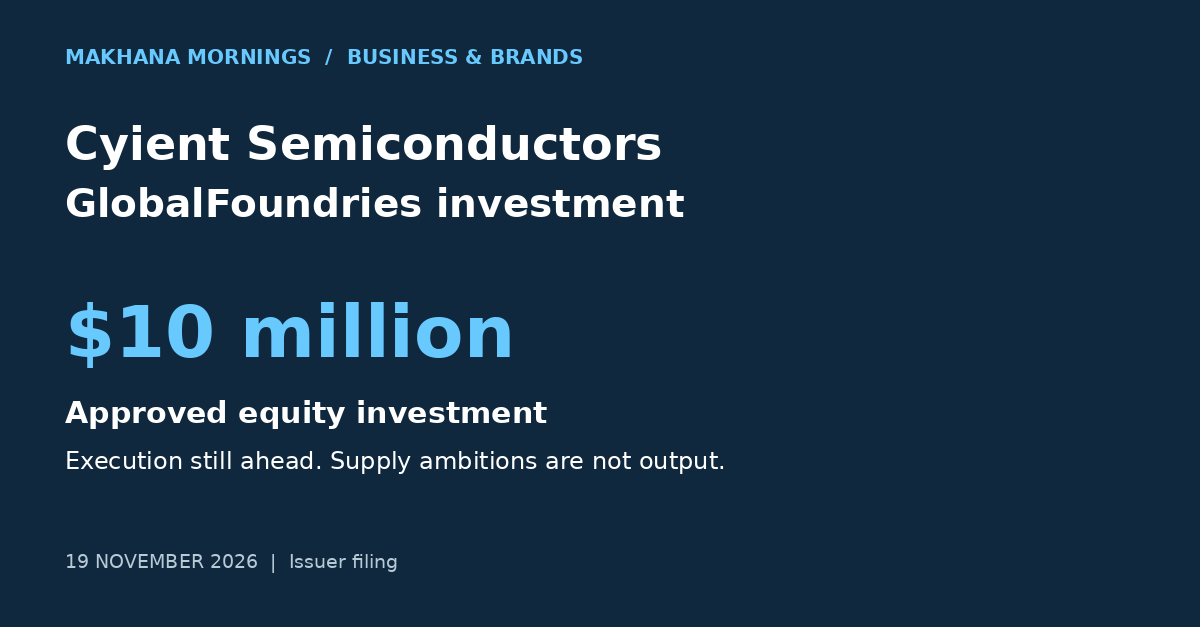
Cyient Semiconductors has approved a $10 million equity investment from GlobalFoundries, according to a November 19 stock-exchange filing by Cyient. The announcement brings a semiconductor manufacturer into the funding story of a custom-chip business, but does not say that the transaction has closed.
The issuer’s release says the investment will be executed at the same $490 million pre-money equity valuation as its recent Edelweiss-led financing round. It reports a combined post-money valuation of $510 million. That combined figure should not be read as the result of adding GlobalFoundries’ $10 million alone to the pre-money valuation.
Funding meets the manufacturing relationship
Cyient Semiconductors says it intends to expand turnkey custom ASIC capabilities, accelerate custom-silicon development and strengthen long-term wafer-supply assurance. An ASIC is a chip designed for a particular application. For such a business, raising money and securing a dependable route from design to manufactured chips address different parts of the same commercial challenge.
The company describes capabilities spanning architecture, design, manufacturing, packaging, testing, qualification and supply-chain management. Those activities should not be interpreted as evidence that it owns every production facility involved. The release identifies design centres in India, Belgium and the United States and target markets including automotive, industrial applications, communications and data centres.
What the announcement does not establish
The release names the investor as GlobalFoundries, or GF, without identifying a specific legal investment vehicle. It provides no quantified wafer-capacity commitment, manufacturing price, customer order or timetable for completed chip deliveries. Its supply-resilience and growth statements are company objectives, not independently demonstrated outcomes from this investment.
Likewise, an announced equity valuation is not sales, profit or cash already received. The operative wording is that the investment has been approved and the transaction will be executed. Readers should keep that status separate from a completed funding receipt.
Why the distinction matters
India’s semiconductor story involves several businesses, not just factories. A custom-silicon provider can combine engineering and intellectual property with manufacturing partners. The commercial test is whether those relationships produce qualified chips that customers buy repeatedly, on terms that support a viable business. The funding announcement supplies a new strategic relationship, not that operating proof.
This is distinct from Cyient DLM’s electronics-manufacturing results. Our explainer on the businesses inside a made-in-India device describes why design, assembly, component production and ownership of intellectual property should be examined separately.
The Crunch
GlobalFoundries’ proposed investment links capital with a potential manufacturing advantage for Cyient Semiconductors. The next evidence to watch is execution of the transaction and measurable customer or supply milestones, rather than treating the valuation as production already delivered.
Leave your thoughts