
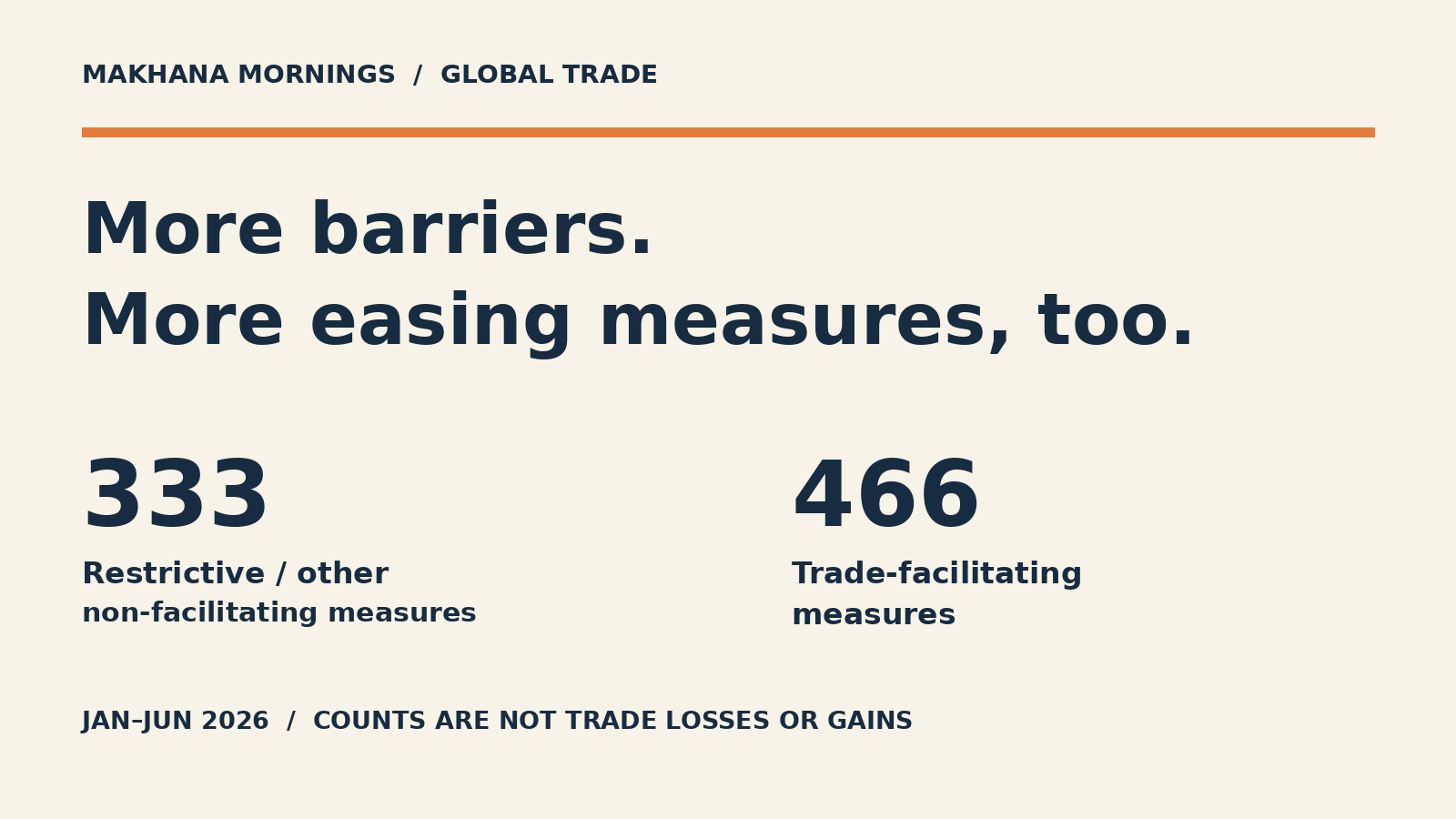
Trade policy is moving faster in two directions at once. The WTO’s November 17 monitoring update describes a sharp rise in restrictive measures alongside an acceleration in measures that make trade easier. Reading only one side misses the business environment the figures describe.
The WTO update records 466 new trade-facilitating measures in January–June 2026, compared with 391 during all of 2025. It also records 333 restrictive and other non-facilitating measures in that half-year, against 300 for the whole previous year. The latter category excludes trade remedies, which are tracked separately.
Counts, coverage and consequences are different
For new import-related measures in the first half of 2026, the WTO estimates trade coverage of $2.0 trillion for restrictions and other non-facilitating measures, and $1.3 trillion for facilitation. These are values of trade covered by policies, not estimates of imports lost or created.
Subtracting the two figures would therefore not produce a net loss to world trade. Nor does a larger count of easing measures show that they offset restrictions: individual measures can cover different products, markets and values. The practical effect on a business depends on the rules affecting its particular shipment.
The stockpile is not this year’s new restrictions
The cumulative import-related stockpile covered $5.4 trillion, or 21.3% of world imports, as of June 30. That measure refers to policies introduced since 2009 which remained in force at the reporting date. It is not $5.4 trillion of newly blocked trade in the latest six months.
In her publicly released November 17 remarks, WTO Director-General Ngozi Okonjo-Iweala linked much of the rise in facilitation to temporary responses to Strait of Hormuz disruptions, including measures affecting energy products and fertilisers. Temporary relief and lasting changes need not have the same commercial significance.
The timing also matters. The report was circulated on October 29 and discussed on November 17; its monitoring period ends on June 30. It is a dated picture of policy activity, not a live count of November border conditions.
For an Indian exporter, the global totals provide context rather than a market-access answer. Product classification, destination, effective dates and the applicable import or export rule still determine what happens at the border. More policy activity means more to check, not a single verdict that every market is becoming either easier or harder.


Leave your thoughts