
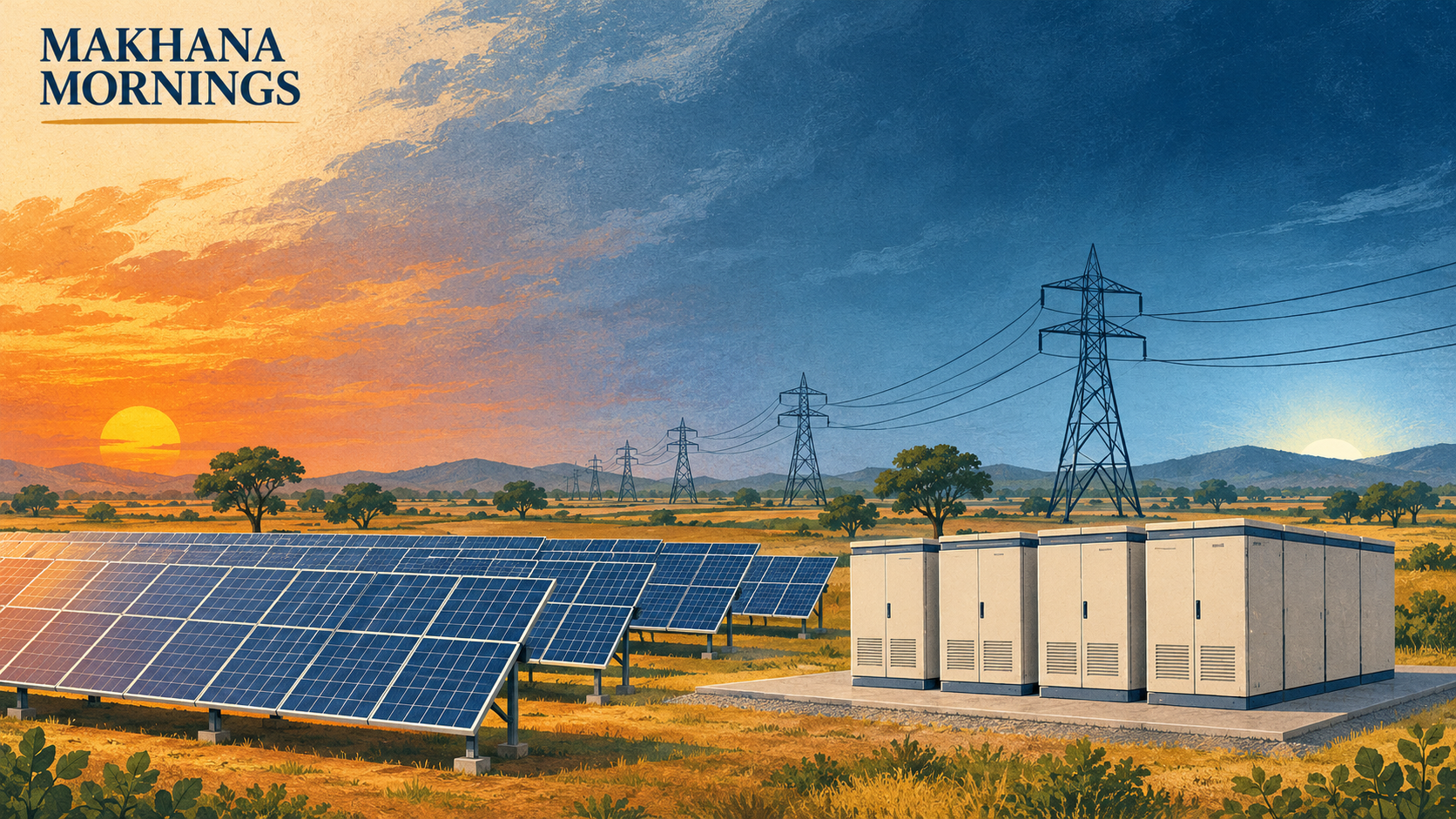
ACME’s Morena solar-and-storage project has moved from an award to a signed power-purchase agreement. The useful detail is not just its size: the project is designed around supplying electricity at specified peak hours.
The Breakdown
In a 16 November exchange filing, ACME Solar said its wholly owned subsidiary, ACME Greentech Sixteen, had executed a PPA with Rewa Ultra Mega Solar Limited for a 220 MW solar project with battery storage at Morena Solar Park in Madhya Pradesh.
The tariff is ₹2.764 per unit. Scheduled commercial operation is 31 December 2027, and the stated project tenure is 25 years from signing the PPA. This is a contractual milestone, not an announcement that the plant has begun supplying power.
The earlier award disclosure, dated 10 February, placed this unit within a 440 MW tender. It described four hours of peak supply, split equally between morning and evening, at 95% annual availability.
Why This Matters
The earlier disclosure also distinguished how those two supply windows would be supported: solar generation would charge storage for the evening peak, while the procurer would provide charging energy free of cost during night hours for the morning peak.
That distinction matters when reading the tariff. A price for this particular supply arrangement is not a simple like-for-like comparison with standalone daytime solar, or with a storage contract where the developer must buy all charging energy.
For the electricity buyer, the relevant service is not only generation over a year. It is delivery when the contract calls for it. Batteries can shift electricity between hours; they do not themselves create the energy being shifted.
The Crunch
The November filing establishes that a PPA has been signed. It does not establish commissioning, actual peak-hour performance or the battery’s energy capacity in megawatt-hours. The 220 MW project figure should not be relabelled as 220 MWh of storage.
The next test is execution towards the scheduled operating date, followed by delivery against the agreed supply requirements. Signing secures the contractual step; dependable peak-hour electricity remains the operational task ahead.
Cover: original AI-generated conceptual illustration, not a photograph or site plan of the Morena project.
Leave your thoughts