
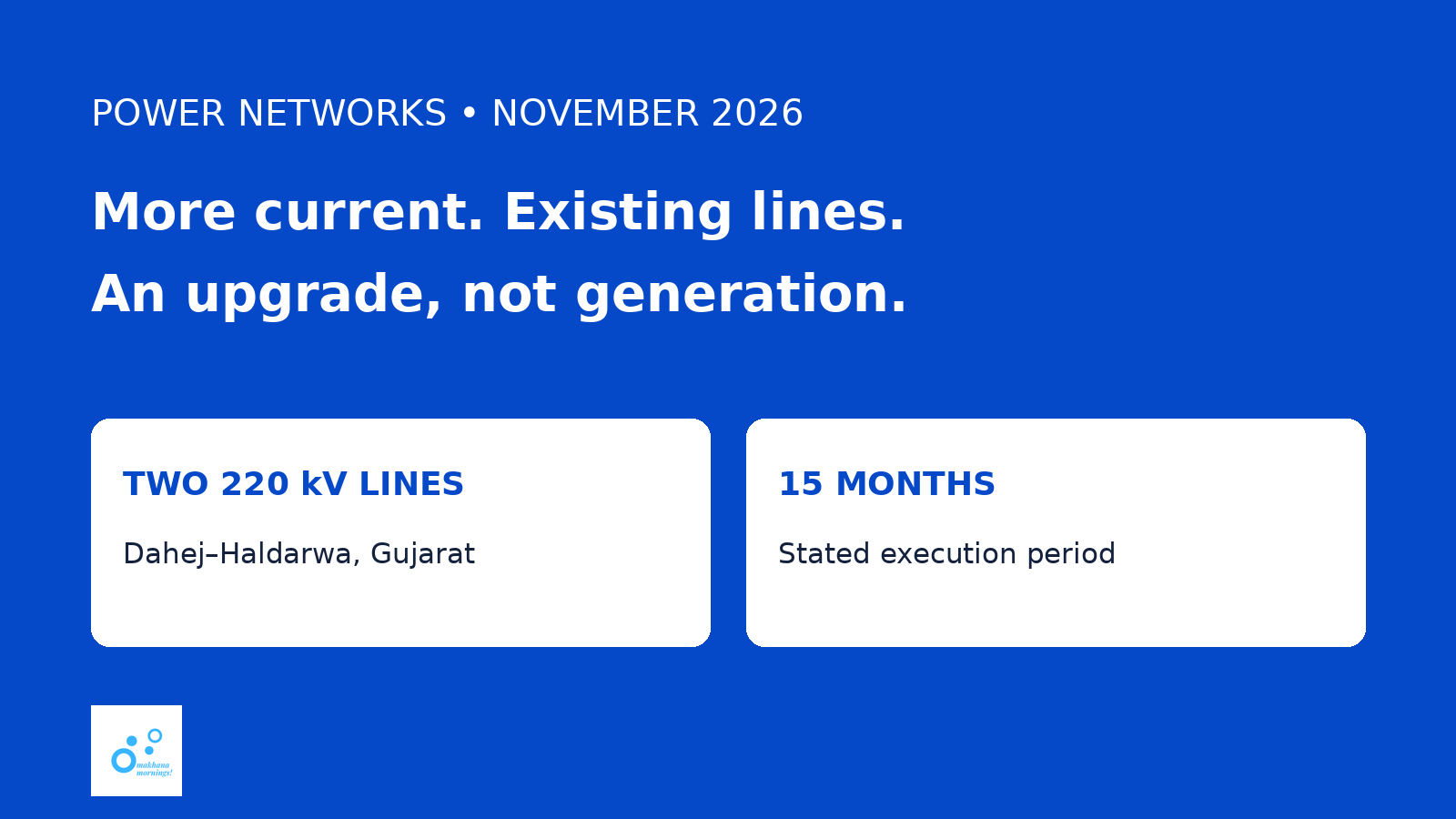
Advait Energy Transitions has received a GETCO order to upgrade the conductors on two existing 220kV transmission lines between Dahej and Haldarwa in Gujarat’s Bharuch Circle. The company’s 17 November exchange filing gives a contract value of ₹130.49 crore, including taxes, and an execution period of 15 months.
The work covers supply, installation, testing and commissioning. Existing ACSR Zebra conductors are to be replaced with higher-ampacity conductors of equivalent weight; the filing excludes gap-type conductors. In plain language, the specified upgrade seeks greater current-carrying capability rather than a new power-generating plant.
What is being upgraded?
The useful distinction is between producing electricity and moving it. This contract concerns the transmission side. Its stated scope is reconductoring existing lines, not adding generation capacity or announcing an entirely new transmission route.
Lawrence Berkeley National Laboratory’s REFA research tool treats reconductoring, rebuilding and voltage upgrades as options whose economics need to be compared for each application. Its description emphasises evaluating conductor choices and project costs and benefits, rather than assuming that one method is always best.
That is also a sensible boundary for reading this order. Advait’s disclosure does not quantify the resulting megawatt increase, a percentage capacity gain or customer-bill savings. General claims about what advanced conductors can achieve elsewhere should not be imported into these two lines.
The MM read
An order value tells readers what has been contracted, not what has already been delivered. The 15-month window makes execution the next test: installation, testing and commissioning are still work to be done. The amount includes taxes and is not a statement of profit or cash already collected.
The broader infrastructure question is practical: when can an existing asset do more, and what work is required to make that useful? This order provides a specific example of that question in India’s power network, without yet supplying a measured operational result.
Sources: Advait exchange disclosure, 17 November 2026; Berkeley Lab’s REFA project description. Contract facts are company-reported; the interpretation is MM analysis.



Leave your thoughts