
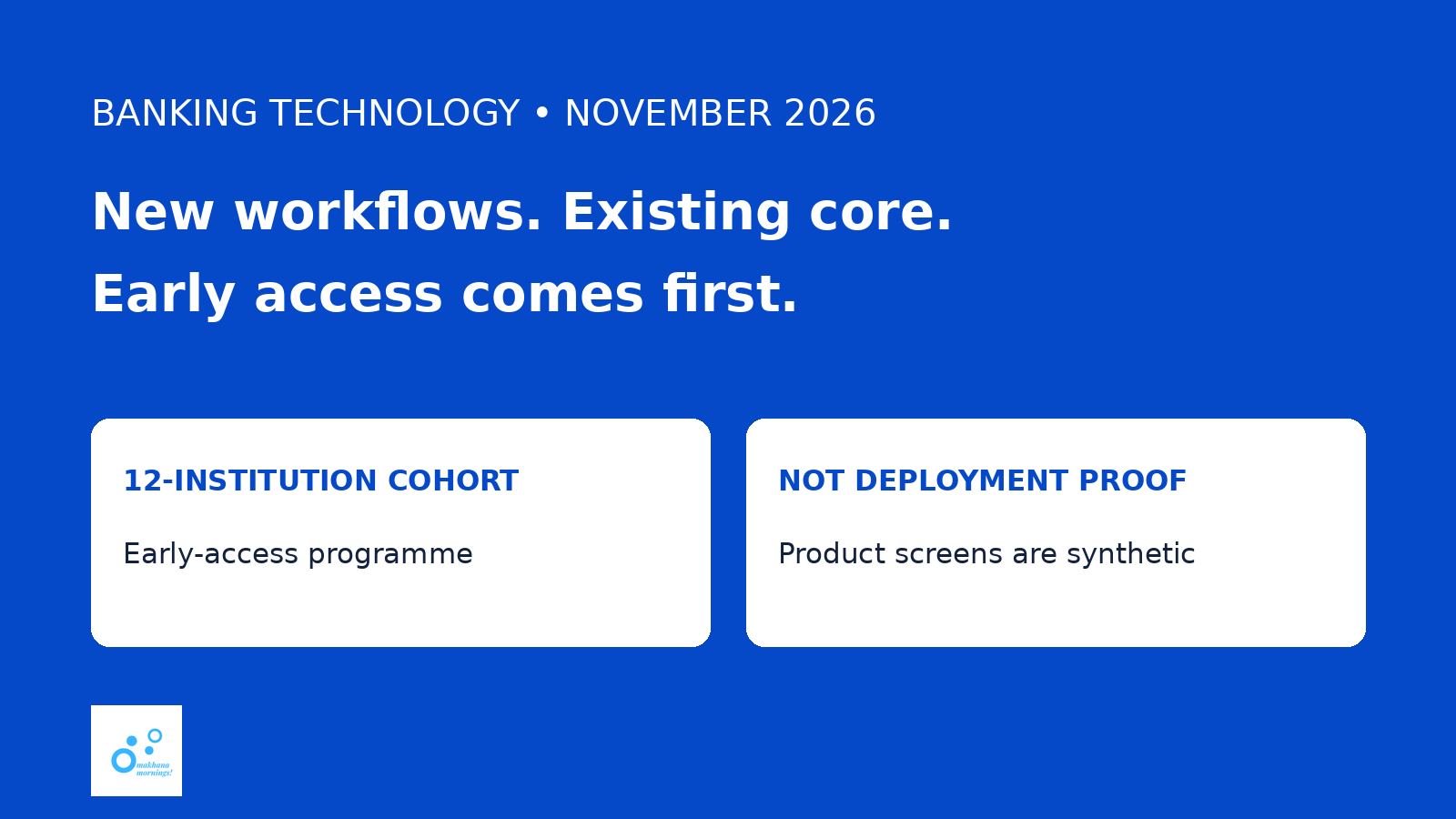
Veefin launched its AI OS banking platform at the Singapore FinTech Festival on 18 November, with availability through an early-access programme for a limited cohort of 12 banks and financial institutions. That is the announced programme size, not evidence that 12 institutions have already deployed it.
The company says the platform can run within Veefin 4.0 or alongside a bank’s existing systems, in cloud or on-premise environments. The proposition is to introduce individual AI-supported workflows without first replacing the core banking platform.
Start with a task, not a replacement programme
The launch describes roles that prepare credit memos, check trade documents and reconcile incoming payments with invoices. Veefin calls them AI Employees. This is a product label for software roles, not a statement that banks have replaced human staff.
For a prospective customer, the important economic question is whether a bounded workflow can improve without turning into a much larger systems project. Avoiding core replacement would not, by itself, eliminate integration work. A bank would still need to test how the chosen workflow handles its own records, exceptions and operating processes.
Veefin says its platform connects to existing systems through APIs, records actions and includes human approval at defined decision points. Those are vendor-described capabilities, not independently measured control performance.
A demonstration is not a customer result
The official product page explicitly says its screen names, accounts and amounts are synthetic. Its illustrated loan and collections scenarios should therefore not be read as real bank decisions, actual disbursements or evidence of customer adoption.
That distinction matters when evaluating a banking-software launch. An early-access programme can establish what to test; it does not establish the cost per successfully completed case, error rate or staff time saved in production. The announcement supplies no such measured customer outcomes.
The MM read
The strongest next evidence would be a named deployment with a clear workflow boundary, a before-and-after comparison and an explanation of what still requires people. For now, Veefin has opened an adoption route and described the product. The business case will depend on results from actual banking work, not the realism of a demonstration screen.
Sources: Veefin exchange filing and launch release, 18 November 2026; official AI OS product page. Product claims are attributed to Veefin; the purchasing interpretation is MM analysis.
Leave your thoughts