
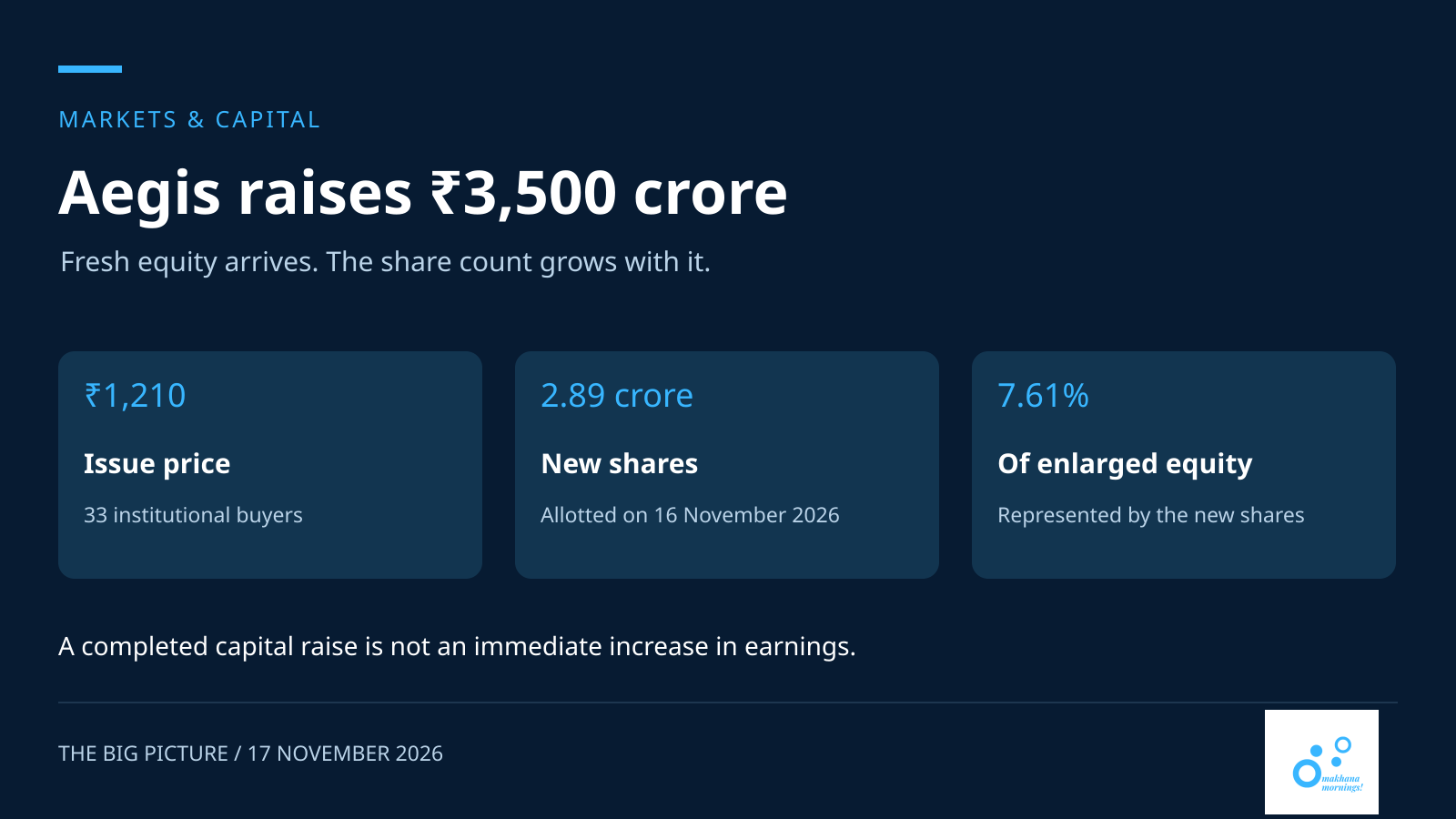
Aegis Logistics has moved from asking for capital to allotting shares against it. The company completed a ₹3,500 crore qualified institutional placement, or QIP, on November 16, issuing fresh equity to 33 institutional buyers.
That is a completed fundraising milestone, not another board approval to raise money. It also means the same business is now divided into more shares.
The Breakdown
Aegis allotted 2,89,25,619 shares at ₹1,210 each, according to its November 16 exchange filing. The issue opened on November 11 and closed on November 16. A QIP is a route through which a listed company raises capital from qualified institutional buyers rather than offering the issue to retail investors.
The company’s total share count rose from 35.10 crore to approximately 37.99 crore. The newly issued shares therefore represent about 7.61% of the enlarged equity base. The share count itself increased by about 8.24%; the two percentages use different denominators.
Put simply, a shareholder who owned 1% before the issue and bought no additional shares would own about 0.924% afterwards. Their number of shares would be unchanged, but their percentage ownership would be smaller.
Who supplied the capital?
The filing identifies Smallcap World Fund as receiving 33.24% of the shares issued in the QIP. Two Quant Mutual Fund schemes together received 31.43%, while New World Fund received 14.21% and Nomura India Investment Fund Mother Fund received 5.14%.
Those percentages describe allocations within this issue, not the investors’ ownership of Aegis after it. They should not be read as stakes in the whole company.
Why this matters
Fresh equity brings capital into a company without creating the principal repayment obligation that accompanies a loan. The trade-off is dilution: existing shareholders who do not participate hold a smaller proportion of the enlarged company.
That does not, by itself, establish that shareholders are better or worse off. The business has more capital as well as more shares. What matters next is how effectively that capital is used and whether the resulting earnings justify the larger equity base.
The allotment announcement is not evidence that revenue, operating profit or earnings per share have already risen. Nor is a prominent fund’s participation a guarantee of future returns.
The Big Picture
The useful distinction here is between funding secured and business performance delivered. Aegis has completed the first step. The investment outcome still depends on what follows.
The Crunch
₹3,500 crore of fresh equity is a concrete capital-raising result. Turning it into greater value per share is a separate test.



Leave your thoughts