
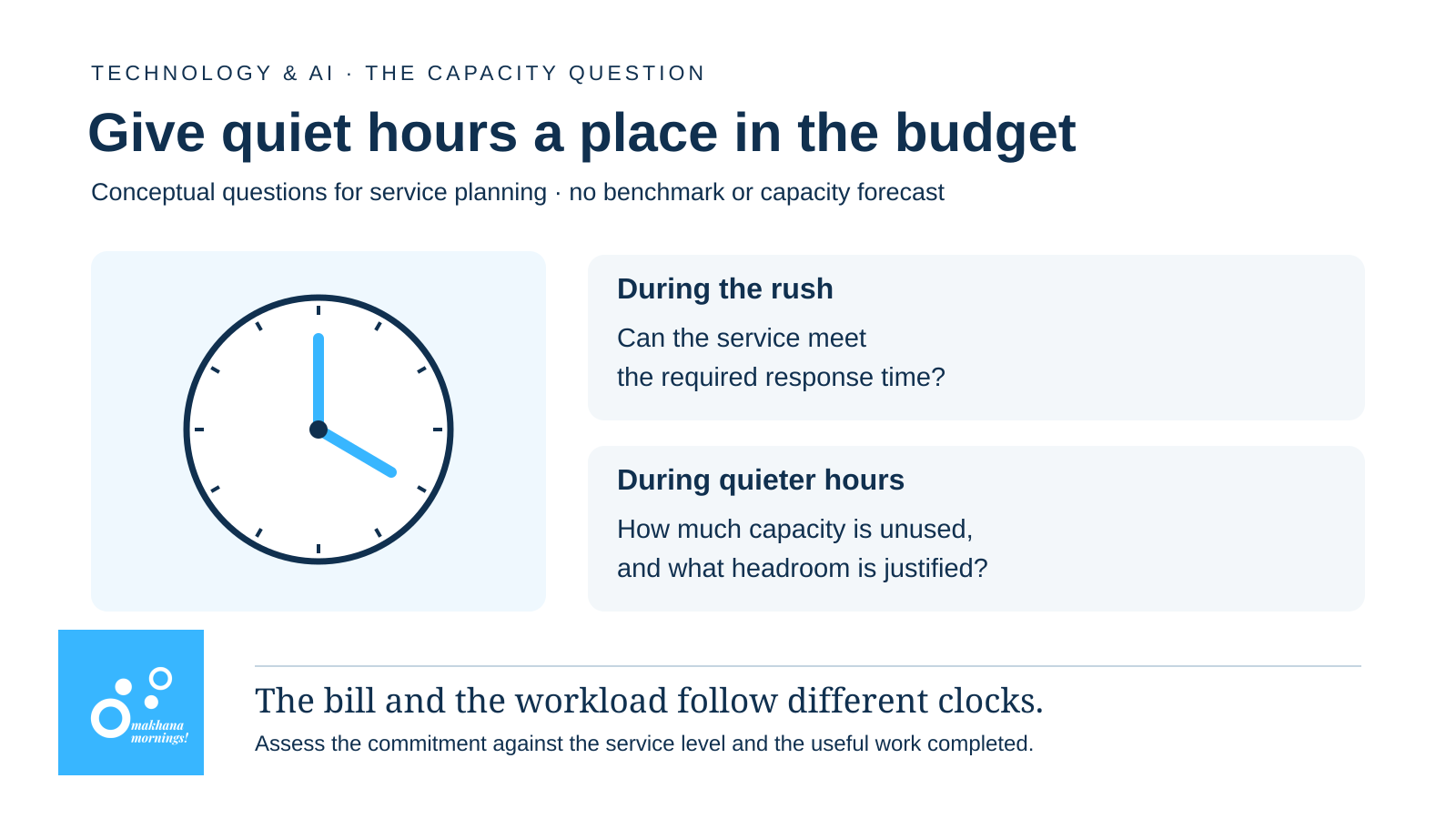
An Indian business planning an AI service faces a timing problem as well as a token bill. The same volume of work can arrive steadily through the day or in a short rush. Capacity that looks economical on a monthly average may be insufficient during the rush, while capacity bought for the rush can sit underused later.
Start with the service customers need
MLCommons’ October 15 guide to MLPerf Endpoints describes testing the model, hardware, serving software and network together across different numbers of simultaneous queries. It separates total output from each user’s streaming speed and the wait for the first response. Results also carry verified, provisional or unverified status. The guide says its official normalisation related to cost uses provisioned power; a comparison of dollar costs is a separate, unverified calculation. A high throughput score therefore needs its load conditions, review status and responsiveness measures beside it.
For an assistant serving customers, compare configurations that meet an acceptable response delay at the expected load during busy hours. The question is how much capacity remains after imposing that service requirement, rather than which system produces the most output without it.
A reservation buys a commitment
Google Cloud describes Provisioned Throughput as a subscription with a fixed cost and term for supported models. Buyers must choose a model and an available location. It is one consumption option, rather than a universal requirement for deploying AI. The reservation’s suitability depends on the work to be served and the capacity required.
Its public pricing, checked on October 30, includes a global example of $2,700 per generative AI scale unit for a commitment of one month. Pricing outside the global option and promotional credits for specific models need separate checking. Consider a purely illustrative $2,700 reservation allocation: spread over 100,000 successfully completed tasks, it is 2.7 US cents per task; over one million, it is 0.27 cents. This arithmetic does not claim that one unit can serve either workload. It excludes other charges and shows only how the same committed cost changes per task when useful volume changes.
Before accepting that calculation as a business case, the team would still have to demonstrate both volumes at the required quality and response time. A task may involve several model calls, retries and external tools. Completion should be measured after those steps, rather than inferred from a request counter. The production test should also include the network path customers actually use.
The Crunch
Keep three records together: the capacity commitment, the service level achieved during busy periods, and the acceptable tasks completed over the billing period. That makes the quiet hours visible without confusing spare capacity with waste: some headroom may be justified by the service promise. The decision is how much headroom that promise needs, and what it costs to maintain.



Leave your thoughts